Category Archives: rental housing market

Statewide Landlord Connections Events

Seeking Compassionate & Trauma Informed Landlord, INQUIRE Below:

By Kahlia Livingston, Fair Housing Project Education & Outreach Coordinator
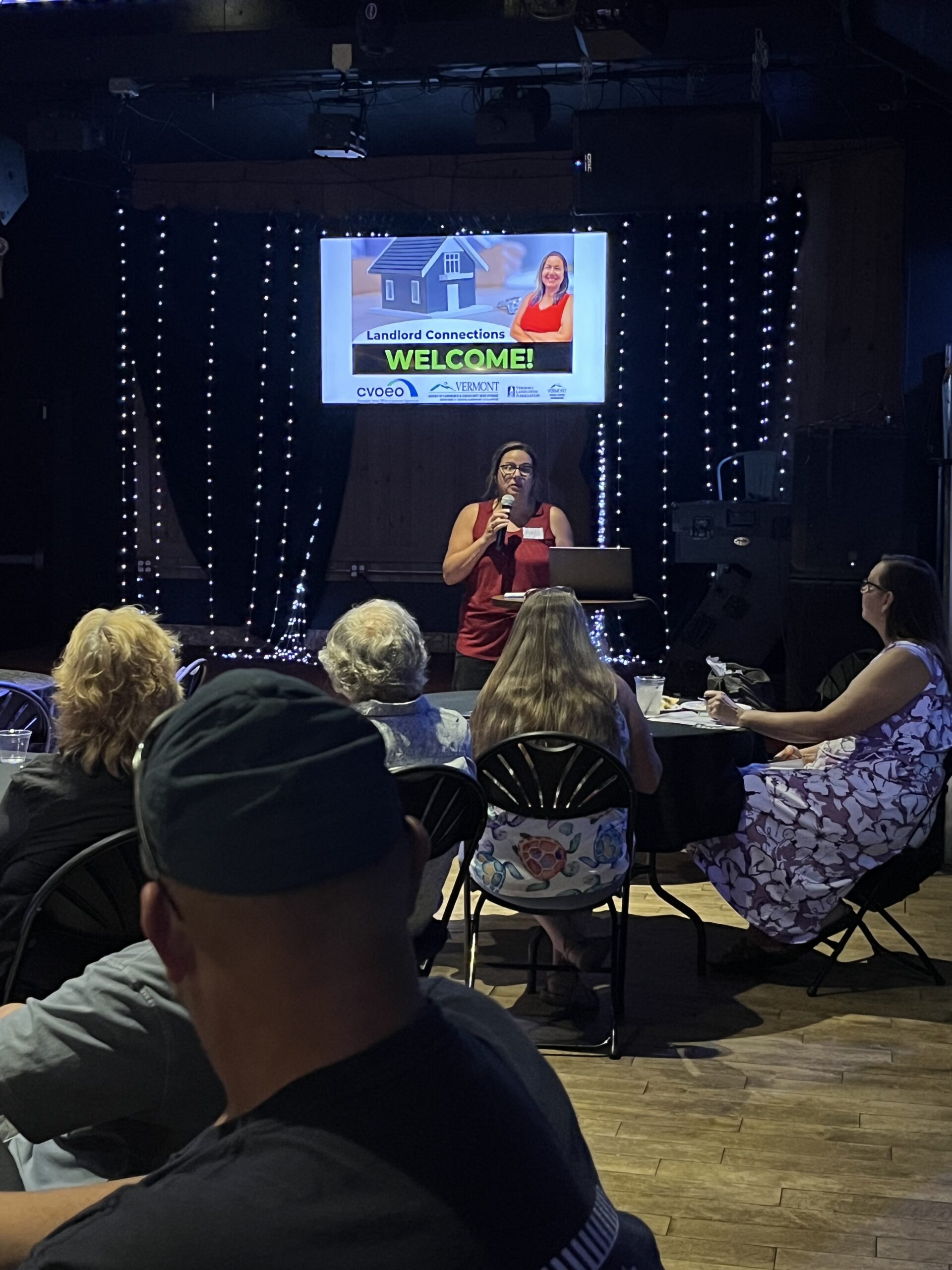
CVOEO’s Fair Housing Project recently held three Landlord Connections events to connect with landlords around the state and provide a space for networking, learning about housing provider concerns, and sharing housing resources available to improve housing conditions and help sustain tenancies. More than 70 housing providers met up in Middlebury, St. Albans, and Burlington for presentations and discussions with CVOEO’s Fair Housing Project and regional Community Action agencies, Vermont Department of Housing & Community Development, Vermont Human Rights Commission, Vermont Landlord Association, Supportive Services for Veteran Families, Burlington Lead Program, and others.

As many may know (and some may not), we are experiencing a worsening housing crisis throughout the nation that is a prominent concern in our great state. Vermont has a tight housing market with low rental vacancy rates in most counties as well as a shortage of affordable housing. Homeownership is a dream for many. However, this desire is not a one-size-fits-all for every Vermonter. Many people also enjoy the benefits that come with renting, which can include flexibility, fewer home maintenance responsibilities, and shorter commitments to an apartment or location. Since many people rely on rental housing and some prefer it, our communities need dedicated housing providers with specific qualities to help us improve the housing challenges that we are navigating. Low-income renters with membership in protected classes under fair housing laws tend to have barriers that can interfere with their access to and retention of affordable housing. These people are especially vulnerable to housing discrimination and insecurity.

Through our work with renters and housing providers, we have seen how clear and respectful communications can help foster positive relationships and successful tenancies.

What do we need in a housing provider?

  • Empathetic and Trauma-informed: Some landlords may not have lived experience of housing insecurity, houselessness, mental illness, having a disability or criminal background, being a survivor of sexual assault, abuse or stalking, (etc.) however, it is helpful for people providing housing to have knowledge, empathy, and tools for supporting these human conditions.
  • Cultural awareness and inclusivity: There are several of languages spoken by residents statewide with people from various cultures and countries enriching our Vermont communities. Housing providers should be knowledgeable and well-practiced in serving renters with different demographics than themselves or their families.
  • Good communications and customer service skills: Landlords are providing goods and services, so building rapport with renters is crucial to curating and maintaining a business that thrives.
  • Low to no profit-centered attitude: Renting is a business that generates income for the housing provider, but in what ways can renters benefit from the money they are investing in monthly rent payments? These costs add up and tend to leave renters with more losses than gains. Co-op housing can allow renters to gain equity in the homes they reside in as the housing market fluctuates. Oregon’s Limited Equity Co-op bill is a useful model that exemplifies how this form of housing benefits property owners and renters: “the project is founded on a shared ownership structure that combines a Community Land Trust with a Limited-Equity Co-op. The benefit of this cooperative model of housing is that it gives the residents more voice in their housing, greater financial stability and security, and a sense of pride as a part-owner of their own housing as well as responsibility for it” (HB 3232 Limited Equity Co-ops, Oregon Legislature). These properties also have a tax-exemption which can relieve financial burden on property owners and residents of the homes. Affordable housing benefits everyone. According to PolicyLink, if rents were affordable throughout the nation during the 2020 pandemic, we could’ve saw $141 Billion of disposable income spent in local communities to revitalize the economy (OUR HOMES, OUR FUTURE: Building the Power to Win Rent Control for Stable Communities, PolicyLink). Do we live in an economy run by capitalism? Yes. Should the human need for housing be driven and controlled by the need to make as much money as possible? …what do you think?

At the Landlord Connections events, housing providers discussed the many challenges they are facing, such as rising taxes and other costs, difficulty finding contractors for needed repairs, and communications with tenants. It was helpful to hear these concerns to better understand what is needed to improve the renting housing market and stock.

What do housing providers need?

  • Accessible resources for home rehab and habitability needs: Being a landlord is a business, and landlords should be able to cover their costs. However, this becomes problematic when the rising costs exceed tenants’ ability to pay or when rents are set to make the highest amount of profit. With an aging housing stock, housing providers need access to funds to bring dwellings up to code and habitable for long-term tenancies.
  • Informed & responsive tenants: Renters who know their rights and responsibilities are aware of the importance of their role as a tenant and can advocate for their needs and any concerns regarding the property. This can decrease issues in the home worsening and burdening both the tenant and landlord. CVOEO’s VT Tenants Program provides free Renters Workshops to improve renter education and skill building when navigating rental housing. This resource allows tenants to earn certificates that some housing providers view as an adequate credential when reviewing rental applications.
  • Communicative Renters: Effective communication between a renter and landlord is key. Establishing a written rental agreement that clarifies all expectations for the tenant and housing provider is necessary before a tenancy starts. There are resources in our community to help facilitate conversations. Requests for interpretation services can be submitted through AALV or CVOEO’s Office of Racial Equity and Community Inclusion (ORECI) and Burlington’s Community Justice Center can support with conflict mediation with the Conflict Assistance Program. Additionally, tenants’ flexibility in modalities for communication can be beneficial to communicate with housing provider efficiently and in a timely manner.

Ultimately, people should have accessible resources to live in their preferred housing. Whether people rent or own, fair housing law states that equal opportunity in housing choice is a right regardless of barriers or limitations. Housing providers should be well informed about resident needs and expected to develop healthy, professional, and proactive relationships with their tenants to support successful tenancies and the well-being of renters of their properties. The landlord-tenant relationship comes with complexity between the needs of all parties involved and it is crucial to meet people where there are and use best practices to meet such needs.

Want to learn more? Contact us to schedule a Fair Housing Training or “Know Your Rights” Fair Housing and Tenant Skills Workshop: (802) 660-3456 ext 110, email: fhp@cvoeo.org

The Debate Around the Legality of Fees During the Rental Application Process

A consideration of the issue and the resources available for renters

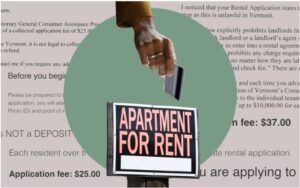
Illustration by Natalie Williams/VTDigger

You may have seen this recent VTDigger article, which highlights the illegal practice of collecting rental application fees and the uncertainty created by vague wording in Vermont law around what constitutes an “application fee.” Under Vermont state law, rental application fees are clearly illegal. But are other fees related to the rental application process illegal too? According to Vermont Legal Aid, the answer is clearly yes; according to the Vermont Landlord Association, the answer is clearly no.

This blog post is intended to clarify some of the context around the issue and provide resources for renters who are trying to secure housing in this uncertain environment.

The Definitive Guide to Renting in Vermont, published in 2015 by CVOEO’s Vermont Tenants Program in collaboration with the Vermont Landlord Association, states that application fees are not legal, but that “charging potential renters for the actual cost of background and credit checks is permitted.”

This is a stance Vermont Tenants has maintained since the guide was written. Vermont Tenants cannot present a stronger position on the debate until a legal precedent is set. As a service and education organization (rather than a legal one), we don’t have the tools or the credentials to interpret the legislative intent of the statute – that is for the lawyers.

Meanwhile, even with the interpretation that the actual cost of credit and background check fees are permitted, it is likely that fees are collected for credit and background checks that don’t happen. In this rental housing market with the lowest vacancy rate we’ve seen in many years and a high number of applicants for every available apartment, if a landlord is charging all applicants the credit and background check fees, it is highly unlikely that all of these checks are actually being run. And if landlords are running the checks for all applications submitted, this practice is wasteful and impractical in a market where hundreds of applications are submitted for any single unit.

In the meantime, it is the lowest-income Vermonters who are most negatively impacted

Unfortunately, in this confusion, the people most impacted are the lowest-income Vermonters. A competitive rental market means that even slight disadvantages can pose real barriers to renting for those pinched hardest by the housing crisis, and discrimination is harder to prove. Leaving the decision up to the renter on whether or not they choose to speak up about their rights and refuse to pay a rental application fee or file a complaint will negatively impact the people already most vulnerable in their housing search. As VTDigger reports, the charging of any kind of fee to apply for housing will continue to prevent many people from submitting enough applications to actually get access to the housing they need. This is a systemic problem that could be addressed by clarity in statute – and better enforcement.a variety of illustrated apartments, apartment buildings and houses

What can we do?

One solution some tenant advocates propose to renters in their housing search is to pull their own credit check report and offer to share the report with each potential landlord. Another solution offered is for prospective tenants to ask for a copy of their credit report after the landlord pulls it. Of course, this still puts the tenant in a vulnerable position, and some may not want to jeopardize their relationship with a potential landlord.

Although the law is very clear that rental application fees are illegal in Vermont, the practice is still common. One contributing factor is the third-party application platforms used by many larger rental companies which don’t allow customization to the forms. Some housing providers, report that the software they rely on doesn’t allow them to change the language from “application fee” to “credit check” fee. Not every renter is aware of the laws around rental application fees, and even those who do know may be hesitant to assert their rights with such stringent competition for rental units. 

Some renters have found remedy by contacting the state Attorney General’s Consumer Assistance Program. If Vermonters are unjustly charged an application fee (worded as such), they may be able to recoup their costs by filing a complaint through the Attorney General. According to VTDigger, some rental companies stopped charging rental application fees after receiving several complaints through the program. Landlords can choose to include the cost of background checks and credit checks in their overall business operating expenses, and adjust their rent accordingly. 

9 V.S.A. § 4456a “Residential rental application fees; prohibited says “A landlord or a landlord’s agent shall not charge an application fee to any individual in order to apply to enter into a rental agreement for a residential dwelling unit. This section shall not be construed to prohibit a person from charging a fee to a person in order to apply to rent commercial or nonresidential property. (Added 1999, No. 115 (Adj. Sess.), § 5.)

Resources for renters

CVOEO has supports available for renters with questions about their rights and responsibilities under landlord-tenant law. For renters seeking support finding housing, working through barriers to renting, and developing application materials, the Finding Housing workshop – offered both as live Zoom classes and a self-paced, on-demand workshop – is a great resource. For renters seeking to repair their credit, to better understand their finances, or needing one-on-one financial coaching, CVOEO’s Financial Futures program has free educational opportunities as well. For people who are currently without housing or at risk of loosing their housing, CVOEO’s Community Action program can assist people with housing navigation, and potentially help with back rent, first month’s rent, security deposits and short-term rental subsidies for eligible applicants. As always, the Vermont Tenant’s Hotline – (802) 864-0099 and vttenants@cvoeo.org – is a resource for people with any questions about their tenancy.

New video highlights issues Vermonters face accessing safe, quality, accessible & affordable housing

It’s not a secret — Vermont is experiencing a housing crisis. There’s so much going on (high rents, escalating home prices, motel vouchers, eviction moratoriums, mobile home park affordability, housing discrimination) it can be hard to know what’s happening and what we can do about it. 

Four housing advocates join the Vermont Affordable Housing Coalition (VAHC) in this video series to highlight some of issues Vermont residents face accessing safe, quality, accessible and affordable housing—and how we must keep these multiple issues in mind as we increase investment in housing.

The video covers mobile home infrastructure with CVOEO’s former Mobile Home Program Resident Organizer Laura Mistretta; evictions in the aftermath of COVID19 with CVOEO’s Vermont Tenants Advocate Madeline Roberts; fair housing and discrimination with CVOEO Fair Housing Project Education and Outreach Coordinator Corrine Yonce, and broadband access with Evernorth Director of Asset Management Rewa Worthington.

In the words of CVOEO’s Corrine Yonce, “The creation of housing that starts happening this fall and will continue for a couple years because of this [federal] funding influx is going to impact the housing landscape and the overall community landscape of Vermont for decades to come. … We need to make sure that our new housing being created actually enables housing choice.”

NLIHC’s Out of Reach Report tells us what we already know: Vermont has a growing affordability problem – Here’s what we can do about it.

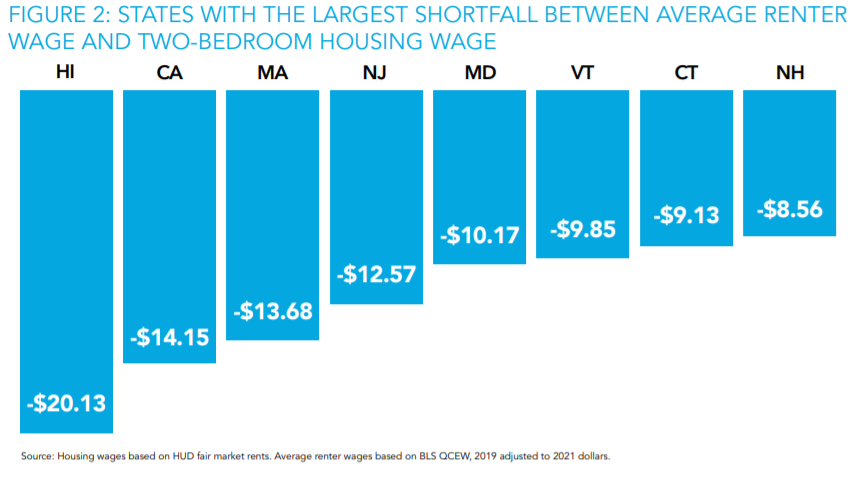
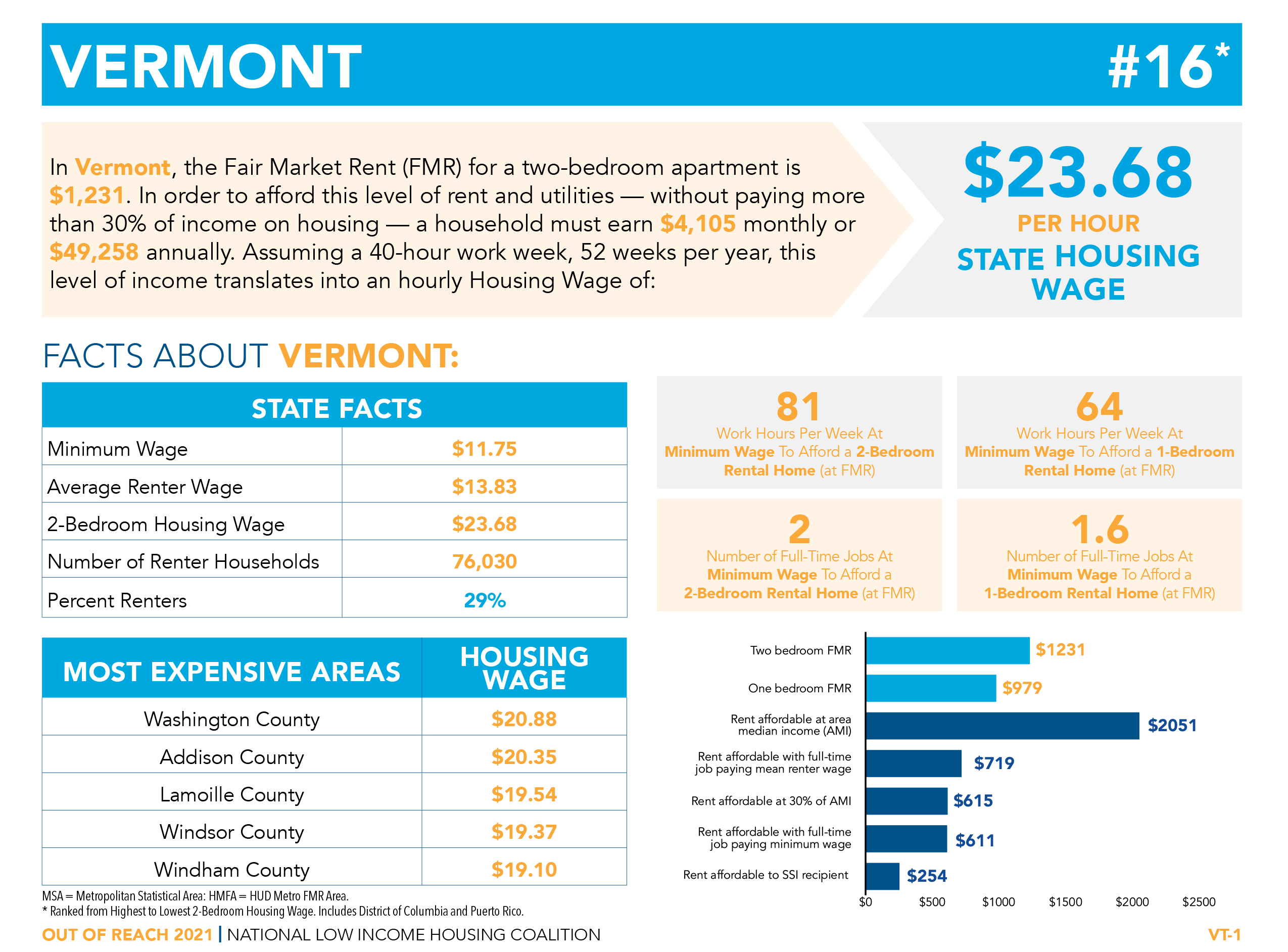
The recent release of the National Low Income Housing Coalition’s Out of Reach report shows that Vermont has the sixth largest shortfall between the average renter wage and the two-bedroom housing wage. In the Burlington/ South Burlington region, where the 2-bedroom housing wage jumps from the state’s average of $23.68 to $31.31, the housing wage gap is particularly acute. This means that full-time employees living in Burlington and South Burlington have to make $31.31per hour in order not to spend more than 30% of their income on rent. Meanwhile, the average hourly wage for Vermont renters is $13.83.

Source: Housing wages based on HUD fair market rents. NLIHC The Gap 2021 pg 5

“We’ve been in the midst of a chronic affordable housing crisis for many, many years,” Kerrie Lohr of Lamoille Housing Partnership, asserted to VTDigger earlier this week, “This report pretty much shows what we already know to be true, is that housing is out of reach for many of Vermont’s renters.” What housing advocates have been seeking to address over the course of Vermont’s long housing affordability history crisis has become especially acute during this past year. While Vermont’s housing sales spiked 38% this past year, many of these new residents purchased with cash-on-hand, often significantly over the asking price, with sales of million dollar homes almost tripling.

These numbers are particularly concerning when we turn an eye to Vermont’s pattern of racial inequity. This year saw rates of COVID doubling in communities of color, highlighting the disparities in health and economic opportunities for People of Color in Vermont. Nationally, the home ownership rate of White households is 70% to the 41% of Back homeowners, a gap caused and reinforced by a pervasive history of racist housing policies, inequal lending, and lack of meaningful policy change to address this systemic problem. Vermont’s homeownership gap is much larger with only 21% of Black households owning their home compared to 72% of white households. Local student activist (and current Fair Housing Project intern) Minelle Sarfo-Adu spoke to VPR about experiencing this stark disparity in her South Burlington community, “I think I only have two African American friends in the whole — like in all Vermont, that actually own homes,” she said. “Other than that, every other one of my friends actually rents, unless they’re white. All my white friends actually own their homes.”

The severe affordability crisis in Vermont creates an environment where landlords can be more discriminative in who they rent to. For renters who belong to the Fair Housing protected classes and face the greatest barriers to housing access in our state, this means longer and more desperate housing searches. While housing advocates are certain that most discrimination goes unreported, testing performed by the Housing Discrimination Law Project of Vermont Legal Aid indicates that housing providers generally disfavor African American renters, renters of foreign origin, renters with children and renters with disabilities. Reports from the CVOEO Vermont Tenants hotline and housing community forums are riddled with stories of people being turned away from housing because of a housing voucher or for having children (both violations of the Fair Housing Act in Vermont), and of desperate housing decisions such as signing leases before viewing the property or even offering to pay more than the listed monthly rent.

So what do we do about it? 

“Treat the housing emergency like an emergency,” retorts the collective voice of Anne N. Sosin, Mairead O’Reilly, and Maryellen Griffin in their recent VTDigger commentary, “Housing is a Public Health Crisis in Vermont.” Sosin is a policy fellow at the Nelson A. Rockefeller Center at Dartmouth College; O’Reilly is a medical legal partnership attorney at Vermont Legal Aid; and Griffin is a housing attorney at Vermont Legal Aid. Housing activists, policy makers, and the broader population of Vermont need to act now to address this growing problem, they wrote as they shared the major lessons housing advocates have gleaned from this past year of COVID response. Their voice has urgency, as some key opportunities to enhance renter protections have already passed. These key missed advocacy moments include the veto of the Rental Housing Safety Bill and a failure to delay the ending of the State of Emergency – which had expanded shelter space for houseless folks through federal CARES funding – until more rental housing was made available. Some economists and sustainable communities experts caution this trend is only at its early fruition as climate change pushes folks from more geographically vulnerable locations.

Much of what Sosin, O’Reilly, and Griffin called for is still possible. Mobilize a statewide response,” they stated, noting that these solutions will be unique to the region and therefore require regional solutions. Our Fair Housing Friday panelists this spring noted that creative solutions require broad civic engagement, especially from those most impacted by the growing inequity of available resources. Housing Committees are a critical tool to mobilizing regional solutions to a statewide problem and can jumpstart conversations at the community level. The common thread  running through all these solutions is that they must center the needs of the communities consistently facing the highest barriers to housing.

Trickle Up Housing: Filtering Does Go Both Ways – Shelterforce

Building homes for extremely low-income people allows other homes to filter up to people in need—a better bet than waiting for luxury units to trickle down.

Author, Miriam Axel-Lute – November 2, 2017

“There’s a lot of talk about how homes will “filter down.” The argument goes that building new luxury housing will allow the wealthiest people to move into new housing, and (if the supply outstrips demand), eventually what had been high-end housing will command less money and will “filter down” to be affordable to lower income levels. Just how well this works, for whom, and how quickly is the subject of muchdebate, which I won’t wade into right now.”

“But here’s the thing we don’t talk about enough: developing affordable housing in a tight, high-cost market also increases overall affordability through filtering! Just in the other direction—it trickles up.”

Source: Trickle Up Housing: Filtering Does Go Both Ways – Shelterforce   Click the link to read the whole story on the Shelterforce site.

“Housing Doesn’t Filter, Neighborhoods Do” by Rick Jacobus

Posted by Rick Jacobus on November 4, 2016 on the “Rooflines, the Shelter Force Blog”
Read the full article (part 1) on the Rooflines, Shelter Force Blog:  http://tinyurl.com/jacobus-filterDown

“There has been a renewed interest in the role that the real estate market can play in solving our growing affordable housing crisis. For decades “affordable housing” has been the near exclusive domain of the public sector, but the crisis has reached the point where we are now calling for all hands on deck. Can private capital, private development companies, and market-rate housing developments help make housing affordable for everyone?”

“Housing advocates tend to agree that we need to supplement market-rate luxury development with subsidized affordable housing, but rarely do we ask the market to provide housing for people further down the income ladder. This dichotomy of new market-rate housing only for the rich and new affordable housing only for the poor has become the de facto housing strategy in most American cities. We can do better.”