Fair Housing Month is over but our work never stops!
SAVE THE DATE for an upcoming discussion on tenants’ rights, responsibilities, and housing safety in Montpelier on September 9th (5p-7p)!
We look forward to seeing you there!
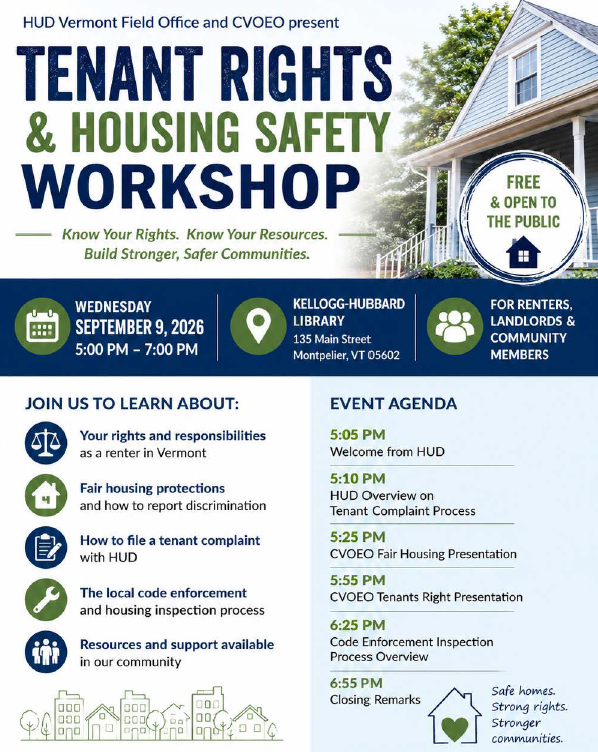
SAVE THE DATE for an upcoming discussion on tenants’ rights, responsibilities, and housing safety in Montpelier on September 9th (5p-7p)!
We look forward to seeing you there!
 It’s been a busy and fun month so far with thought-provoking Fair Housing Friday webinars, community Know Your Rights workshops, more than 1,000 art kits distributed through libraries and housing sites across the state, and more. We’re also collaborating with the City of Burlington’s Community & Economic Development Office to distribute more art kits, along with free books on issues of housing and homelessness.
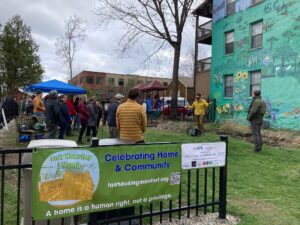
Yesterday’s Fair Housing Month event at Champlain Street Park in Burlington combined park clean-up, art, and neighborhood connections with inspiring words about housing equity, environmental justice, and community from CVOEO, Burlington’s Office of Racial Equity, Inclusion & Belonging and Parks & Recreation Department, and reps from our congressional delegation. See some of the news coverage here: https://www.mynbc5.com/article/burlington-community-members-clean-up-parks-to-help-promote-equitable-housing/43647899
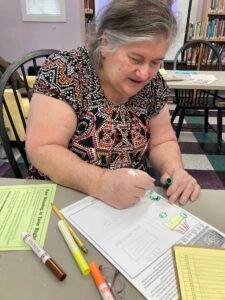
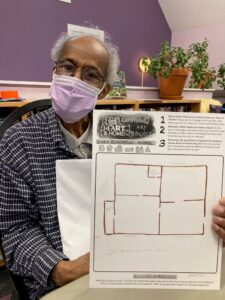
Also yesterday, a sweet HeART & Home activity hosted by the Groton Public Library and RuralEdge brought together a small group of elementary school students and seniors to make art related to home and community.
 .
.
 Each April we celebrate the 1968 passage of the Fair Housing Act with a series of free public education and art events to raise awareness about the importance of equal access to housing, free from discrimination, and the positive role that inclusive, affordable housing plays in thriving communities. Virtual and in-person activities include workshops, community discussions, presentations, library events, and the all-ages HeART & Home Community Art Project.
Fair Housing is the right to equal opportunity in housing choice and the right to rent or buy a dwelling free from discrimination. The federal Fair Housing Act prohibits discrimination in housing based on race, color, religion, national origin, sex, disability, and family status. Vermont has additional protections based on age, marital status, sexual orientation, gender identity, receipt of public assistance, being a victim of domestic violence, sexual assault, or stalking, and denial of development permitting based on the income of prospective residents. For more information about fair housing in Vermont, visit www.cvoeo.org/FHP or email fhp@cvoeo.org.
The Fair Housing Project of CVOEO coordinates April Fair Housing Month activities in collaboration with a statewide network of housing, community, and arts partners, including Burlington City Arts, Burlington Community and Economic Development Office (CEDO), Burlington Office of Racial Equity Inclusion and Belonging (REIB), Junction Arts Media, ONE Arts, Randolph Community Development Corporation, RuralEdge, Vermont Affordable Housing Coalition, Vermont Department of Housing and Community Development, Vermont Department of Libraries, Vermont Human Rights Commission, Vermont Legal Aid, Vital Communities, and White River Valley Consortium. These activities are made possible through the generous sponsorship of Farrell Properties, CEDO, REIB, Champlain Housing Trust, Redstone, Vermont State Housing Authority, Evernorth, Main Street Landing, Vermont Housing Finance Agency, Two Rivers-Ottauquechee Regional Commission, Vermont Housing & Conservation Board, Cathedral Square, and Pomerleau Real Estate.
Each April we celebrate the 1968 passage of the Fair Housing Act with a series of free public education and art events to raise awareness about the importance of equal access to housing, free from discrimination, and the positive role that inclusive, affordable housing plays in thriving communities. Virtual and in-person activities include workshops, community discussions, presentations, library events, and the all-ages HeART & Home Community Art Project.
Here’s a sampling of this year’s statewide events. For full schedule and details visit https://fairhousingmonthvt.org/event-calendar.
Fair Housing is the right to equal opportunity in housing choice and the right to rent or buy a dwelling free from discrimination. The federal Fair Housing Act prohibits discrimination in housing based on race, color, religion, national origin, sex, disability, and family status. Vermont has additional protections based on age, marital status, sexual orientation, gender identity, receipt of public assistance, being a victim of domestic violence, sexual assault, or stalking, and denial of development permitting based on the income of prospective residents.
For more information about fair housing in Vermont, visit www.cvoeo.org/FHP or email fhp@cvoeo.org.
The Fair Housing Project of CVOEO coordinates April Fair Housing Month activities in collaboration with a statewide network of housing, community, and arts partners, including Burlington City Arts, Burlington Community and Economic Development Office (CEDO), Burlington Office of Racial Equity Inclusion and Belonging (REIB), Junction Arts Media, ONE Arts, Randolph Community Development Corporation, RuralEdge, Vermont Affordable Housing Coalition, Vermont Department of Housing and Community Development, Vermont Department of Libraries, Vermont Human Rights Commission, Vermont Legal Aid, Vital Communities, and White River Valley Consortium. These activities are made possible through the generous sponsorship of Farrell Properties, CEDO, REIB, Champlain Housing Trust, Redstone, Vermont State Housing Authority, Evernorth, Main Street Landing, Vermont Housing Finance Agency, Two Rivers-Ottauquechee Regional Commission, Vermont Housing & Conservation Board, Cathedral Square, and Pomerleau Real Estate.
Introduction: Vermont has a housing crisis, and if you live here (especially if you are a renter or have gone through the home-buying process recently), you probably don’t need to be told that. Although housing solutions might seem simple (why don’t we just build more housing?), how we talk about housing, what we mean when we talk about housing, and what our housing needs are can actually be quite complex. This guide is intended to provide a basic framework so that we can have a common vocabulary when we talk about housing.
In this latest Thriving Communities blog series, we break down the network, language, and housing advocacy into several parts:

–What do we mean when we say “Vermont has a housing crisis?”
Before going much further, we want to plug again this post on housing committees, a really great place to start if you are looking to make an impact on your local housing landscape. This may hold you over until our final chapter is released! And for those arriving at this resource to understand Vermont affordable housing, subsidized housing, and emergency housing resources, Vermont’s US Department of Housing and Urban Development (HUD) state office has issued this comprehensive guide on Vermont housing and rental assistance.
Finally, a word on why it is important for us to all be educated on housing terminology and avenues for citizen housing advocacy:
Housing as a human right, absolutely foundational to each person meeting their basic needs. Equal opportunity for housing choice is also critical to thriving, inclusive communities because where you live determines your proximity to resources – transportation, social services, jobs – where your kid goes to school, what kinds of foods you can access, and perhaps what environmental conditions you live in. Housing stability is critical to children’s educational growth, to citizen’s ability to be civically engaged, and to overall neighborhood resilience. Homeownership *can* be a path to housing stability and wealth accumulation. The reality is, neither housing choice nor housing stability is guaranteed in our state for a growing number of people, many of whom represent groups of people historically denied equal access to housing.
Simply put, we do not have enough housing to fit the needs of our community. A tight housing market also means higher rates of discrimination, as a larger pool of housing-seekers means housing providers can be more selective without consequence, and more susceptible to bias. We measure our housing needs through three major reports:
The National Low Income Housing Coalition’s Out of Reach Report: The National Low Income Housing Coalition releases a comprehensive annual Out of Reach Report which documents the gap between renters’ wages and the cost of rental housing across the US. The report’s central statistic, the Housing Wage, is an estimate of the hourly wage a full-time worker must earn to afford a modest rental home at HUD’s fair market rent (FMR) without spending more than 30% of his or her income on housing costs, the accepted standard of affordability. You can check out Vermont’s stats here, and you can even go deeper and by putting in your own town or county. While the Out of Reach report does not measure demographic differences of renters, other statistics confirm that BIPOC renters are disproportionately impacted by these gaps, and both the Vermont Human Rights Commission and Vermont Legal Aid report higher rates of discrimination for people with disabilities.*
The Vermont Housing Needs Assessment: In 2019 the Department of Housing and Community Development hired VHFA to conduct the 5-year Vermont Housing Needs Assessment. This Assessment is used to inform the State’s 5-Year Consolidated Plan to the U.S. Department of Housing and Urban Development (HUD) and other statewide and county housing and policy decisions. You can find the report highlights here. And the full document and fact sheets here. In addition to the written report, VHFA hosts and regularly updates the indicators included in this report on the Community Profile section of www.housingdata.org as a resource for anyone interested in the demographic makeup, housing needs, and economic indicators for communities and regions around Vermont.
The Point in Time Count: This report chronicles the landscape of and changes in homelessness in Vermont in 2022 and over a ten-year period with breakdowns by location of homelessness, household type, and subpopulation. The Annual Point in Time Count is a statewide count of persons experiencing literal homelessness on January 26, 2022. The Count captures the most vulnerable population, those literally homeless and does not include those at risk of homelessness, doubled up, living in unsafe housing, or couch surfing.
In our next chapter of Housing Demystified, we will be digging into the different categories of housing, the organizations which provide them, the different ways affordable housing is financed, and what resources exist for those currently homeless or at risk of homelessness.
For renters:
If you are a renter, knowing your rights under state Landlord-Tenant Law and state & federal Fair Housing Law becomes critical in a tight housing market. It is important for you to know your responsibilities to maintain housing. Fortunately, CVOEO’s Housing Advocacy Program has a wealth of free resources to that end, including the Definitive Guide to Renting, live and self-paced workshops, and a variety of other resources at your disposal. You can find a summary of our programs below and learn more at www.cvoeo.org.
While Vermont has a robust affordable housing infrastructure, many housing non-profits have waiting lists. It is important to know what kind of housing you are looking for before beginning your applications. Stay tuned for Housing Demystified Chapter 2: Types of Housing Nonprofits and Programs, and Who They Serve
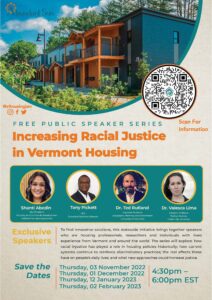 A group of Vermont housing organizations is hosting a free four-part series examining how racial inequities impact access to housing in Vermont.
The public speaker series has been developed by Abundant Sun, together with the Vermont Racial Justice Housing Jam, a committee of community members with lived experience and representatives from nonprofit housing organizations. Local, national, and international speakers will address selected topics focused on increasing racial justice and equity in Vermont housing. The goal of the initiative is to identify actions on policy, programmatic and cultural levels to expand access to affordable housing for all Vermonters.
The Vermont Racial Justice Housing Jam is coordinated by the Vermont Housing & Conservation Board, working in partnership with Abundant Sun, Champlain Housing Trust, Downstreet Housing & Community Development, RuralEdge, Windham & Windsor Housing Trust, NeighborWorks of Western Vermont, NeighborWorks America, and Vermont Housing Finance Agency, with additional support from the Federal Home Loan Bank of Boston.