Chittenden County has a critical shortage of housing, particularly housing that is affordable to those earning below the Area Median Income. This housing shortage puts a greater burden on marginalized communities by allowing landlords to be more selective in how they rent to tenants and allowing for more discrimination. This recent VPR investigation digs deeper into some of the ways housing segregation continues to persist in communities across New England – including Vermont- and how that impacts the lives of those affected.
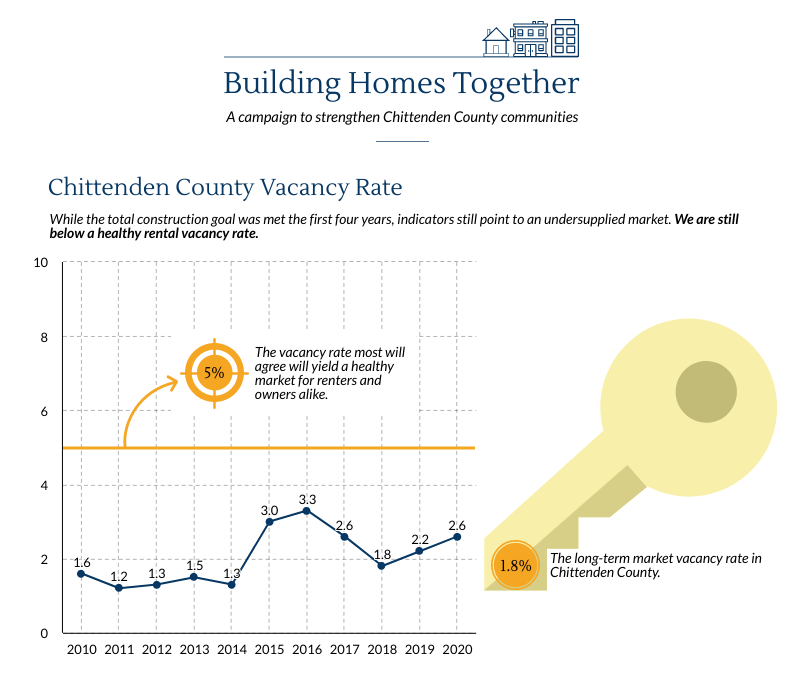
Chittenden County currently has a vacancy rate of 2.6%, which while higher than the 1.8% of 2018, is still well below the healthy vacancy rate is 5%
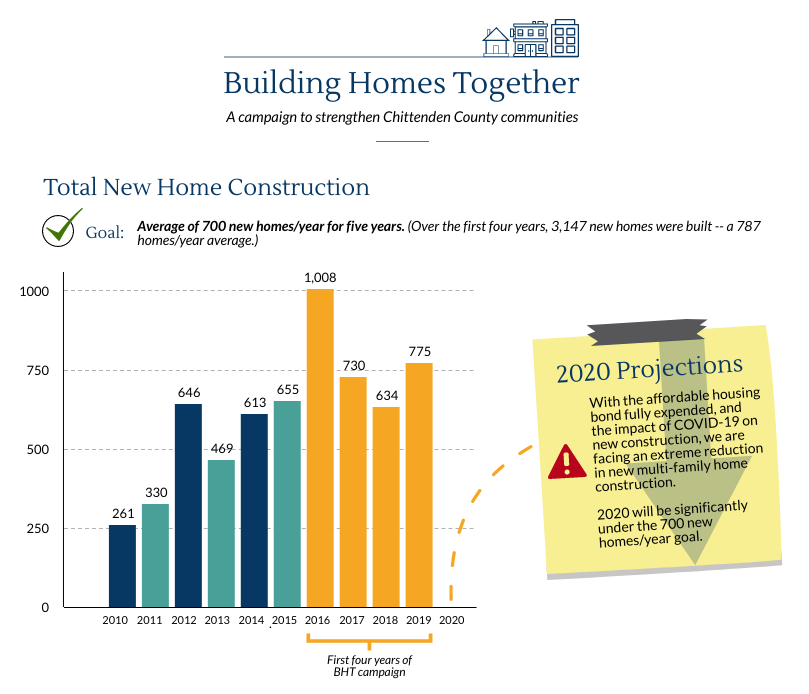
The “Building Homes Together” campaign was started in 2016 to encourage the production of more housing. Its annual report shows that market-rate housing production has been steady for the past four years, but Chittenden County has repeatedly failed to meet the campaign’s target for new permanently affordable homes, leaving a gap for those who are already struggling to make ends meet and those who have been impacted by the economic hardships of the coronavirus crisis.
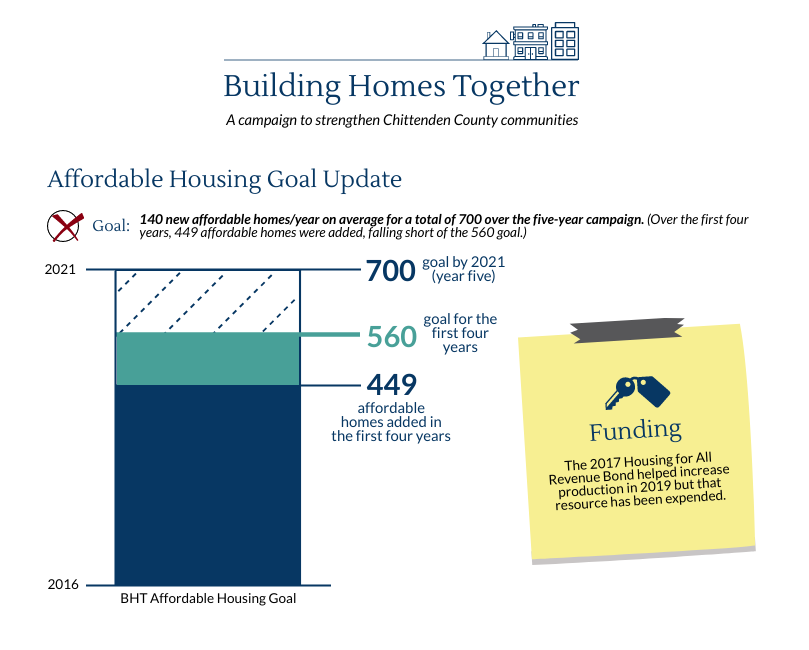
The campaign, supported by over a hundred local and state officials, nonprofits, businesses, and individuals, set a five year goal of 3,500 new homes in Chittenden County with 20% of them permanently affordable. This amounts to an annual target of 700 overall homes with 140 affordable; the average over the first four years is 787 homes, but of those homes only 112 were affordable.
“We did see a spike in 2019 of new affordable homes with 169 built, but that followed three years of missing our target,” said Nancy Owens, co-President of Evernorth. “The increase in 2019 demonstrates that new capital from the Housing for All Revenue Bond passed in the State of Vermont in 2017 was essential to meet this critical housing need, but it hasn’t been enough.”
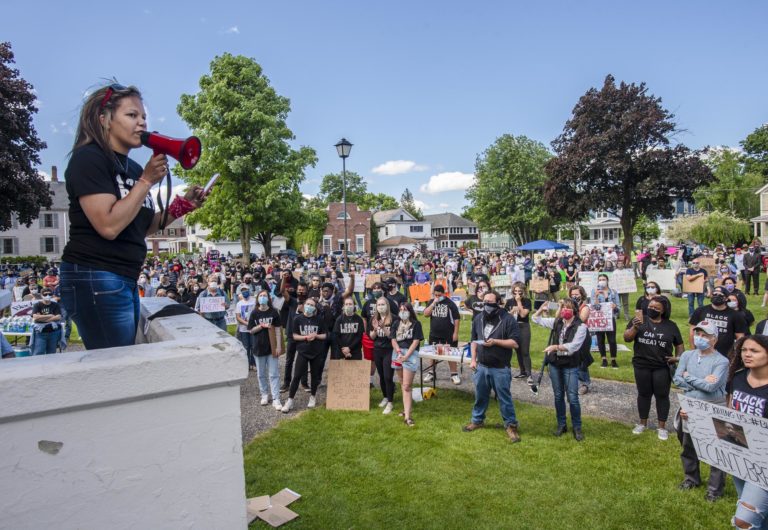
Other economic, social and public health factors are in play. “While 2020 has been consumed by the coronavirus and calls for racial justice, it’s also been a year where safe, decent and affordable housing has been even more obviously lacking in our communities. We need to do better,” said Brenda Torpy, CEO of the Champlain Housing Trust, noting that at one point this summer there were 2,000 homeless Vermonters living in hotels and motels
Champlain Housing Trust, Chittenden County Regional Planning Commission and Evernorth (formerly Housing Vermont) are jointly calling for local, state and federal policymakers to fund affordable housing and make housing a priority in responding to the economic, racial and health injustices of our current time.
Please see CVOEO’s statement below on the recent presidential Executive Order limiting federal government, contractors, and grant recipients from conducting diversity training containing “divisive concepts” which “promote race or sex stereotyping or scapegoating.” This could include discussions on systemic discrimination, institutional patterns of segregation, disparate impact, white privilege, internalized racism, and other topics related to implicit bias or the history of systemic racism. These concepts are an integral part of our fair housing education and outreach efforts.
CVOEO Response to New Executive Order Limiting Diversity Training
President Trump’s Executive Order on Diversity Training and Promotion of “Divisive Concepts” on September 22, 2020 raises deep concerns for the staff of the Champlain Valley Office of Economic Opportunity (CVOEO). Whether it applies to grantees of federal agencies or not, it is a fundamentally unsound order which does not address the need for continuous improvement toward racial and social justice. Although the terms of this order assume protection to grantees of federal programs such as CVOEO from compliance with the order, there remains a risk that such compliance will be required as federal agencies are asked to revisit their grant programs and to consider compliance with the requirements of the executive order. This could impact any grantees’ ability to continue to address the issue of systematic and structural racism observed in our workplaces.
CVOEO is one of five Community Action Agencies in Vermont. Since forming in 1965, the staff and board of CVOEO carries out the Economic Opportunity Act of 1964, by addressing the fundamental issues of economic, social, and racial justice, intended to help people achieve economic independence.
We are an anti-racist organization among the signatories of the City of Burlington’s recent petition which classifies racism as a public health emergency. Our recently hired Director of Racial Equity’s mission includes identifying areas of disparity within the organization, and implementing anti-racist actions such as enhancing learning opportunities with diversity and inclusion training, adopting best practices that comply with Title VI and Title VII of the Civil Rights of 1964, and creating a support system that will help our diverse workforce and the individuals we serve to thrive.
We believe that this executive order does not promote inclusion and could instead deepen the preexisting gap observed in our country’s social and economic systems. We are also concerned that these measures will prevent people from being informed of their rights. Additionally, this executive order could serve as a rationale deterring them from taking the necessary steps to achieve racial equity.
In Vermont, practices in compliance with the requirements of the executive order will go against the recommendations made by the Racial Equity Task Force to the governor earlier this month. These recommendations emphasize “mandated training for organizations and agencies receiving federal/state funding on cultural and linguistic appropriate services, federal laws on access, anti-racist practices.”
We hope you will join us in speaking out against this executive order and share our concerns with others.
In deep appreciation for the work you do to end social and racial injustice.
“I grew up here, in the area, and I never really felt entirely welcome, even though this is my home. There were just so many messages that I got, that I didn’t belong.” -Tabitha Moore, The Rutland Area NAACP
Tabitha Moore leads The Rutland Area NAACP and is an outspoken advocate for racial justice. In early September, Moore spoke to VTDigger for a Q & A where she shared how her heightened visibility has made the home -that never fully welcomed her- even more unwelcoming. “Vermont is not white by mistake. It’s not just a happenstance.” This important read reminds us the critical need for housing opportunities to be not just inclusive, but host a culture that supports inclusion.
VTDigger’s article, Q&A with Tabitha Moore: ‘I am not OK’, features a September Q&A with Moore about her recent experiences as one of Vermont’s most prominent Black leaders in a moment of historical social unrest.
Representation is critical to creating the culture of belonging foundational to thriving communities. Unfortunately, some of Vermont is still resistant to representing black and brown people in their community public spaces.
“The only way to deal with an unfree world is to become so absolutely free that your very existence is an act of rebellion.”
Quote by Albert Camus, to be paired with the planned portrait by Vermont artist team Kasso and Herrera as part of a public arts installation
Vermont Artists, Will Kasso Condry and Jennifer Herrera Condry were in line to continue the mural art installations commissioned by Soda Plant tenants, SoapBox Gallery and CO Cellars. They planned a colorful work based on the portrait of their daughter in an afrofuturist style with this quote by Albert Camus, “The only way to deal with an unfree world is to become so absolutely free that your very existence is an act of rebellion.” While the piece was commissioned by the Soda Plant businesses and visible to drivers on Pine Street, the wall itself is the backside of Kerry’s Kwick Stop and relied on the continued support from owner Carrie Rockwood. After reviewing the mock-up up, Rockwood said no. “I do not like the photo or the phrase. I would like something representative of our community/Burlington.”
It is no secret that Vermont is a very white state, with almost 93% people identifying as “white alone” in the recent census data. Still, Burlington’s communities are more diverse, with almost 17% of people self identifying as BiPOC (Black or Indigenous People of Color), and as Moore said, “Vermont is not just white by happenstance.” Rockwood’s assertion that images of BiPOC people do not represent the community is part of a long, systemic history of white people controlling the narrative of who belongs. An important part of addressing systemic racism is having access to a balanced, honest history of how our communities are created.
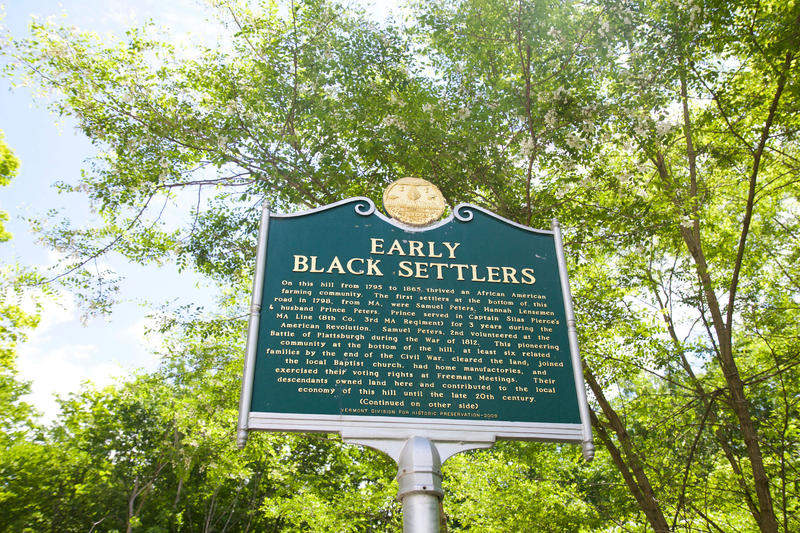
The history of Black people establishing communities in Vermont during the 1800s has been scrupulously researched by one author, and it is just being uncovered by others. Photo by ELODIE REED / VPR
This Vermont Public Radio podcast, Brave Little State, takes a deeper dive at the history of Vergennes, home to one of Vermont’s 19th century Black communities. In 1790, 7% of Vergennes’ population was Black, however the most recent census show the civilian Black population is at 0.2%. Other towns listed as having sizable historical Black populations include Bennington, Woodstock, Windsor and Ferrisburgh, along with cities like St. Albans and Rutland. This critical look at Vermont’s 19th century Black communities helps listeners understand the the conditions which shrunk diversity in our communities, rather than foster environments for all people to thrive equally.
This Brave Little State deep episode shows, as Tabitha Moore said in her VT Digger article, that “Vermont isn’t white by mistake.” Messages like Carrie Rockwood’s, when she implied that images of Black and Brown people don’t represent our Burlington community, is part of a bigger trend of systemic inequality that our city and state is deeply entrenched in. Representation matters, and is one small but important element to ensure we all live in an equitable, thriving community.
There is still money available to help Vermont tenants and landlords with back rent through the Rental Housing Stabilization Fund.
In this Vermont Public Radio episode, Vermont State Housing Authority’s Richard Williams and Vermont Legal Aid‘s Jean Murray talks about the Rental Housing Stabilization Fund, a $25 million program giving renters and landlords a way to apply for corona virus relief funds to cover unpaid rent, even if it was from before March.
Recent changes in the program allows for renters to use funds for assistance moving into more sustainable living situations- meaning you are currently paying more for rent than you should be based on your income- so that you can pay first and last month’s
“What relief is available to someone who is trying to make the rent payments, is not falling behind, but is still struggling and for example cannot otherwise get healthcare or .. fix their car? It is very scary to be a renter. Is there relief for people who is making rent but does not have back rent due?” asks a caller from Montpelier.
“ Is there relief for people who is making rent but does not have back rent due?”
Murray responds by reminding listeners that the relationship between tenant and landlords does not have to be adversarial. “Even though it is scary to be a renter, most landlords out there are serious about their roles as providers for housing.” She encourages listeners to talk with your landlord about your financial situation.One of the reasons for this rental relief fund is so that Vermont would not have to make the decision between housing and eating.
Talk to your landlord, make a plan. For folks who can’t make the full rent and make arrangements with their landlord to do partial payments, the landlords are eligible for funds from the Stabilization Program for the amount the tenant is not able to pay.
There is no doubt that this is an extraordinary and, for many, devastating moment in our history. It is a time of great loss but also of rapid rebuilding of our social support structures. To help mitigate the short-term economic impacts of the COVID-19 pandemic and create strategies for long-term business and community recovery, Governor Phil Scott created the Economic Mitigation and Recovery Task Force. The task force includes leaders across Vermont from credits unions, power companies, job creators, and community leaders.
One of the tools to emerge from the Economic Mitigation and Recovery Task Force is this Tool for Municipal Engagement for Diversity, Equity, and Inclusion. As part of the task force’s work brainstorming and compiling resources for community recovery, this tool was created for municipalities and local leaders to help increase the vibrancy of their communities by creating a culture of inclusion. At the Fair Housing Project, we know that inclusivity and diversity in housing is critical to those efforts.
It is clear that health disparities and economic struggles have hit groups who have been historically marginalized the hardest, which is as true during the COVID-19 pandemic as it has been with preceding national emergencies. This new tool calls on municipalities and local leaders to first acknowledge the privilege that comes from being a part of the dominant culture, and to recognize that if no action is taken in the way outlined in this tool, policies will continue to benefit those in a dominant position.
The Fair Housing Project of CVOEO goes a step further to remind our readers that historically our Federal Government has gone so far as to enact policies to intentionally benefit white families and individuals, such as participating in red lining practices and by excluding people of color from the benefits of the GI Bill. Housing discrimination predates these policies, and though the Fair Housing Act was created to mitigate these discriminatory practices, housing discrimination continues to be a major issue across the country with the rollback of the Affirmatively Furthering Fair Housing rule and the recent proposed rollbacks to protections for transgendered people experiencing homelessness.
In Vermont, the fair housing protections have been expanded to include seven additional protected classes, so in addition to it being illegal to deny housing based on race, color, country of national origin, religion, family status, sex and disability, it is also illegal to deny housing for gender identity, age, sexual orientation, marital status, receipt of public assistance, abuse sexual assault or stalking, and denial housing development based on the income of the prospective residents. The Tool for Municipal Engagement for Diversity, Equity, and Inclusion calls on local leaders and municipalities to host conversations on Justice, Equity, Diversity, and Inclusion (JEDI), and guides readers to model resources across Vermont.
The tool also calls for municipalities to:
Ensure accessibility for people of varying abilities by designating a group to receive and address accommodation inquiries and complaints.
Invite new people to participate in municipal meetings in more accessible ways.
One of the ways to break down barriers to having an impact in municipal government for people from more marginalized or stressed communities is by doing outreach in a more equitable way. Front Porch Forum and working with mutual aid groups that have already organized are a few of the recommended ways to reach a broader range of people.
Consider ways to support economic development of Minority- and Women-owned Business Enterprises (MWBEs)
Evaluate opportunity for small-scale housing and business in local zoning. From the perspective of the CVOEO Fair Housing Project, starting a Housing Committee (with an emphasis on Fair Housing, of course) is a great way to meet this goal from the housing entry point. The video below includes more information on why a Housing Committee is critical in this moment, and you can find the Housing Ready Toolkit here
Create a Diversity and Equity Commission and support schools in curriculum development.
Examples in Putney and Hartford, Vermont were shared for reference.
Translate materials into other languages, with the most common languages outside of English in Vermont being: French, Nepali, Somali, Swahili, Burmese, Vietnamese, Arabic, Mandarin, and Spanish.
Language access was a major gap in our state’s Covid response, but some grassroots organizers like Iceberg Consulting took matters in their own hands and were able to translate important materials for non-English speaking communities.
And lastly, to better understand which communities are being served and represented in municipal government, break down data on the programs the municipality administers by race, disability status, and other demographics.
We are in an unprecedented moment, still deep into a health crisis that has magnified existing economic and health disparities and has destabilized our country, state, and communities. Meanwhile, there is a tremendous energy for civic engagement and people are finding ways to make positive change at the local level and to support their neighbors.
It’s clear that safe, affordable homes are the foundation for opportunity and there is a strong correlation between health disparities and housing opportunity, especially for people of color and others in protected classes. Thousands of Vermonters were already in a precarious housing situation before covid – and tens of thousands more struggle to find affordable, and accessible homes.
A local housing committee can be an effective tool for addressing housing needs and promoting equal housing opportunity in towns and cities of all sizes. These committees can take the form of a municipally-supported committee, subcommittee of the planning commission, resident advocacy group, housing discussion meet-up, or any other group that seeks to support or change the quality, quantity, affordability, and/or inclusiveness of housing in a community.
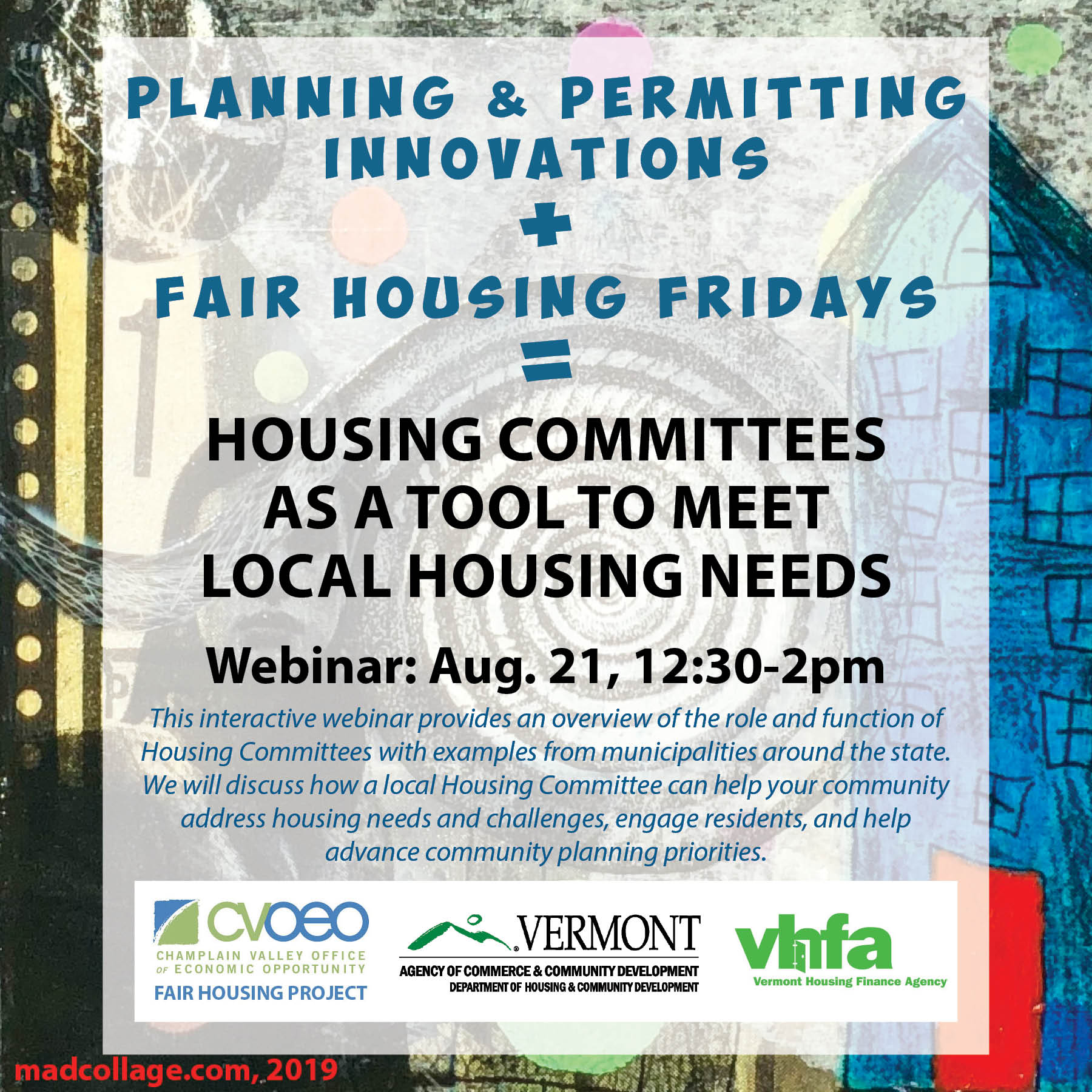
This interactive webinar provides an overview of the role and function of Housing Committees with examples from municipalities around the state. We will discuss how a local Housing Committee can help your community address housing needs and challenges, engage residents, and help advance community planning priorities.
COVID-19 takes its greatest toll on the most vulnerable, oppressed, and marginalized in our communities.
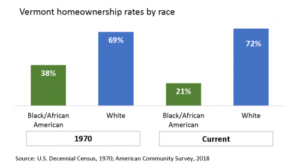
The Vermont Housing Finance Agency examines racial inequity in VT homeownership as it relates to the states history of housing segregation & communities of color current vulnerabilities during the pandemic.
The National Fair Housing Alliance reported an uptick in housing discrimination complaints throughout the pandemic, some of our hardest hit communities nationally included homeless populations and low-income, essential workers, the pandemic disproportionately affected people of color and housing advocates argue the nation’s history of housing segregation is at fault. The pandemic has forced our housing communities to adapt in many ways.
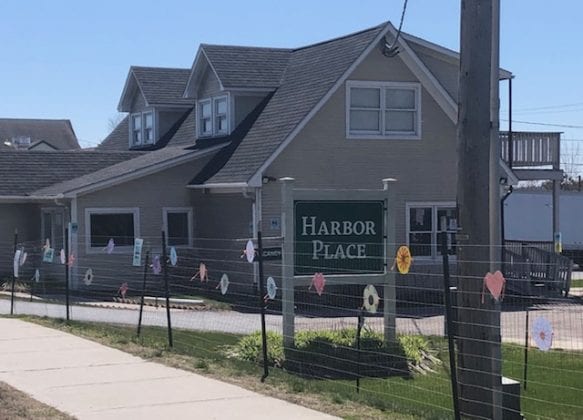
The Harbor Place motel in Burlington, Vt. Photo courtesy of Champlain Housing Trust
The good news is that here in Vermont we have pulled out some remarkable solutions. This spring housing advocates effectively temporarily ended homelessness in our state. Our own Champlain Housing Trust garnered national attention with this Shelterforce article for its ingenuity with the pre-exisiting Harbor Place, a former motel purchased by Champlain Housing Trust to provide services and transitional housing to homeless individuals. In Woodstock, a mutual aid group, the Woodstock Area Relief Fund, raised $320,000- nearly half of which went to rent and mortgage relief. Vermont passed an eviction moratorium, a critical but complicated law which gave renters much needed relief during a time when unemployment was skyrocketing and many did not know when they would return to the workforce. In April we hosted a Fair Housing Friday about renters’ rights during COVID-19 highlighting the eviction moratorium, which has been extended to Sept. 30. New reports show that Vermont has the 2nd lowest rate of pandemic-related housing insecurity. And this month the Rental Housing Stabilization Program started receiving applications.
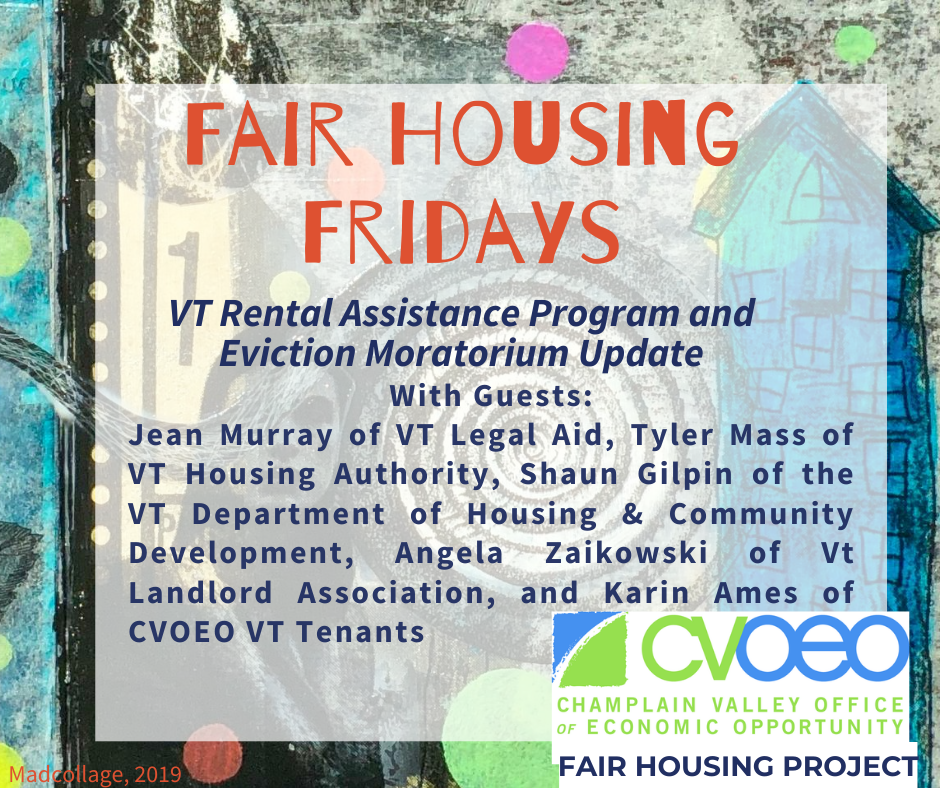
If you missed our most recent Fair Housing Friday webinar about the Rent Stabilization program, you can watch the full video here.
The Rental Stabilization funds landlords on behalf on tenants who are in need of help paying past due rent. The program is intended to prevent folks from being evicted so that people can safely shelter in place during the pandemic. For this reason, people can apply even if their rental arrearage is not strictly related to the pandemic and *may* be able to use the program for back rent from before the pandemic. Both the tenant and the landlord have to apply. The program has $25 million and applications are first come, first serve. Applicants have to be income-eligible and their rent has to meet the affordability requirements set by Vermont Housing Finance Agency, about $1,464 for a two-bedroom apartment in the Burlington and South Burlington area, and $1,199 for a two-bedroom in Central Vermont. Two weeks into the program, already an estimated 1,400 households applied for rental assistance.
Some of the questions asked during the webinar:
Q: If I have two tenants behind on rent applying for Rental Rehabilitation program and I only want to keep one of the tenants as a renter, can I apply for one renter and not the other?
A: That sounds like a violation of the Fair Housing Act. It would depend on the situation, and we caution everyone to head state and federal fair housing laws that protect against specific tenants from protected classes.
The point of the program is to provide rental arrearage money so that everyone stays housed where they are.
Q: A lot of the callers to Vermont Tenants hotline don’t have access to the internet and won’t be able to download even a pdf of the application. Where would we refer folks for assistance?
A: You can download the pdf on your phone using mobile data. If you are unable to do that, you can work with your landlord to get the application, call Community Action, call Vermont LegalAid, or call the Vermont State Housing Authority for the application to get mailed to you.
Q: What is the turnaround time for the application?
A: There are 10 working days for Vermont State Housing Authority to respond to the application, which may be a confirmation of a yes – in which case the payment will go directly to the landlord on the 1st and 3rd week of the month, or it may be a referral to Vermont LegalAid.
Q: Will tenants be denied if they indicate on the application that their rent is unsustainable?
A: No. That question is there only if people have the option to move to a more affordable place, and needs help to pay for rent for a more affordable apartment.
Q: If a tenant has already submitted their portion of the application and the landlord has not, how does the tenant move forward?
A: The Vermont State Housing Authority will match applications. If we are not able to get the landlord portion of the application, we will refer the tenant to Vermont LegalAid. If your landlord says they won’t submit an application, you can ask them to call the Vermont Landlord Association. Ultimately, a landlord cannot be forced to apply for the program.
The Vermont State Housing Authority has a full FAQ page which can be found here.
Applications for the Rental Stabilization Program can be found here.
There were a lot of resources we referenced in the webinar, and the full list has been uploaded here.
Always, we ask that if you have questions or concerns about your tenancy, please call our Vermont Tenants Hotline at (802) 864-0099