Just cause increases household health and stability

This is part of a series of commentaries by CVOEO and Vermont Legal Aid in support of Just Cause Eviction policy. The series includes:

By Housing Navigator Ryan Murphy and Director Sandrine Kibuey, Housing Advocacy Programs, CVOEO

Thousands of Vermont renters live day-to-day, in precarious housing, uncertain of how they will be able to make ends meet and afford the rent, buy food, or put gas in their car to get to work. It is a constant struggle and COVID-19 has deepened the impact of these daily struggles. The state and federal eviction moratoriums have provided temporary relief to many tenants, but the fear of being evicted is nonetheless real. And on top of it all, the question about why and when is also a great source of stress as a “no cause” eviction is a possibility for all tenants living in Vermont.

Vermont housing law allows landlords to evict any tenant for any reason with as little as 90 days’ notice and no-cause eviction is particularly worrisome for families, older Vermonters, as well as people of color. For many, this experience has been one of extreme consequences; here are a few examples.

Maintenance complaints and retaliation

Jeffrey and his partner, Abigail, received a no-cause lease termination notice this winter after almost a decade in the same home. He was not totally happy with the apartment as the heat had been cutting out, the wooden floors splintered his kids’ feet, and the driveway iced over so badly that he had once fallen and broken his leg.

Jeffrey had verbally complained to the landlord about these issues many times and he even had a few records of his complaints in his email outbox and ‘sent’ text messages. His landlord lived down the block, and Jeffrey felt that hand-delivering a letter, or sending one via certified delivery, might come off as petty and antagonizing but finally decided to send one.

It was hard not to feel like the eviction notice had come as retaliation for frequent repair requests. In Vermont, landlords are prohibited from practicing this kind of retaliation, but there is no mechanism to stop them from delivering no-cause termination notices. If the landlord’s case against Jeffrey went to court, Jeffrey might stand a chance of winning. Because of COVID, though, eviction cases are “stayed.” Technically, Jeffrey and his family could stay in the apartment until the end of the moratorium, but then they could risk getting an eviction for cause as holdover tenants and ruin their housing history for a long time. 

It was clear to Jeffrey and Abigail that they needed to line up a new place to live. After weeks of scouring the internet for available, affordable apartments around Burlington, they made the difficult decision to put down a deposit on a place in a neighboring state. They did not see the benefit of engaging in a big fight to stay in a home that would still need many repairs and a landlord resenting them, refusing to address these habitability issues.

From stability to eviction

On the last day of 2020, John’s family received a no-cause lease termination notice. It was yet another difficulty in a challenging year. John imagined trying to explain his current situation to the person he’d been only 12 months ago.

In March, John had been furloughed from his lucrative job as a contractor, and then he had been let go entirely. His job had been the family’s sole source of income. John had always made enough money to take care of himself, his wife, and his kids. Despite his job loss, he was grateful that he had enough in his financial safety net to keep current on rent for a couple of months until the pandemic ended.

A couple of months turned into a few, so John and Michaela applied for the Rental Housing Stabilization Program. They’d never had to apply for any kind of assistance before, but the deal was too good to pass up. The money would cover four months’ rent in full as long as their landlord agreed to sign their application. The landlord did agree to sign it, but in doing so, saw that the couple was in dire financial straits.

John finally found work again, though at a lower salary.  His paychecks went towards paying off past-due medical bills and the credit cards that had been maxed out buying groceries and gas. Interest kept accruing and so many creditors called that he and Michaela couldn’t tell which were legitimate and which were scammers.

Then then the car got repossessed. John’s credit score took a 100-point nosedive. He still needed to get to work and couldn’t deal with another monthly debt payment, so he found a car on Craigslist and bought it outright. Registration, titling, and inspection would cost the equivalent of 16 hours’ pay assuming that nothing needed repair.

Then, in December, he was holding a piece of paper that ordered his family to pack up and leave in 90 days. In agreeing to the Rental Housing Stabilization Program, John’s landlord had agreed not to evict him for nonpayment, but there were no protections against no-cause eviction. There was also a statewide eviction moratorium, but it was slated to end two weeks before the day the needed to be out. Although John’s family could only be forced to leave their home through a court order, staying in their home past the date on the eviction notice could cause them to be evicted for cause as holdover tenants.

With a low credit score, low income, and an eviction proceeding hanging over their heads, John was not hopeful about their prospects. It was completely defeating. He had never worked so hard in his life, but the more he tried to keep his family afloat, the more they only seemed to get further underwater.

Eviction is a traumatic event with lasting effects on a person and family’s emotional, social, and physical well-being. These conditions affect a person’s ability to lead a healthy life and deepen health disparities. Voting “yes” for just cause eviction would offer renters a modicum of security by requiring landlords to provide a good reason for evicting their tenants. Just cause would increase overall housing stability, which leads to stronger and more vibrant communities.

To learn more about this issue, view the Feb. 26 Fair Housing Friday webinar

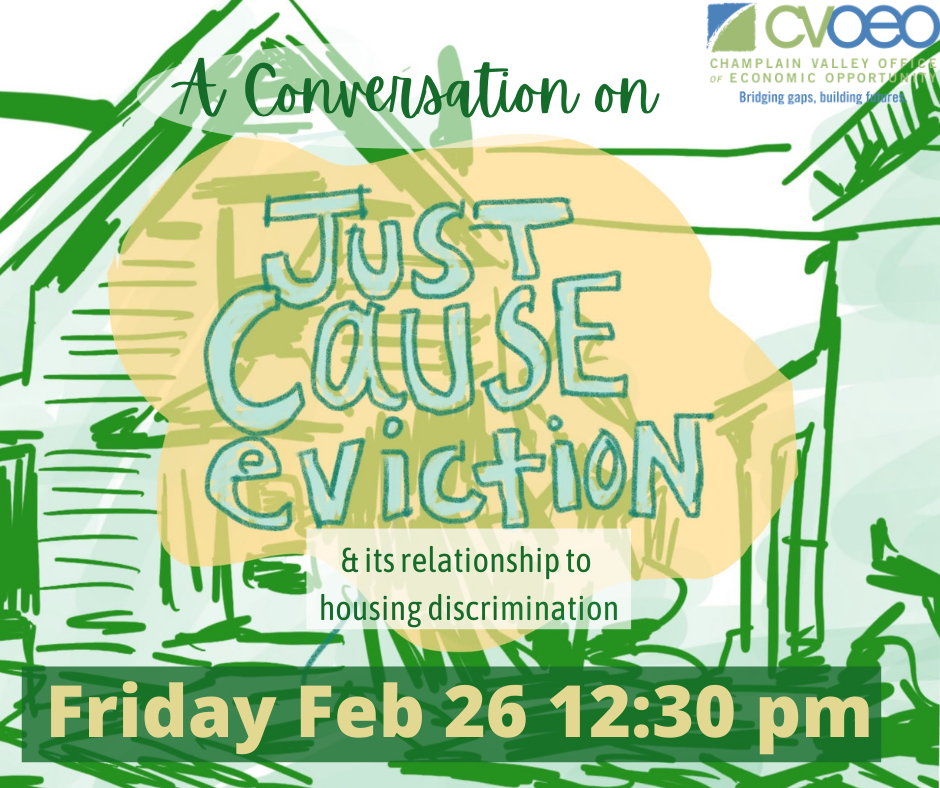
Fair Housing Friday: Just Cause Eviction & Why It is Important for Housing Equity Feb 26

Join us for a lunchtime conversation on Just Cause Eviction on Friday, Feb. 26 – 12:30-1:30pm.

Panelists include Brian Pine, speaking on behalf of the Just Cause Coalition, Michael Monte from Champlain Housing Trust, Bor Yang from the Vermont Human Rights Commission, and Christie Delphia from the Burlington Tenants Union. 

This conversation will highlight the ways language similar to Just Cause is already being used by nonprofit housers across Vermont, why evictions should be avoided & when they are actually necessary, and how Just Cause can combat housing discrimination. This lunchtime conversation will be recorded and have time at the end for a Q & A session.

Register using this link: https://us02web.zoom.us/meeting/register/tZIvd-2hrDovG90HXUx0PDe1zXZYj6e7HHnI

And you can share our facebook event here:

http://https://www.facebook.com/events/451236372739293

Regarding the Just Cause Opposition’s recent disinformation campaign:

On Monday Morning of February 22nd, leaders from Rights & Democracy VT, Vermont Affordable Housing Coalition, The Black Perspective, Burlington City Council, Burlington Tenants Union, Burlington VT Democrats Vermont, state representative Kesha Ram -among others- came forward to address a recent disinformation campaign lead by the opposition to Just Cause. Leaders condemn the red lawn signs designed to scare tenants, spread baseless statements and co-op racial equity language.


And here is the Vermont Affordable Housing Coalitions response to this recent smear campaign: https://www.vtaffordablehousing.org/2021/02/19/the-vermont-affordable-housing-coalition-fully-supports-the-burlington-just-cause-charter-change-proposal/


Join COVID Support VT for a Virtual Town Hall on Housing Assistance: 5-7pm Feb. 4

ft. Brenda E. Patoine Freelance Writer/Reporter/Photojournalist for COVID Support VT

This guest blog feature is by Brenda E. Patoine
Freelance Writer/Reporter/Photojournalist working with COVID Support VT. COVID Support VT helps people cope with the pandemic through education, emotional support and connections to community services that promote resilience, empowerment and recovery. CVOEO’s Fair Housing project welcomes our partners to add their voices to our Thriving Communities blog. Please send inquiries to fhp@cvoeo.org

Continue reading Join COVID Support VT for a Virtual Town Hall on Housing Assistance: 5-7pm Feb. 4

The Enduring Legacy of Dr. Martin Luther King Jr

While Martin Luther King Day is relegated to one day each year, it is important to remember that the legacy of Dr. Martin Luther King Jr’s lives on, his advocacy and preaching never loosing relevance in our day-to-day. Throughout our Vermont communities, folks came together to reflect and celebrate the Dr. Martin Luther King Jr’s commitment to justice.

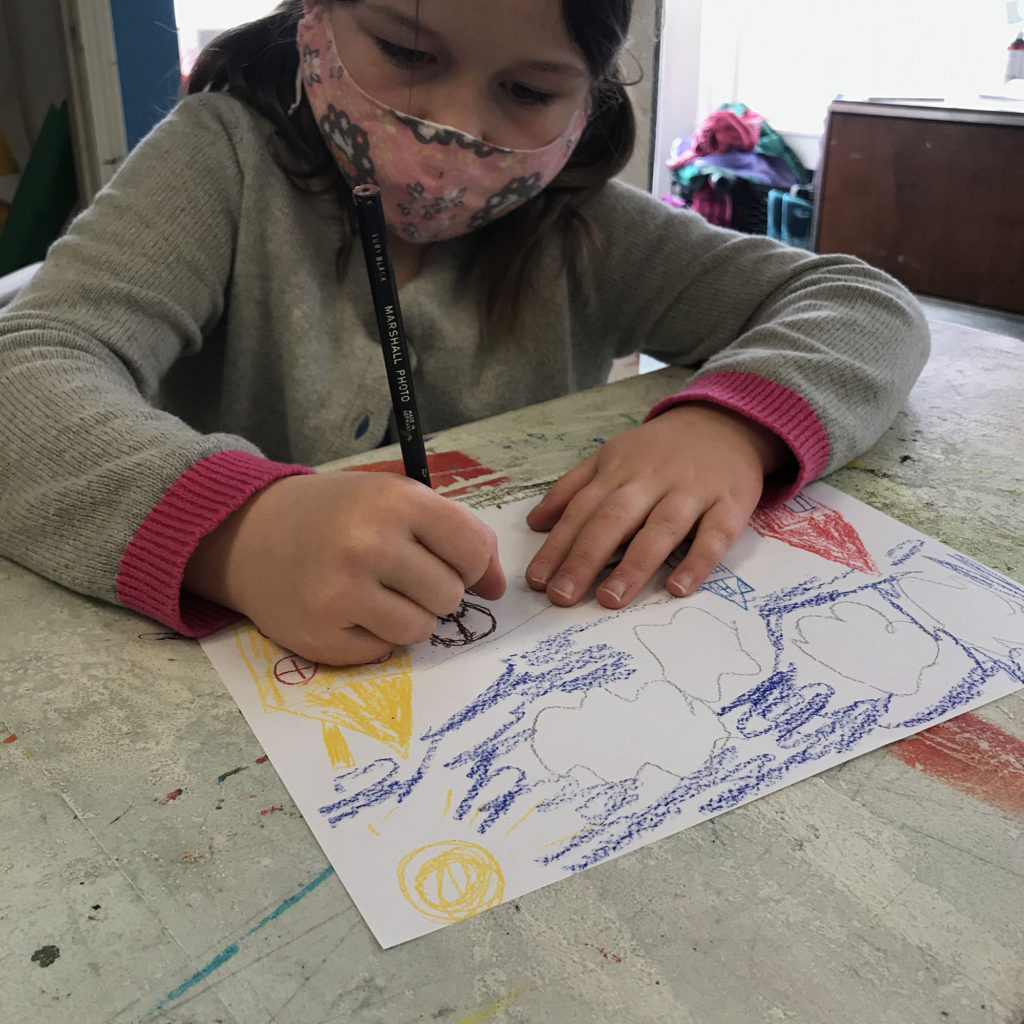
The Fair Housing Project’s partner, the Old North End Arts Center, celebrated Dr. Martin Luther King Jr’s legacy with their Better World Camp. The ONE Art Center invited kids to explore kindness through art projects, focusing on fun and the different ways the children can express themselves. They spent MLK Day by making art projects in a variety of media, practicing drama, storytelling, dancing, playing organized games, asking kids to think about What is service to others?

Photos by Brian Letizia, courtesy of Old North End Arts

The pandemic has put unprecedented stress on our communities, our families, our coworkers, our neighbors. But as we move into the safety of the zoom cyber space, collaboration has become second nature. Organizations have the flexibility to not only cohost conversation across sectors, but even for connections to be built across state lines. The City of Burlington hosted this thought-provoking panel on Reparations and Reconciliation, inviting not just local city officials and scholars, but representatives from other cities experiencing their own Reparations and Reconciliation discussions and legislative actions.


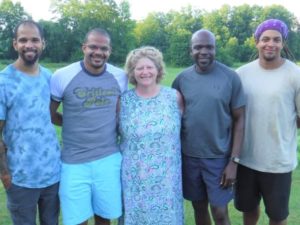
The Providence family of Guilford includes, from left, Justin, Rohan, Sherry, “Prov” and Aaron. Photo by Kevin O’Connor/VTDigger

Following the themes advocates and leaders raised in this conversation, in this VT Digger article, Rohan and his brothers, Aaron and Justin Providence, share a vulnerable conversation about their experiences growing up Black in Vermont with a level of candidness new even to their own family.

“You have to take a step back and just listen,” Rohan tells VT Digger, echoing a sentiment not only shared in the city hosted panel on Reparation and Reconciliation, but an echo of Black voices since the beginning of the racial justice movement. With vulnerable honesty, this family shares their story to illustrate what must be done all across Vermont: frank conversations about race and racism in our communities.

That “raw truth” is core to this powerful commentary from Kesha Ram (D-Chittenden), Vermont’s first woman of color to serve in the state Senate. State Senator Ram points to the glaring racial disparities in COVID-19 rates, policing, and homeownership as the true causes of Vermont’s prevalent & persistent whiteness. Ram corrects the popular and comfortable opinion that Vermont’s lack of racial diversity can be solved merely through more rigorous recruitment, adding critical insight to an urgent equity issue in our state.

You can find the rest of Burlington’s recorded MLK Day events, including a story walk organized by Fletcher Free Library that you can still participate in on your own, here.


Understanding Protections Against Sexual Harassments in Housing

ft. Emily Collins, Civil Rights Specialist Contractor for The United States Attorney’s Office of the District of Vermont

This guest blog feature is by Emily Collins, a Civil Rights Specialist, Contractor for Vermont’s United States Attorney’s Office . The United States Attorney’s Office is one of the resources available for folks who want to file a complaint about housing discrimination, particularly if there are patterns or practices of discrimination. CVOEO’s Fair Housing project welcomes our partners to add their voices to our Thriving Communities blog. Please send inquiries to fhp@cvoeo.org Continue reading Understanding Protections Against Sexual Harassments in Housing

2020 Round Up: Acts of Resiliency

2020 is finally coming to an end. We are tired, and many of us have faced significant losses this year. But throughout this past year, communities across our state and country have demonstrated amazing acts of resiliency, building their own resources and support networks in their time of need. We at the Fair Housing Project want to take some time to reflect on the inspiring lessons we can glean from the grassroots, community-centered solutions which have grown throughout 2020, and will continue to be essential cornerstones of thriving communities for years to come.

Continue reading 2020 Round Up: Acts of Resiliency

Housing Equity & Preservation of Open Space

updated, 12/29/20

At the Fair Housing Project, we generally applaud community members who organize to get their needs better met. But this featured article in the Other Paper as part of the Vermont Community News Network begs a counter response.  Continue reading Housing Equity & Preservation of Open Space

The Fair Housing Project Visits Burlington City & Lake

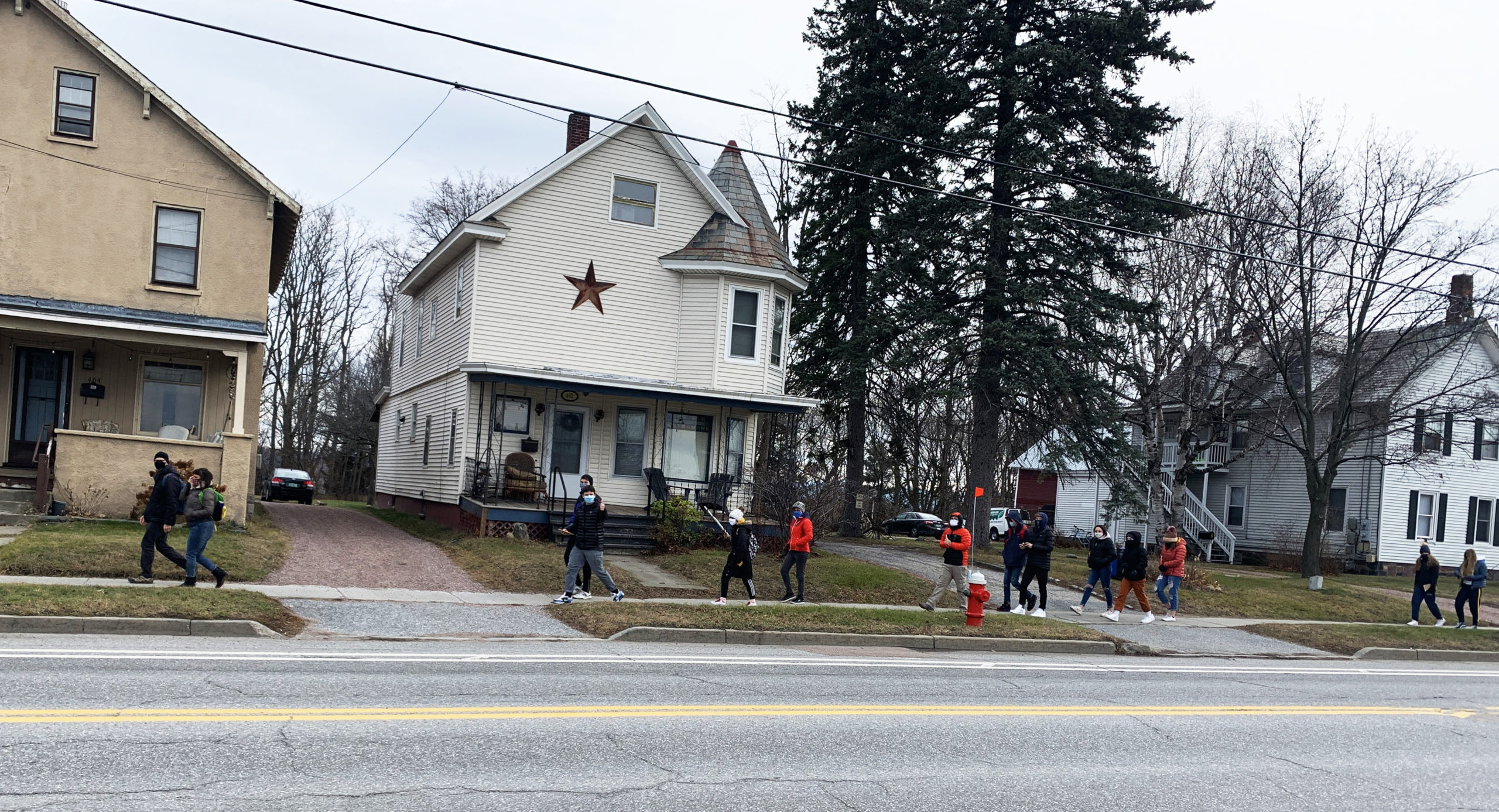
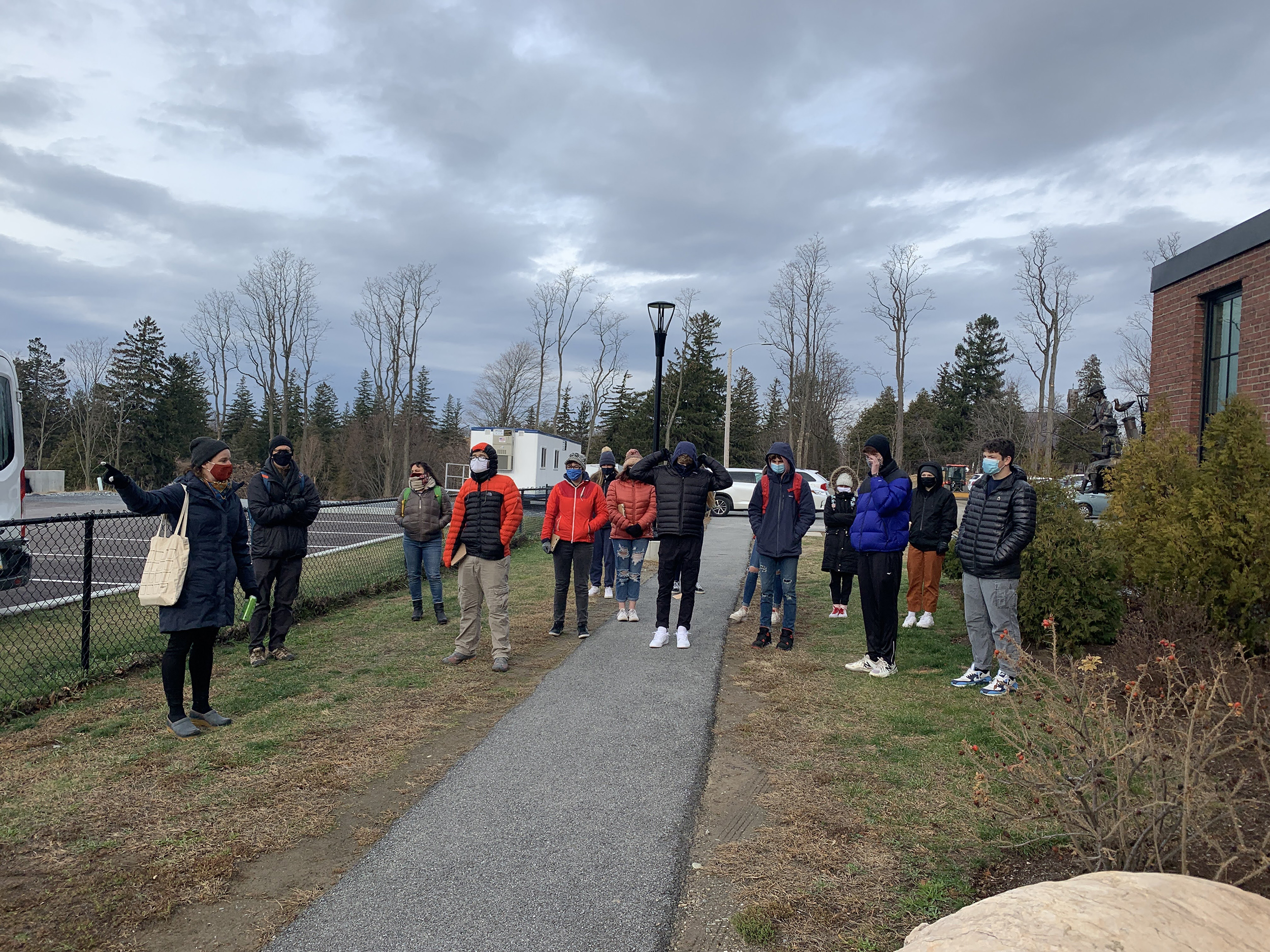
On Dec. 4, CVOEO’s Fair Housing Project Outreach and Education Coordinator, Corrine Yonce, took fair housing education out into the community by spending time with Burlington High School’s immersive learning program, Burlington City Lake Project.

Burlington City & Lake Students walk from the bus stop to Cambrian Rise, a new mixed-income community near their school

The day started by unpacking what fair and affordable housing mean. Corrine introduced the concepts through her own personal experiences, and asked students why they think both fair and affordable housing are important to inclusive communities. They also discussed and defined common housing terms like the Fair Housing Act, inclusionary zoning, protected classes, section 8, and market rate housing.

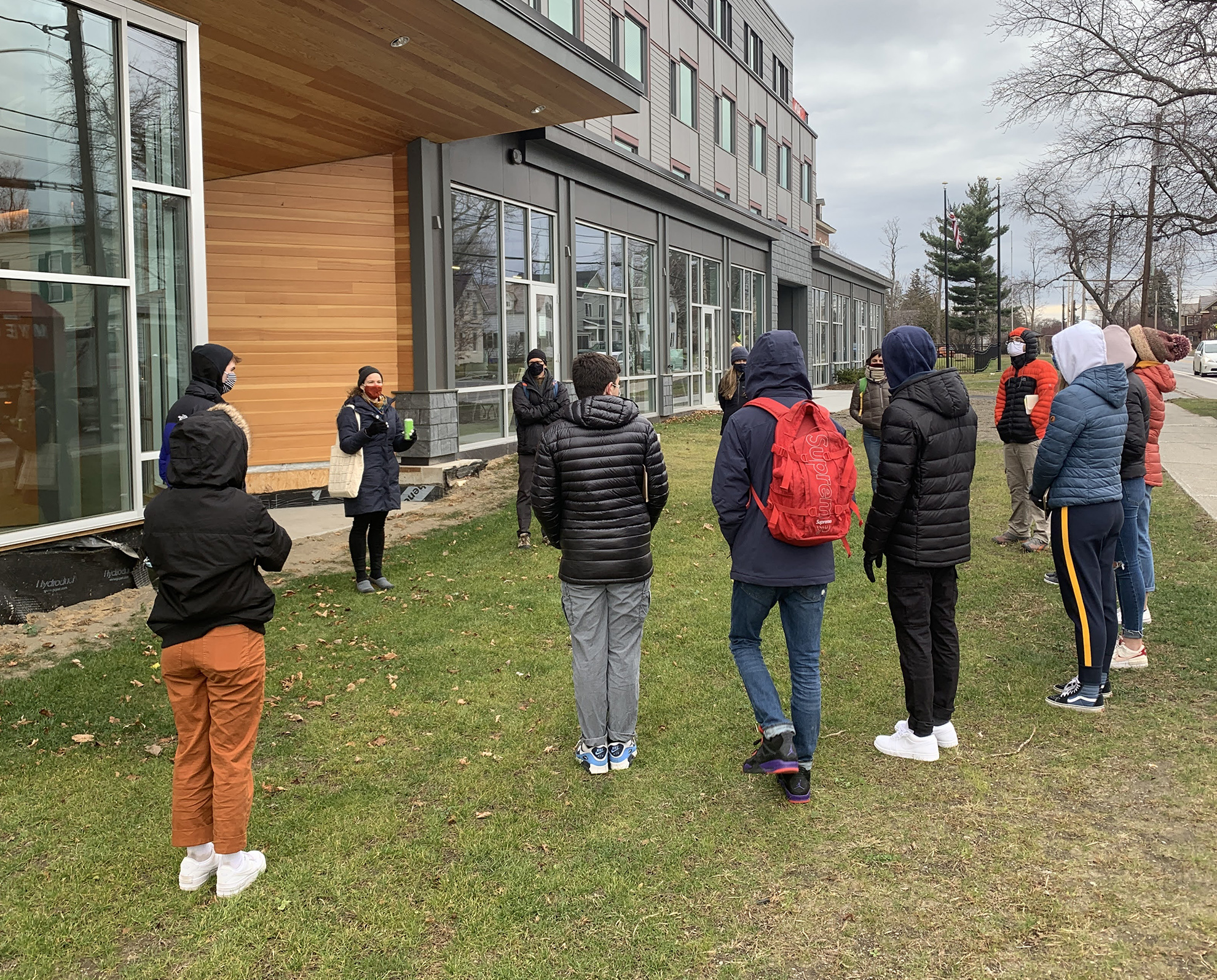
Students gather around Cambrian Rise to discuss how affordable & fair housing is important for thriving communities.

The students and teachers then took public transportation to check out one of the newest mixed-income housing complexes near where they go to school – Cambrian Rise. They talked about the controversy surrounding that development, and did the math for what 700 new housing units do for a community that has 1-2% housing vacancy rate.

One student asked “Why would they make 25% of the housing affordable by the lake when they could make more money developing all the housing as market rate?” which led to a discussion about equity in resourcesespecially for those in protected classes – and the important value of mixed-income communities.

“I grew up in a house nowhere near the lake, and I turned out fine. Why should having a view of the lake be important to low-income people?”

Another student was still not sold. “I grew up in a house nowhere near the lake, and I turned out fine. Why should having a view of the lake be important to low-income people?” Other students joined the conversation to point out the proximity of Cambrian Rise to other resources, like the bus line which they took to visit the community and the multi-use path that follows the coast of Lake Champlain.

Corrine shared an anecdote about working with the Champlain Housing Trust community, Laurentide, one of the earliest Cambrian Rise buildings to be fully occupied. Many residents there arrived to an art workshop Corrine had lead with images of the sunset on the lake. A few residents explained how past places they lived were overcrowded, on busy streets, and only close to strip malls. The lake added to their sense of place, belonging, and provided a peaceful outlet for busy lives.

This anecdote helped students understand that not all the impacts of fair, affordable, inclusive housing are quantifiable. Some of the impacts can only be learned through listening to the experiences of the people most impacted by affordable housing.

Come Join Our Team

The Fair Housing Project of CVOEO is seeking a Community Organizer!

The Community Organizer position will work to coordinate a statewide effort to support local housing committees, including outreach, training, local policy development, and research related to housing discrimination and local housing needs.

 
This is an excellent opportunity for a highly motivated person who has community organizing experience and a true passion for understanding Vermont’s affordable housing landscape, especially within the racial, social, and economic equity issues.


The Community Organizer will work with local organizations, municipalities, and the general public to raise awareness about fair housing rights and responsibilities, local housing policy, affirmatively furthering fair housing, and building inclusive and affordable communities.  This position will be part of CVOEO’s statewide Housing Advocacy Programs team, which includes Vermont Tenants and the Mobile Home Program.  The Community Organizer will also assist with outreach and education projects, including a new Statewide Library Partnership and Data Collection Initiative.
 
We are incredibly eager to grow our team, especially during a time when housing is so critical. Community engagement around the complications of housing – building more housing, housing retention, housing equity and accessible housing- requires a sincere effort to connect municipalities and the general public to the tools they need to advocate for their community’s needs. If this sounds like the job for you, you can read more and apply on our website here.

Vermont Civil Rights Conference this November

The Vermont Human Rights Commission is hosting the inaugural Vermont Civil Rights Conference on November 17-19, 2020. This year’s conference is focused on the theme of Fair Housing: The Consequences of Housing Segregation and Where we go From Here.

This three-day conference is free and open to the public, and features Richard Rothstein, author of The Color of Law, and Sarika Tandon, Equity Strategist and Racial Justice advocate.

Richard Rothstein is an American academic and author affiliated with the Economic Policy Institute, and a senior fellow, emeritus at the Thurgood Marshall Institute of the NAACP Legal Defense Fund. His current research focuses on the history of segregation in the United States with regards to education and housing, and he is most recently recognized for authoring The Color of Law. We’ve called on the expertise of Richard Rothstein many times in our Thriving Communities blog, most recently highlighting his Op-Ed in the New York Times here.

Sarika Tandon is an equity strategist and racial justice advocate.  She consults, teaches, writes, researches, and collaborates at the intersection of race, equity, and environmental issues. Sarika is deeply committed to working within the environmental movement to address issues of racial and environmental injustice and to support the inherent power, brilliance, and well-being of communities of color. She also  supports racial equity in nonprofit, education, criminal justice reform, and cultural spheres.

Other workshops include, “Housing Barriers in Vermont: Community Challenges & Collective Solutions – Moving the work forward collectively,”  “Vermont’s Housing Crisis: State’s Consolidated Plan – What are we doing about it?” “Fair Housing Act: Critiques and Implications” and “Community Reflections on the Consequences of Housing Segregation and Where we go from Here.” Panelists include representatives from various housing and support organizations, state government, and fair housing advocates – including the CVOEO Fair Housing Project.

All community members are welcome to join. Please see below for additional information about the conference.

Register in advance: https://us02web.zoom.us/meeting/register/tZYtdOyqqzoqHtF6v3iTob9QIcRSvRLnuAux

After registering, you will receive a confirmation email containing information about joining the meeting.

The Vermont Human Rights Commission works to promote full civil and human rights in Vermont by enforcing laws and providing education  around equal access to housing, places of public accommodation, and in state government employment. The Commission protects people from unlawful discrimination in housing, state government employment, and public accommodations. Learn more about the VHRC’s at https://hrc.vermont.gov/.