Continue reading Fair Housing Month Recap – and the Work Ahead
Final Fair Housing Friday of Fair Housing Month
Celebrate Fair Housing Month with After School & Spring Break Activities
Fair Housing Month Activities, Schedule, & More

Voices of Home Returns to Cambrian Rise
CVOEO Statement of Support to the Asian-American Community
- Read about more ways to support AAPI community members from the Vermont Human Rights Commission below and see the statement from VT APIDA for Black Lives Group calling for state and federal action.
The Champlain Valley Office of Economic Opportunity grieves for and stands with the victims, their families, and the entire community in Atlanta. We feel the burning pain of the intolerance, misogyny, and racism that led to these eight tragic deaths. We stand up in protest to their murders because we cannot bear to see racism, misogyny, or any other manifestation of intolerance exist and spread further fear. This has to stop.
To you, our Asian and Asian-American community members, you are our next-door neighbors; you are our co-workers, your children are our children’s classmates. We are each a part of one another. We see you. We see your strength. We see you rise, day after day, to make our community stronger. We see the many ways you contribute to and help lead our community. We see you making Vermont more inclusive and stronger every day.
When someone dies, we are called to remember how important and sacred life is. We must continually recommit to shared values that ensure safety, equity, and a more just society for all. At CVOEO, we strive to help build a diverse, fair, equitable, and unbiased society by providing support to individuals in meeting their needs and reaching their goals. We know that your safety is our safety and your freedom is our freedom. We are all in this life together.
As an organization, CVOEO will continue to take action to move towards a just society. We will continue advocating for policies, education and resources that dismantle racism. To our Asian and Asian-American community members, and our BIPOC and LGBTQ plus community members: We see you! We believe in your dignity, resilience and strength and we stand with you; you are part of us.
To people across Vermont we invite you to join with CVOEO as we strive towards a fair, equitable, and just society where each individual, regardless of their skin color, gender, sexual identity, religion, income level, or political affiliation, belongs.
Vermont Human Rights Commission Statement Against Asian American and Pacific Islander Violence & Discrimination
Please also see the recent statement by the Vermont Human Rights Commission in solidarity with Asian American and Pacific Islander (AAPI) community members. HRC’s statement includes:
- Statistics on incidents of hate, violence, harassment, discrimination, shunning, and child bullying against AAPI in the United States over the past year: 3,795 incidents, ranging from verbal harassment to physical assault. The Stop AAPI Hate Report paints only a sliver of what is happening on the ground because not all survivors of harassment, discrimination, and acts of violence come forward. There are many barriers to speaking out.
- A link to the recording of HRC’s May townhall “When Fear Turns to Hate: Addressing Racism in VT against Asian and Pacific Islander Communities.“
- Concrete ways to support AAPI community members in Vermont:
- On April 8th, from 5:30-7:30 p.m., join the Peace and Justice Center, SURJ, and the Vermont Human Rights Commission in a Bystander Intervention training. Register here: Meeting Registration
- If you are a member of the AAPI community and would like to stay connected to other AAPI community members e-mail Amanda.garces@vermont.gov to direct you to grassroots groups creating connection and community.
- If you experience harassment or discrimination, report it to Human Rights Commission or Attorney General’s Office.

Join Us to Celebrate Fair Housing Month
It is almost our favorite time of year here at the Fair Housing Project of CVOEO- Fair Housing Month!
Each April at CVOEO’s Fair Housing Project, we celebrate the 1968 passage of the Fair Housing Act with a series of public education and art events to raise awareness about housing discrimination in Vermont and the positive role that inclusive, affordable housing plays in thriving communities. To promote Fair Housing education and awareness, the Fair Housing Project facilitates a series of zoom webinars, Fair Housing workshops, and art activities, prompting participants to reflect on what Fair Housing means in their community.
Join us!
There are a variety of ways you, your community, or your organization can participate in the celebration this year, despite us being unable to meet in person. Our Fair Housing Month calendar is filling with events hosted by us and organizations across the state, including Fair Housing Friday zoom webinars, the Old North End Art Center’s art camps, and HeART & Home community art project, library book and film discussions, and Fair Housing workshops.
Let us know how you, your community, or your organization would like to participate by filling out this brief form.
(Of course, we anticipate these activities will be held remotely, and when possible, outdoors with physical distancing.)
Here are some examples of the variety of ways you can join us in celebrating Fair Housing Month:
- Host an event in your community focusing on the history and impact of the Fair Housing Act, local housing needs, or the value of diversity and inclusion in housing (which we will add to our Fair Housing Month event calendar)
- Participate in the HeART & Home Community Art Project, or lead a HeART & Home Community Art activity in your community/classroom/organization
- Participate as a panelist in one of our three Fair Housing Fridays
- Invite us to do a Fair Housing workshop with your community/organization
- Start a discussion group in your organization or community (see list of books and films at https://libraries.vermont.gov/fairhousing2021)
This year we have a new partnership with the Vermont Department of Libraries and Vermont Library Association for new activities, like book discussion groups, story walks, and more at sites all over the state. Click here to learn more!
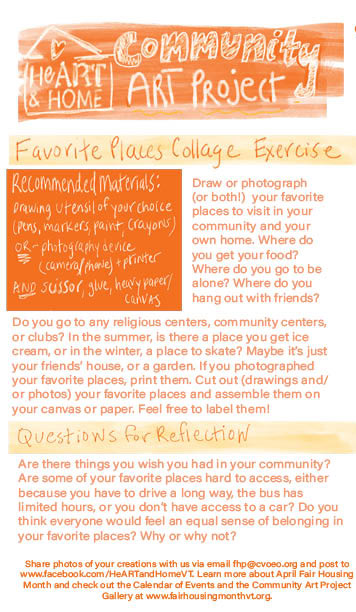
Are you curious about our HeART & Home Community Art Project? Check out a couple of the prompts we are sharing with our project participants.
For examples of past activities and to see this year’s full calendar of events (which will be posted later this month), visit www.FairHousingMonthVT.org.
If you are interested in participating in any capacity in our Fair Housing Month Celebration, please fill out this brief form.
Fair Housing Month activities in Vermont are coordinated by the Fair Housing Project of CVOEO, in collaboration with Vermont Department of Libraries, Vermont Library Association, ONE Arts Center, Vermont Legal Aid, Vermont Human Rights Commission, VT Department of Housing and Community Development, and other partners. This program is supported by a Department of Housing and Urban Development (HUD) Fair Housing Initiatives Program grant and supported by the Institute of Museum and Library Services, a federal agency, through the Library Service and Technology Act as administered by the Vermont Department of Libraries.
Fair Housing is the right to equal opportunity in housing choice and the right to rent, buy, finance, and live in a home free from discrimination or harassment. The federal Fair Housing Act prohibits discrimination concerning the sale, rental, and financing of housing based on race, color, religion, national origin, sex, and as amended, disability and family status. This also covers harassment, including sexual harassment.
Vermont has additional protections based on age, marital status, sexual orientation, gender identity, receipt of public assistance, being a victim of domestic violence, sexual assault, or stalking, and denial of development permitting based on the income of prospective residents.
To learn more about your Fair Housing rights and responsibilities, visit www.cvoeo.org/fhp and see www.fairhousingmonthvt.org for April fair Housing Month details. Contact us at fhp@cvoeo.org.
It is time to vaccinate people experiencing homelessness
By Paul Dragon, Executive Director of the Champlain Valley Office of Economic Opportunity
We need to vaccinate people experiencing homelessness – now.
People experiencing homelessness are much more likely than the general population to have chronic medical conditions along with mental health and substance use conditions. In addition, homelessness is deeply traumatic. According to the Substance Abuse and Mental Health Services Administration (SAMHSA) people experiencing homelessness for even a brief duration are often traumatized by the sudden loss of a home and by adjusting to conditions on the street or in a shelter. Some people living in homelessness, particularly women already have histories of trauma, including sexual, psychological, or physical abuse. Families experiencing homelessness, disproportionately headed by women, experience posttraumatic stress disorder, depression, and substance use at much higher rates higher than the national average. Individuals and families experiencing homelessness are the most marginalized, isolated, and discriminated against. They are highly vulnerable to disease, violence and victimization, and re-traumatization is ever present.
The Champlain Valley Office of Economic Opportuning (CVOEO) is currently operating one of the State’s largest emergency housing programs along with a daytime warming center. We have witnessed that the trauma, loneliness and disconnection from community are further exasperated during this pandemic. Not only are people experiencing homelessness more susceptible to disease but the instability in housing leads to frequent movement and potential community spread particularly among other people experiencing homelessness. In addition, homelessness can be a barrier to attaining and keeping protective equipment and adhering to the many public health protocols.

According to the United Nations Charter, safe and affordable housing is a basic human right. It is our failure as a society to provide decent, affordable housing that has created homelessness which results in poor health outcomes and increased vulnerability during this pandemic. It is our responsibility to do all we can to protect people during this time including providing them with a vaccine. We often turn away from people who are homeless thinking there is some personal or perhaps moral failure in what we see. In fact, it is society that has failed them. Now it is time and our duty as a society during this pandemic to provide them with a vaccine and some measure of relief.
Just cause increases household health and stability
This is part of a series of commentaries by CVOEO and Vermont Legal Aid in support of Just Cause Eviction policy. The series includes:
- No Cause Eviction Law is an Unjust Law by CVOEO Executive Director Paul Dragon
- Just Cause is a Racial Justice Issue by Devon Ayers and Erika Johnson of Vermont Legal Aid’s Housing Discrimination Law Project
By Housing Navigator Ryan Murphy and Director Sandrine Kibuey, Housing Advocacy Programs, CVOEO
Thousands of Vermont renters live day-to-day, in precarious housing, uncertain of how they will be able to make ends meet and afford the rent, buy food, or put gas in their car to get to work. It is a constant struggle and COVID-19 has deepened the impact of these daily struggles. The state and federal eviction moratoriums have provided temporary relief to many tenants, but the fear of being evicted is nonetheless real. And on top of it all, the question about why and when is also a great source of stress as a “no cause” eviction is a possibility for all tenants living in Vermont.
Vermont housing law allows landlords to evict any tenant for any reason with as little as 90 days’ notice and no-cause eviction is particularly worrisome for families, older Vermonters, as well as people of color. For many, this experience has been one of extreme consequences; here are a few examples.
Maintenance complaints and retaliation
Jeffrey and his partner, Abigail, received a no-cause lease termination notice this winter after almost a decade in the same home. He was not totally happy with the apartment as the heat had been cutting out, the wooden floors splintered his kids’ feet, and the driveway iced over so badly that he had once fallen and broken his leg.
Jeffrey had verbally complained to the landlord about these issues many times and he even had a few records of his complaints in his email outbox and ‘sent’ text messages. His landlord lived down the block, and Jeffrey felt that hand-delivering a letter, or sending one via certified delivery, might come off as petty and antagonizing but finally decided to send one.
It was hard not to feel like the eviction notice had come as retaliation for frequent repair requests. In Vermont, landlords are prohibited from practicing this kind of retaliation, but there is no mechanism to stop them from delivering no-cause termination notices. If the landlord’s case against Jeffrey went to court, Jeffrey might stand a chance of winning. Because of COVID, though, eviction cases are “stayed.” Technically, Jeffrey and his family could stay in the apartment until the end of the moratorium, but then they could risk getting an eviction for cause as holdover tenants and ruin their housing history for a long time.
It was clear to Jeffrey and Abigail that they needed to line up a new place to live. After weeks of scouring the internet for available, affordable apartments around Burlington, they made the difficult decision to put down a deposit on a place in a neighboring state. They did not see the benefit of engaging in a big fight to stay in a home that would still need many repairs and a landlord resenting them, refusing to address these habitability issues.
From stability to eviction
On the last day of 2020, John’s family received a no-cause lease termination notice. It was yet another difficulty in a challenging year. John imagined trying to explain his current situation to the person he’d been only 12 months ago.
In March, John had been furloughed from his lucrative job as a contractor, and then he had been let go entirely. His job had been the family’s sole source of income. John had always made enough money to take care of himself, his wife, and his kids. Despite his job loss, he was grateful that he had enough in his financial safety net to keep current on rent for a couple of months until the pandemic ended.
A couple of months turned into a few, so John and Michaela applied for the Rental Housing Stabilization Program. They’d never had to apply for any kind of assistance before, but the deal was too good to pass up. The money would cover four months’ rent in full as long as their landlord agreed to sign their application. The landlord did agree to sign it, but in doing so, saw that the couple was in dire financial straits.
John finally found work again, though at a lower salary. His paychecks went towards paying off past-due medical bills and the credit cards that had been maxed out buying groceries and gas. Interest kept accruing and so many creditors called that he and Michaela couldn’t tell which were legitimate and which were scammers.
Then then the car got repossessed. John’s credit score took a 100-point nosedive. He still needed to get to work and couldn’t deal with another monthly debt payment, so he found a car on Craigslist and bought it outright. Registration, titling, and inspection would cost the equivalent of 16 hours’ pay assuming that nothing needed repair.
Then, in December, he was holding a piece of paper that ordered his family to pack up and leave in 90 days. In agreeing to the Rental Housing Stabilization Program, John’s landlord had agreed not to evict him for nonpayment, but there were no protections against no-cause eviction. There was also a statewide eviction moratorium, but it was slated to end two weeks before the day the needed to be out. Although John’s family could only be forced to leave their home through a court order, staying in their home past the date on the eviction notice could cause them to be evicted for cause as holdover tenants.
With a low credit score, low income, and an eviction proceeding hanging over their heads, John was not hopeful about their prospects. It was completely defeating. He had never worked so hard in his life, but the more he tried to keep his family afloat, the more they only seemed to get further underwater.
Eviction is a traumatic event with lasting effects on a person and family’s emotional, social, and physical well-being. These conditions affect a person’s ability to lead a healthy life and deepen health disparities. Voting “yes” for just cause eviction would offer renters a modicum of security by requiring landlords to provide a good reason for evicting their tenants. Just cause would increase overall housing stability, which leads to stronger and more vibrant communities.
To learn more about this issue, view the Feb. 26 Fair Housing Friday webinar.
Fair Housing Friday: Just Cause Eviction & Why It is Important for Housing Equity Feb 26
Join us for a lunchtime conversation on Just Cause Eviction on Friday, Feb. 26 – 12:30-1:30pm.
Panelists include Brian Pine, speaking on behalf of the Just Cause Coalition, Michael Monte from Champlain Housing Trust, Bor Yang from the Vermont Human Rights Commission, and Christie Delphia from the Burlington Tenants Union.
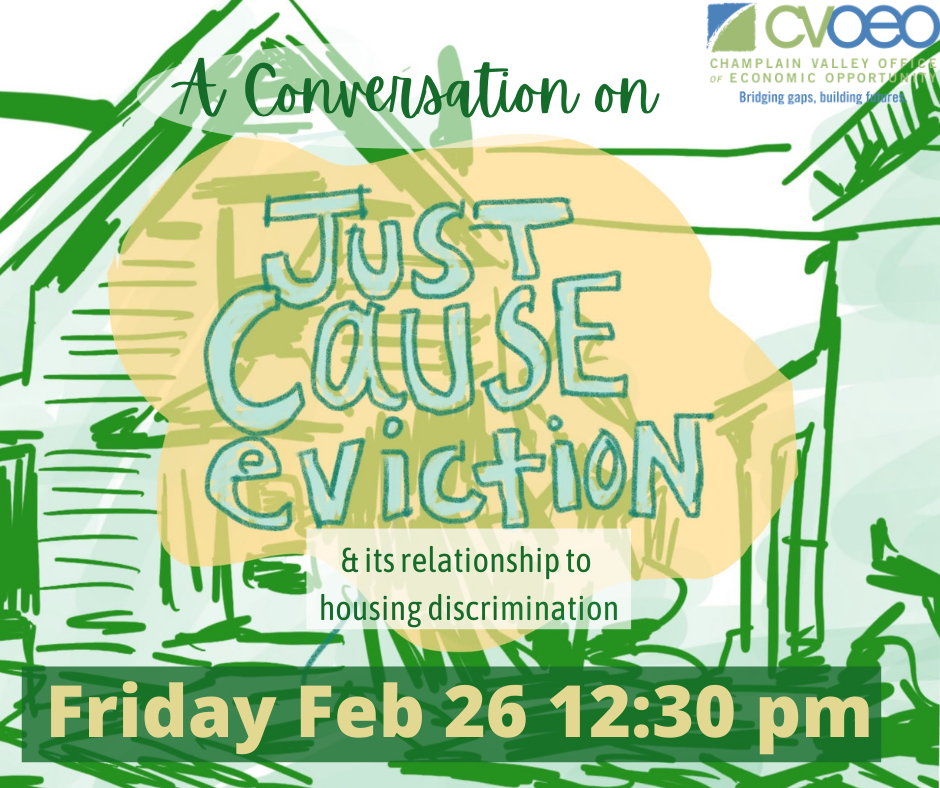
This conversation will highlight the ways language similar to Just Cause is already being used by nonprofit housers across Vermont, why evictions should be avoided & when they are actually necessary, and how Just Cause can combat housing discrimination. This lunchtime conversation will be recorded and have time at the end for a Q & A session.
Register using this link: https://us02web.zoom.us/meeting/register/tZIvd-2hrDovG90HXUx0PDe1zXZYj6e7HHnI
And you can share our facebook event here:
http://https://www.facebook.com/events/451236372739293
Regarding the Just Cause Opposition’s recent disinformation campaign:
On Monday Morning of February 22nd, leaders from Rights & Democracy VT, Vermont Affordable Housing Coalition, The Black Perspective, Burlington City Council, Burlington Tenants Union, Burlington VT Democrats Vermont, state representative Kesha Ram -among others- came forward to address a recent disinformation campaign lead by the opposition to Just Cause. Leaders condemn the red lawn signs designed to scare tenants, spread baseless statements and co-op racial equity language.
And here is the Vermont Affordable Housing Coalitions response to this recent smear campaign: https://www.vtaffordablehousing.org/2021/02/19/the-vermont-affordable-housing-coalition-fully-supports-the-burlington-just-cause-charter-change-proposal/