Category Archives: renters

Here a crisis, there a crisis

Never mind California or the Northeast. The housing-unaffordability problem can be found lots of other places, some of them rather unlikely. If you breeze through news coverage from around the country, you can find stories from all over that use the phrase “crisis” or “crunch” or “shortage” to describe the local or regional housing-unaffordability profile:

Just in the past few days, stories have bubbled up from Taos,  Taos Jackson Hole, Aspen, Madison, Asheville, Hawaii, and Austin — all in crisis mode.

Austin is an interesting case: There’s not only an affordability shortage, most of the supposedly affordable units aren’t really affordable after all, according to a rather scathing audit that just came in. From the report summary: “The City does not have an effective strategy to meet its affordable housing needs. Neighborhood Housing and Community Development has not adopted clear goals, established timelines, or developed affordable housing numerical targets to evaluate its efforts in fulfilling the City’s adopted core values. Key information needed to evaluate program effectiveness is incomplete, inaccurate or unavailable.” Austin3  This, in the latter-day birthplace of public housing that  the mayor pronounced the most economically segregated city in the country.

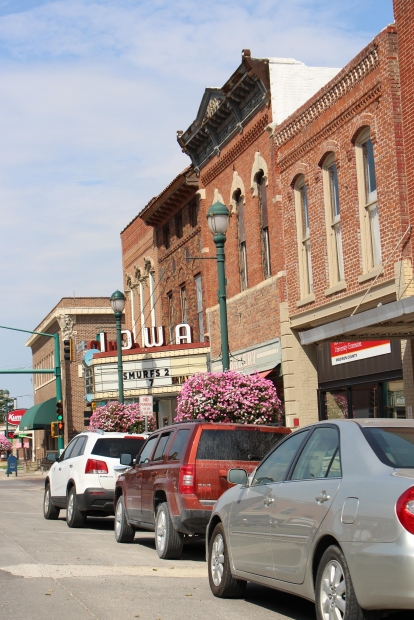
Among the places you might not expect to find a housing crisis: Minot, N.D., rural Iowa, IowaNorth Platte, Neb. (Say it ain’t so, North Platte!) And to think that this is not something the presidential candidates can even be bothered to talk about!
In fact, every county in the country can be said to be in crisis when it comes to housing extremely low-income households (that is, households with less than 30 percent of median income, 11.3 million nationwide). No county has enough units for such people, according to an analysis the Urban Institute did this summer. For an interactive map that will show you how many affordable units in each county for 100 poor households, click here. In Vermont, Orange, Windsor and Windham counties come out the best, with 49 affordable units for 100 households; Caledonia, Lamoille and Orleans have the fewest, at 29. The national average: 28.

Of course, the national challenge is not just to create plenty more affordable housing but to locate it judiciously. New housing options have to be provided for low-income people in low-poverty neighborhoods, otherwise known as “high-opportunity” areas. That’s what affirmatively furthering fair housing is about — breaking up historic settlement patterns of concentrated poverty and segregation and promoting integration.

Naturally, AFFH generates pushback. So, sprinkled among the wash of “housing crisis” stories are accounts of resistance to affordable housing projects in well-healed suburbs – such as Simsbury, Conn. (median household income$104,000) , and Wilmette, Ill. ($127,000).


Tampering with the sacrosanct

The presidential candidates have a lot to say about tax reform, but with one exception, they’re not about to get rid the big sacred cow — the mortgage-interest deduction, found on Schedule A of Form 1040:scheduleA (2)

Economists have been complaining about the mortgage-interest deduction for years. It’s a regressive benefit, increasing with income. It enhances inequality, effectively inflates property values and misallocates resources, or so the argument goes. In 2012, the mortgage interest deduction cost the federal government $70 billion, according to the Urban Institute, compared $36 billion for low-income housing subsidies.

But nobody expects that deduction to go away any time soon. It’s a firmly entrenched loophole (aka “third rail”) not only for the wealthy elite, but for the simple majority. The home ownership rate in this country exceeds 60 percent (in Vermont, it’s over 70 percent), and of course the lion’s share of those people are mortgage-holder beneficiaries. IRS2

The ranks of renters are increasing, though, and the more they do, the more seriously they might be taken as a political constituency. Politicians take renters seriously in Germany, where renters are in the majority and the regulatory climate is much more in their favor. Germany doesn’t offer a mortgage-interest deduction, either.

Might the growing numbers of American renters be mobilized to support the elimination of the mortgage-interest deduction — which ostensibly doesn’t benefit them anyway — in favor of increased housing subsidies for low- and moderate-income tenants? That seems like a stretch, unless another Occupy-style movement sweeps the country.

Well, if eliminating the mortgage-interest deduction discourages home ownership, so be it. There’s even evidence that home ownership isn’t necessarily such a wonderful thing, because it damages labor markets:

“We find that rises in the home- ownership rate in a U.S. state are a precursor to eventual sharp rises in unemployment in that state,” write economists David Blanchflower and Andrew Oswald, in a 2013 paper. Why? Partly because higher rates of homeownership curtail labor mobility and lead to longer commutes.

So, who’s the exception among the presidential candidates? Ben Carson. bencarson He’s the only one who has said he’d do away with the mortgage-interest deduction. (Even Bernie Sanders doesn’t go that far – he’d cap it at $300,000.) For a full-throated defense of this Carson stance from someone who doesn’t agree with much of anything else he says, click here. 

Another population bubble

Millennials become the most numerous living generation this year, outnumbering the Baby Boomers, and there’s no shortage of treatises analyzing their tastes, their world views, and their impact on the housing market. How seriously to take these generalizations, or any other thumbnail pronouncements about generations, is an open question. (For a Pew Foundation exegesis of “generations research” that finds Millennials less religious, more diverse and less conservative than their predecessors — that is, compared to Generation X, Baby Boomers and the Silents(!), click here.)

Clearly, though, people born after 1980 tend to have higher levels of student loan debt than their forebears, and fewer are buying houses as a result.Millennials1 Young renters’ student debt burdens grew after the Great Recession, even as their median incomes dropped, which left them less able to qualify for a mortgage or to save for a downpayment. A new research brief from the Harvard Joint Center for Housing Studies, “Student Loan Debt and the Housing Decisions of Young Households,” lays out the details.

Nevertheless, there are commentators who see Millennials as poised to fuel a housing boom. “Millennials are making their move in the housing market,” proclaims the Dallas Morning News, quoting real-estate industry source attributing 30 percent of home sales to Millennials.

The common notion that Millennials want to live in cities is subject to dispute. More Millennials are moving from cities to suburbs than the other way around, Census data supposedly show. A survey came out earlier this year that got plenty of attention: It had 66 percent of Millennials preferring a life in suburbs, 24 percent rural areas, and just 10 percent cities.

The survey was sponsored by the National Association of Home Builders, though — an entity that would seem to have a vested interest in promoting the single-family-home-big-yard lifestyle.

But wait. A survey closer to home suggests that many Millennials really do hanker for a single-family home with a big yard. The 2014 “Young Professional Housing Survey Report,” sponsored by the Lake Champlain Regional Chamber of Commerce, asked 400 respondents (63 percent of whom were renters) what type of residence they would most like to live in, and 82 percent said single-family detached house with a yard. And most of those wanted a big yard!millennials2

Now, to the extent that these Burlington-area Millennials prefer suburban living, they do want to live in a place that’s a short commute to work, and a place where they can walk to community services.

Still, the young cohort seems to cling to the old American dream of a low-density-neighborhood lifestyle. Hasn’t anyone told them that big yards are obsolete in the Age of Climate Change?

So what if?

If you’re fed up with the high-priced housing here and want trade the Champlain Valley for the Treasure Valley (Boise, Idaho), be careful. Boise If you’re making less than $35,000 a year, you’ll be hard-pressed to find an affordable apartment, according to this article in the Idaho Statesman. (“Low-income housing crisis,” blares Idaho Public Radio.)  Sure, average rents are lower there than in Burlington, but they’re rising fast. What’s more, developers say they can’t make a profit on affordable housing without more incentives than Idaho makes available.

If you think you’ll be better off in Illinois,Illinois1 be aware that you probably can’t get on a waiting list for a housing choice voucher (72 percent of the Section 8 waiting lists are closed, we learn from a report whose title says it all, “Not Even a Place in Line.” True, average rents in Illinois are a bit lower, as is the “housing wage” — the amount you need to earn an hour to be able to afford a two-bedroom apartment.  (“Afford” means you pay no more than 30 percent of your income for housing.) Vermont’s 2BR housing wage is $20.68 an hour; Illinois’ is $18.78. Don’t spend the difference all in one place.

If you still hanker for California in hopes that you can make do outside the glitzy metro areas, think again. Even Bakersfield, site of a recent “Affordable Housing Summit,” is brooding about a housing “crisis,” with rent inflation far outpacing wage growth. (Bakersfield!)

In Denver, described as “a landlord’s market,” at least you can call a housing hotline for advice, but you might be put on hold. Calls are coming in steadily, with affordability the main concern and callers reporting rent hikes of $200 to $400.

If you think a career in academia will spare you housing-unaffordability travails, you might be right in the long run … but not necessarily in the short run in Ithaca, N.Y.,  where junior faculty at Ithaca College are reportedly struggling.

If you’re a prospective student at Middlebury College with an ambulatory disability, you might wonder if a new townhouse-style dorm under construction – sans elevators — will fully accommodate you. But you can take heart that scores of accessibility/visitability advocates at the college are in your corner.

If you’re an artist hankering for affordable artists’ housing – something that is emerging in warehouses and abandoned factories around the country, as we’ve noted before – you can forget about Burlington’s celebrated artists’ enclave, the Enterprise Zone in the South End. The mayor said no to housing there, as did the City Council, as did the Housing Action Plan. Did anyone take a serious look at whether affordable housing could be introduced there without gentrifying the neighborhood? Not that we’ve heard.

Oh well, Kingston, N.Y., had another idea. An old lace factory Kingston there has been converted to affordable housing  for “writers, dancers, graphic designers, musicians, painters, photographers, and even a puppeteer,” we learn from a local news account.

Where growth yields to high rents

Here’s another way to look at the housing-affordability problem: as a damper on economic growth. city1

Two economists published a study this summer that essentially made that point. They analyzed growth rates of 220 metropolitan areas and how those rates contributed to national growth from 1964 to 2009. They found, surprisingly, that some of the most productive cities, where pay rates also happen to be high, actually contributed less to overall growth than one might have expected. That’s because employment didn’t grow proportionately in those cities — they cite New York, San Francisco and San Jose in particular — in large part because of housing constraints.

“The main effect of the fast productivity growth in New York, San Francisco, and San Jose was an increase in local housing prices and local wages, not in employment,” write Chang-Tai Hsieh, of the University of Chicago, and Enrico Moretti, of U.C.-Berkeley. “In the presence of strong labor demand, tight housing supply constraints effectively limited employment growth in these cities.”

In other words, workers were prevented from migrating to these productive, high-wage areas because they couldn’t find affordable places to live. By contrast, three-fourths of U.S. growth in those years was attributable to Southern cities and a group of 19 other cities, where housing was more plentiful and wages were lower.

city3

Their article has an overweaning title, “Why do cities matter? Local growth and aggregate growth,” but it’s worth noting their conclusion that the housing constraints in the productive, high-wage cities derived from restrictive or exclusionary land-use regulations. They write:

“Constraints to housing supply reflect both land availability and deliberate land use regulations. We estimate that holding constant land availability, but lowering regulatory constraints in New York, San Francisco, and San Jose cities to the level of the median city would expand their work force and increase U.S. GDP by 9.5%. Our results thus suggest that local land use regulations that restrict housing supply in dynamic labor markets have important externalities on the rest of the country. Incumbent homeowners in high wage cities have a private incentive to restrict housing supply. By doing so, these voters de facto limit the number of US workers who have access to the most productive of American cities.”

And here’s what they say about Silicon Valley, the region between San Jose and San Francisco, which has “some of the most productive labor in the globe. But … by global urban standards, the area is remarkably low density due to land use restrictions. In a region with some of the most expensive real estate in the world, surface parking lots, 1-story buildings and underutilized pieces of land are still remarkably common due to land use restrictions. While the region’s natural amenities—its hills, beaches and parks—are part of the attractiveness of the area, there is enough underutilized land within its urban core that housing units could be greatly expanded without any reduction in natural amenities. Our findings indicate that in general equilibrium, this would raise income and welfare of all US workers.”

Sounds like the technological mecca is plagued by exclusionary zoning.

The economists propose two remedies, neither of which is plausible in the current political climate. One is for the federal government to place limits on locally set land-use regulations. The other is to finance mass transit (such as high-speed trains) that would enable workers to commute to these productive areas without having to live there.

Now then, might any of this translate to Vermont? Consider:

Burlington is an analogue to San Francisco. Of the state’s 19 labor market areas, Burlington/South Burlington’s average annual pay is the highest, by far — $48,529, or about $10,000 more than half the other areas in the state.) Burlington also has an affordable housing shortage that could be termed above average: 61 percent of Burlington’s renters are house burdened (paying more than 30 percent of their income on housing), compared to a state average of 52 percent; and 36 percent are severely house burdened (they pay more than 50 percent), compared to a state average of 26 percent.

So, following their argument, might it be that Vermont would be growing at a higher rate if more workers could afford to live in or near Burlington, one of the state’s highly productive cities? Is Burlington channeling much of its productivity growth into higher housing prices and higher wages?

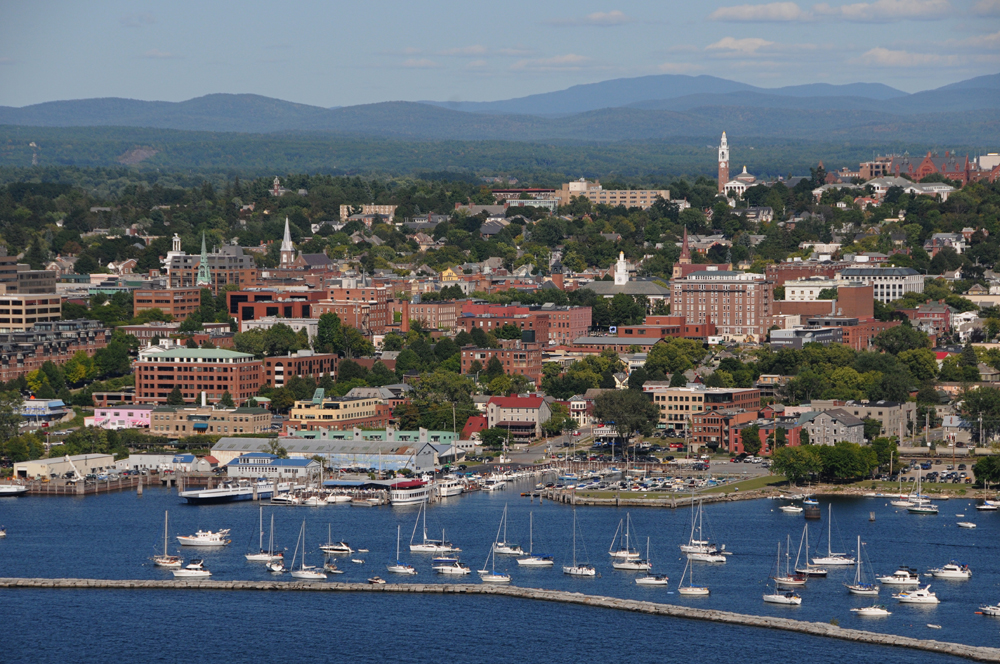
Lake Champlain Burlington, Vermont.

Perhaps, perhaps not. In Burlington’s favor is a higher rate of employment growth than (3 percent, from 2014 to 2015) than most anywhere else in the state.

On the other hand, employment here might well grow even faster if more workers from the provinces could afford to live here.

California’s sideshow

Nowhere, seemingly, is the U.S. housing crisis more acute than in California.

GG1

So you might suppose that here, in unassuming, modestly-overpriced Vermont, we can safely ignore what’s unfolding in California. To the contrary, it does make sense to pay some attention, for these reasons:


  • California social trends and public policies have a way of diffusing through the rest of the country. Not only that, middle-class Californians, in exodus because they’ve been priced out of the housing market, are moving in droves to other parts of the country and effectively bidding up housing prices in the places where they relocate.
  •  Sundry housing-affordability initiatives in California might give us some ideas about what to do here. San Francisco has a Nov. 3 election with a ballot full of affordable housing measures. Redwood City, to the south, just approved an affordable-housing impact fee over developers’ objections. People in L.A. are looking into the prospects for land trusts, something Vermonters already know a fair amount about. And as we’ve mentioned before, school districts are facilitating workforce-housing developments merely to attract and retain teachers.
  •  California generates much of what we consume here as mass-media entertainment, so we should be aware of the social context.
  •  Unavoidably, the part of entertainment value in what we’re hearing about the extraordinary California housing market, especially the one in the Bay Area, is in the form of Schadenfreude. Apparently, “there goes the neighborhood” applies when Apple employees start moving in.

Any dreams you have of moving out there should be dispelled by this short film, “Million Dollar Shack,”

a middle-class lament is filled with tales of egregiously over-priced properties, skyrocketing rents, absentee overseas investors, etc.


Stuck in the middle

Couple with daughter together in front yard
 

Middle-class financial struggles have occupied the public discourse for some time, but wouldn’t you know, we’re starting to hear more about housing unaffordability as a stresser for this beleaguered population segment.

The annual “State of the Nation’s Housing” report from Harvard took note this summer:

While long a condition of low-income households, cost burdens are spreading rapidly among moderate-income households. The cost-burdened share of renters with incomes in the $30,000–45,000 range rose 7 percentage points between 2003 and 2013, to 45 percent. The increase for renters earn­ing $45,000–75,000 was almost as large at 6 percentage points, affecting one in five of these households. On average, in the ten highest-cost metros—including Boston, Los Angeles, New York, and San Francisco—three-quarters of renters earning $30,000–45,000 and just under half of those earning $45,000–75,000 had disproportionately high housing costs.”

Granted, much of the news about middle-class housing unaffordability is coming out of the big cities – places where “middle income” is construed to reach far above Vermont standards. For example, Cambridge, Mass., is taking steps to reserve a share of “affordable” housing in a new Kendall Square building for families with incomes in the low six figures! San Francisco is also considering measures that would expand affordable housing eligibility and help out renters in the $100,000 to $140,000 bracket. And Portland, Ore., where the “housing emergency” is apparently wide-ranging, is looking at a form of inclusionary zoning that make apartments available to people making 100 120 percent of the median income (Up to $96,875 for a family of four).

Perhaps it’s a testament to the severity of the housing crisis around the country, and/or to the fragility of the middle-income stratum, that the terms “middle class” and “subsidy” are suddenly being spoken in the same breath.

middle2

Here’s the thing: To qualify for most subsidized housing, applicants can’t earn more than 80 percent of the local median income. Where does that leave people who draw an average salary, or perhaps a little more? Perhaps in a place where they can’t readily afford housing but can’t get any help, either. How many such people there are in Vermont is unclear; plenty, no doubt.

(Note: Middle-income earners are not beneficiaries of Burlington’s inclusionary zoning ordinance, which aims to provide affordable rentals for people earning up to 65 percent of the median; and for sale, up to 75 percent.)

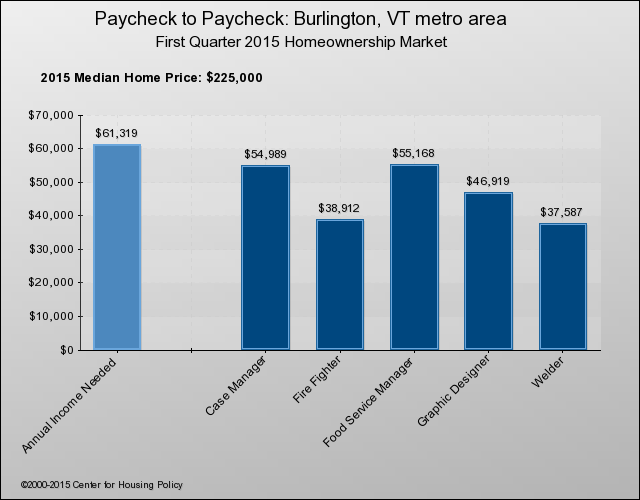
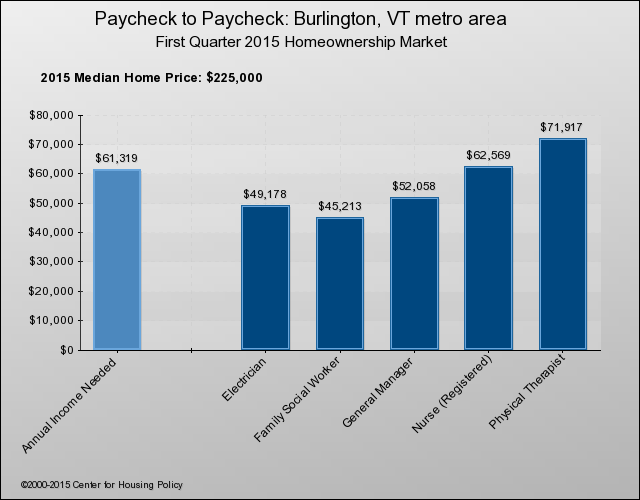
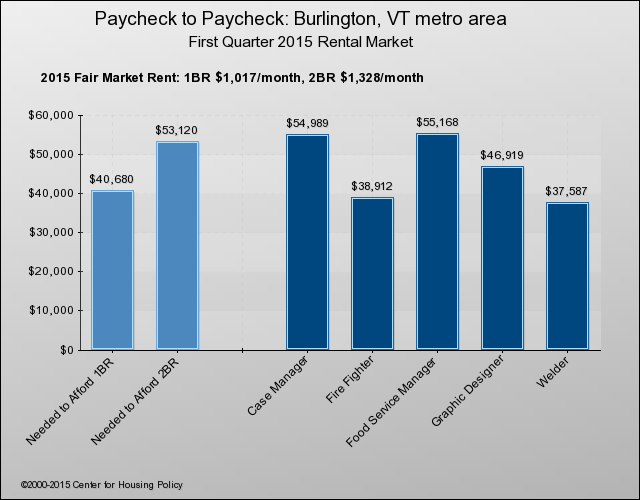
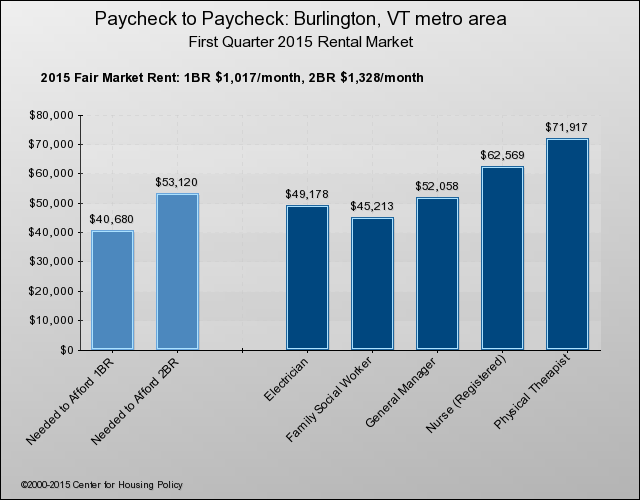
For an illustrative display of how housing costs compare to standard incomes, the National Housing Conference’s interactive “Paycheck to Paycheck” shows bar graphs for each of the nation’s metro areas – and just one in Vermont, Burlington/South Burlington. One graph compares salaries to the pay needed to afford a median-priced home; another does the same thing for 1- and 2-BR apartments at HUD’s “fair market rent.”

Below are the charts for 10 occupations that might be considered to be middle class. As you can see, eight of the 10 would be hard pressed to afford purchase of an average home in Burlington:

paycheck3


paycheck5


They do a little better in the rental market, but still, six of 10 can’t comfortably afford a two-bedroom apartment in Burlington:

paycheck4


paycheck6


Vermont dreaming … in California

Vermont fantasies can take many forms, but one has to wonder: Where are the Vermont brand police when you need them? Not in California.

Consider “The Vermont,” a luxury, high-rise apartment complex in L.A.’s Koreatown that promises “sky-high decadence.” Here’s the web page’s come-on (“bask in paradise seven stories up”):

vermontcover

Hmm, doesn’t look much like Vermont (come on, we have only a handful of buildings higher than six stories in the entire state!) , so where might the name have come from? Perhaps from Vermont Avenue, which runs alongside and is one of L.A.’s longest thoroughfares.

Why that street is named for Vermont is another question. A quick Google search didn’t provide an answer, but it did turn up this 1874 photo of an area where Vermont Avenue was later platted:

vermontave1

That’s more like it.

Now, you may consider all of this off-topic for a housing blog, but bear with us…


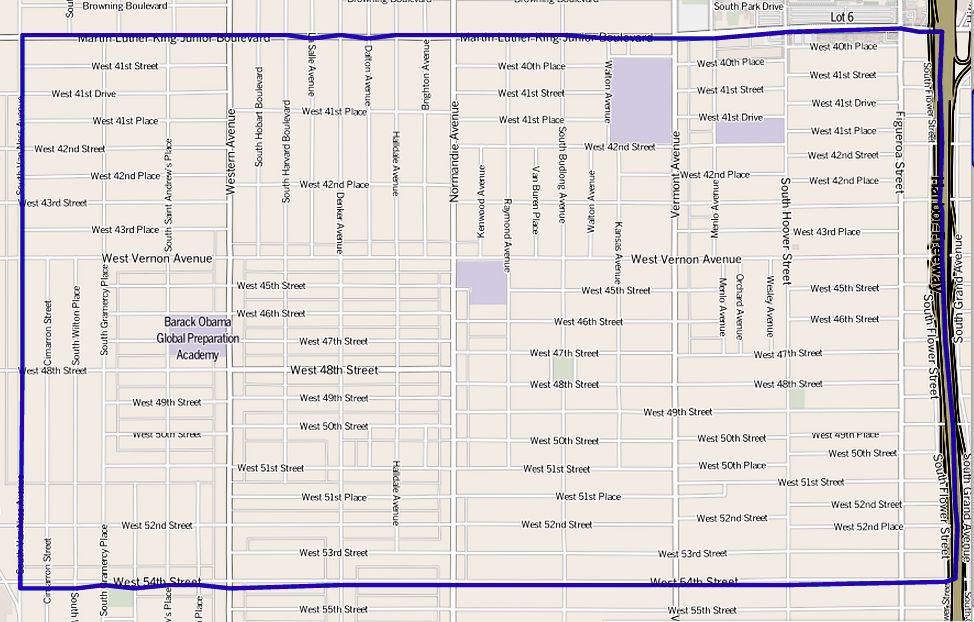
There’s another curious Vermont vestige in L.A. that’s more than a century old, called Vermont Square. It’s a section of south Los Angeles (Vermont Avenue runs through it) that’s among the city’s most densely populated areas.

Vermont_Square,_Los_Angeles,_California


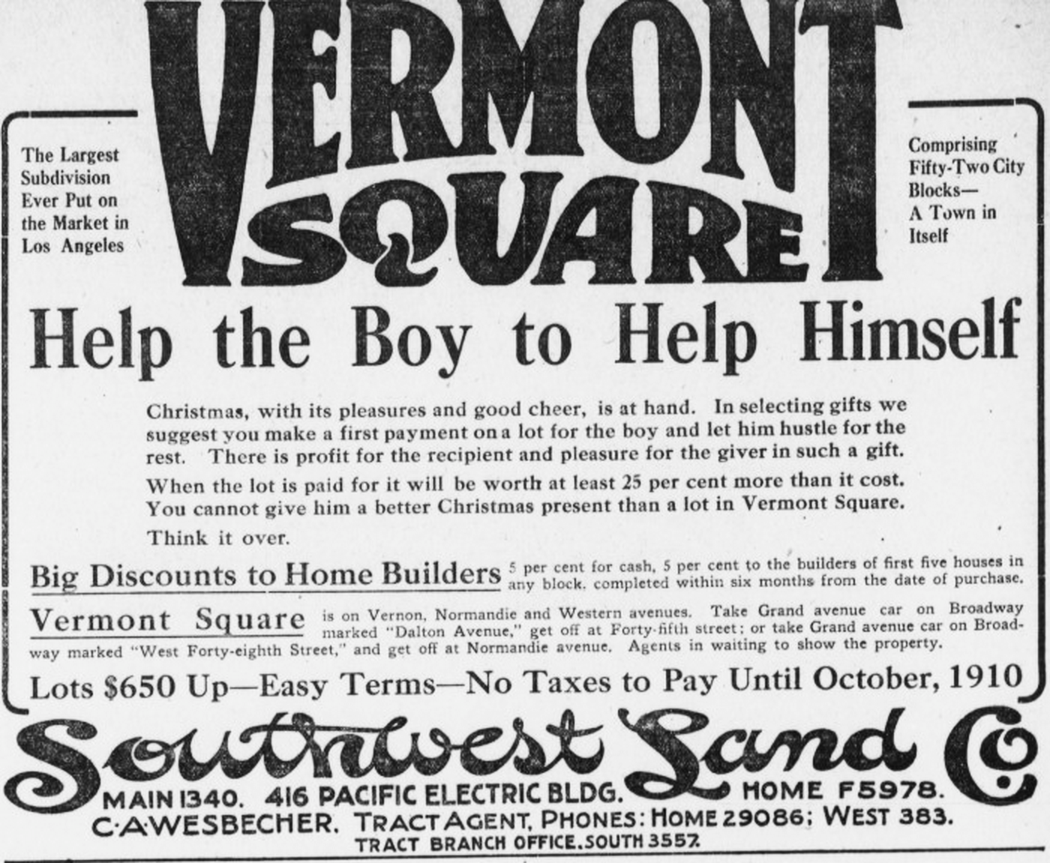
“Vermont Square” apparently was a developer’s name for what, in the early 20th century, was a huge subdivision — “the largest ever put on the market in Los Angeles,” according to this 1909 newspaper ad, “comprising fifty-two city blocks – a town in itself.”

vermontsquaread1909

That doesn’t seem particularly Vermont, either.

Back on Vermont Avenue, we learn that one of its southern segments is known as “death alley,” with one of the highest homicide rates in the city.

That’s certainly not very Vermont, so we’ll retreat to “The Vermont,” on the corner of Vermont Avenue and Wiltshire Boulevard. What are apartment rates?

A corner two-bedroom-two-bathroom suite, about 1,000 square feet, “starts” at $2,890.

vermontcorner

Finally, an unmistakable Vermont quality! Unaffordability!


Variations on a sordid theme

“Forty families on one lot, using one water faucet. Living in barren one room huts, they were deprived of the glory of sunshine in the daytime, and were so poor they could not even at night use the electricity that is to be generated by our great river…

“I found one family that might almost be called typical. Living within one dreary room, where no single window let in the beneficent sunlight, and where not even the smallest vagrant breeze brought them relief in the hot summer – here they slept, here they cooked and ate, here they washed themselves in a leaky tin tub after carrying the water for 100 yards. Here they brought up their children ill-nourished and amid sordid surroundings…”

The speaker was Congressman Lyndon B. Johnson, in his home district of Austin, describing the “slum tarnish” he observed during a Christmas Day walk through town. He made his remarks in a radio address to his constituents (this was well before LBJ himself got into the radio business), hoping to win their support for something new in town: public housing. The address became known as his “Tarnish” speech.

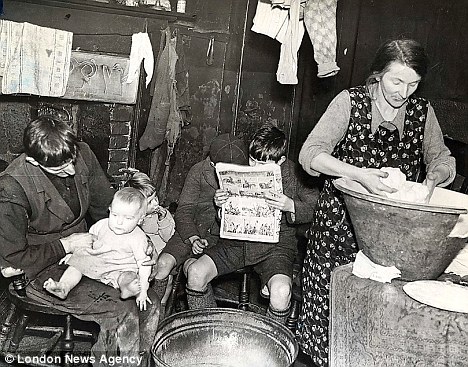
Here’s a photo (albeit not from Texas) that seems to capture what he was talking about:

slumscene


Thirty years before he orchestrated the passage of the Fair Housing Act as president, Johnson – whose ambition as a young congressman is captured by this 1937 photo of him shortly after his election, with FDR in Galveston – prevailed in that housing campaign.

lbj1938B

The first public housing in the country built under the 1937 housing act was in Austin. It was segregated, like most public housing that sprang up around the country over the next few decades, but less sordid than what they replaced. LBJ used that word – sordid – to good effect at HUD’s inauguration, when he declared: “Our cities and our new urban age must not be symbols of a sordid society.”

“Sordid” might be an apt description for some blocks of big-city, high-rise public housing, thoroughly segregated, underfunded and bereft of hope, if not sunlight. High rises came into planners’ favor in the ‘40s, but a couple of decades later they were not. For a tidy history of public housing, click here.

Some argue that public housing outside the big inner cities has worked quite well, and perhaps that can be said for places like Vermont, which apparently got into public housing fairly late in the game. (Burlington’s housing authority dates from 1961, and the state’s, from 1968.) If a history of Vermont’s public housing hasn’t been written, it’s a thesis topic in waiting.

Carrots and sticks

Affirmatively furthering fair housing (AFFH) is a recurrent theme on this website, so if you’re still not conversant with the phrase, today’s post is another opportunity. Essentially, the AFFH rule issued by HUD over the summer represents a reinvigorated push to promote inclusive communities and to break up concentrated areas of segregation and poverty that the 1968 Fair Housing Act was intended to dispel.

AFFH

If for no other reason, you should become familiar with AFFH because it’s a key addition to contemporary American civil rights vocabulary. You can bone up on previous posts here,  or here, or delve in to some of this website’s Resources.

And if you’re a citizen committed to supporting affordable housing development in mixed-income, higher opportunity areas, your role may be important than you thought. Consider this excerpt from an essay by Michael Allen, a partner in the civil rights law firm of Relman, Dane & Colfax and one of the leading legal lights nationally in fair housing litigation:

“What HUD produced is a Final Rule long on ‘carrots,’ but painfully short on ‘sticks.’ To compound that problem, HUD does not currently have—and is very unlikely to acquire—sufficient resources to police the compliance of 1200 block grant recipients and 3400 public housing agencies. As a consequence, the promise of the Affirmatively Furthering Fair Housing (AFFH) mandate is likely to be realized only in communities where grassroots and legal advocates mobilize and create their own enforcement strategies. The success of the Final Rule will depend on this grassroots mobilization, on a community-by-community basis, all over the country. That means advocates, collectively, need to step up to the plate and provide the tools and resources for a sustained ‘ground game.’”

As for “carrots” that municipalities can offer for affordable housing development, the Fair Housing Project’s own Ted Wimpey offered a nice summation in his August testimony to the Vermont Advisory Committee to the U.S. Commission on Civil Rights: inclusionary zoning, density bonuses and impact-fee reductions, among others.