Category Archives: fair housing

Fair Housing Friday: “Is Building More the Cure?”

Our last #FairHousingFriday of Fair Housing Month 2022 left us with a lot to consider. Featuring Bor Yang, Executive Director of the VT Human Rights Commission; Owiso Makuku, CEO of Main Street Landing and VT Affordable Housing Coalition Steering Committee Member; and Elizabeth Bridgewater, Executive Director of Windham & Windsor Housing Trust, we discussed how relying on development alone won’t ensure housing opportunities for the communities with the greatest housing needs in Vermont. This conversation highlighted how housing opportunities are not equally accessible to all low-income Vermonters and presenters shared tools and policy ideas that could be considered to ensure housing equity and housing opportunities for our most vulnerable Vermonters

We heard from panelists about how climate migration – still lead predominately by people with the resources to move- is already impacting housing opportunities for potential first-time home buyers across the state, especially in Southern Vermont. We also heard about how employers are taking on the burden of finding housing for their employees in an effort to meet their workforce needs. Of the tools listed to further equitable housing opportunities, panelists pointed to zoning reforms like inclusionary zoning policies, critical looks at minimum lot sizes and how that curbs what kind of housing is developed, and allowing for more multi-family housing such as duplexed, triplexes, and larger apartment developments. Also highlighted was the need to modernize municipal bylaws that could inadvertently be posing barriers to developing in communities across Vermont.

Unfortunately, audience members are left with the knowledge that often it is the vocal minority that gets in the way of developing new affordable housing, and that housing discrimination continues to impact communities of color, new Americans, folks with disabilities, and renters with children on a wide scale. And discrimination is challenging to track as it is so hard to report, and those with the greatest housing needs may not know their rights, but often are so taxed by trying to meet their own housing needs that they are unable to report the discrimination they face. We are left with the with the responsibility to mobilize in our own communities to consider our regional housing equity gaps, and advocate for policies that not only encourage more housing development, but ensures that housing meets the needs of our community members who are most often overlooked and left behind from the housing conversation.

If you missed it, find the full recording below: 

Resources shared as a part of this Fair Housing Friday:

To learn more about Fair Housing Month and upcoming activities: https://fairhousingmonthvt.org/

To learn more and get help: https://www.cvoeo.org/get-help/fair-housing-and-discrimination

Our free Vermont Tenants workshops:
https://www.cvoeo.org/get-help/vermont-tenants-rights-and-resources

More information about the Human Rights Commission:
https://hrc.vermont.gov/

Vermont Housing Finance Agency on Home Ownership for BIPOC Vermonters https://vhfa.org/news/blog/future-strategies-promote-homeownership-opportunity-bipoc-vermonters

Vermont Housing Finance Agency on Understanding VT’s Vacant Homes: https://vhfa.org/news/blog/future-strategies-promote-homeownership-opportunity-bipoc-vermonters

Bylaw Mondernization Grants : https://accd.vermont.gov/content/bylaw-modernization-grants

Conversation with Elizabeth Bridgewater and Gus Seelig Addressing the Roots of Our Current Housing Crisis : https://vtdigger.org/2022/04/17/vermont-conversation-the-roots-and-way-out-of-vermonts-housing-crisis/
Stay tuned for our Fair Housing Month wrap up, and remember, these conversation MUST continue throughout the year. Thank you for joining us, and please stay in touch.

Fair Housing Friday: “Unique Challenges and Opportunities of Mobile Home Parks”

Our second #FairHousingFriday of the month was a fantastic hit! Hosted by Nate Lantieri of CVOEO’s Mobile Home Program, panelists included Kelly Hamshaw, Senior Lecturer at UVM Dept. of Community Development & Applied Economics; Gayle Pezzo, Board President of Westbury Homeowners Association; and Elise Shanbacker, ED of Addison County Community Trust.

Panelists covered a extensive array of topics in a short amount of time, from the challenges of financing infrastructure updates for mobile home communities, the challenges community members encounter with funding basic park maintenance such a plowing, and the unique ways mobile home communities are impacted by climate change.

We ended on a powerful message from Gayle Pezzo, Board President of the Westbury Homeowners Association in Colchester, VT. Gayle spoke to the ways a mobile home community uniquely met her needs as a retired, single person, and how joining the Westbury Homeowners Association board necessitated a level of civic engagement she did not anticipate as she advocated for her community to access municipal resources. At the conclusion of the conversation, Gayle pointed out the shift in language from “trailer park” to “mobile home community” had a powerful impact on the way mobile home communities are viewed, and her own connection to her neighborhood.

If you missed it, find the full recording below: 

Resources shared as a part of this Fair Housing Friday:

To learn more about Fair Housing Month and upcoming activities: https://fairhousingmonthvt.org/

To learn more and get help: https://www.cvoeo.org/get-help/fair-housing-and-discrimination

Our free Vermont Tenants workshops:
https://www.cvoeo.org/get-help/vermont-tenants-rights-and-resources

Resources available from USDA Rural Development here in Vermont : https://www.rd.usda.gov/vt

More resources for Mobile Home Parks through CVOEO: https://www.cvoeo.org/get-help/mobile-home-park-rights-and-resources

The Cooperative Development Institute (CDI) : https://cdi.coop/

Do NOT Miss Our Final Fair Housing Friday!

Friday, April April 29th 12:30 – 1:30 PM: “Is Building More the Cure?”

In this final Fair Housing Friday for Fair Housing Month, we will discuss how relying on development alone won’t ensure housing opportunities for the communities with the greatest housing needs in Vermont. Featuring Bor Yang, Executive Director of the VT Human Rights Commission; Owiso Makuku, CEO of Main Street Landing and VT Affordable Housing Coalition Steering Committee Member; and Elizabeth Bridgewater, Executive Director of Windham & Windsor Housing Trust.

And coming up this week:

  • Arts So Wonderful Art opening at the South Burlington University Mall! Friday April 29th from 4pm to 7 pm, or alternative dates at request. Read the full Call to Artists here

TONIGHTTuesday, April 26th:

Throughout the month of April:

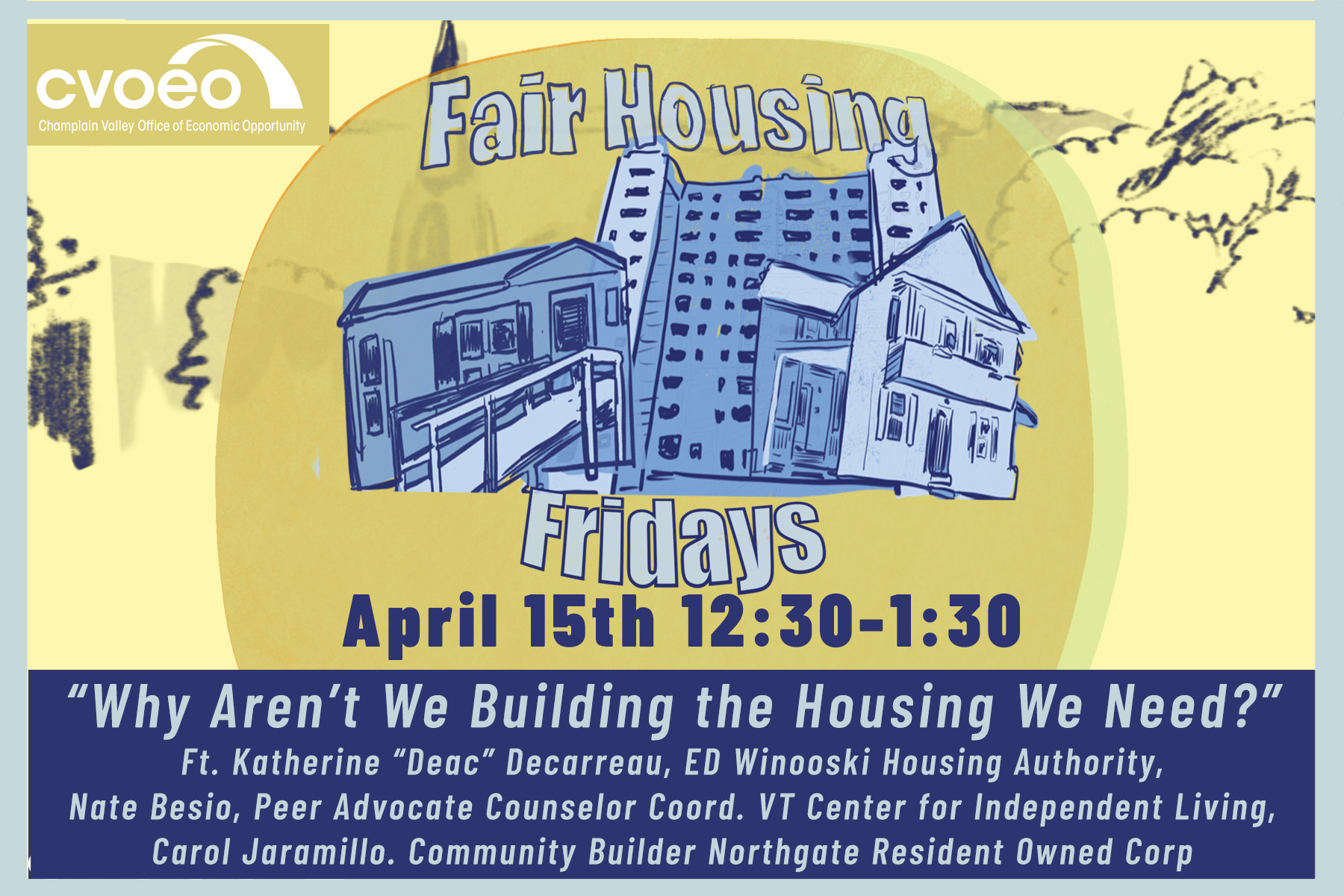
Fair Housing Friday: “Why Aren’t We Building the Housing We Need?”

Our first #FairHousingFriday of the month happened last week! Featuring Katherine “Deac” Decarreau, Executive Director of the Winooski Housing Authority, Nate Besio, Peer Advocate Counselor Coordinator at Vermont Center for Independent Living, Carol Jaramillo, Community Builder Northgate Apartments, and Bhagawat Pudyel from the Financial Futures Community Ambassador Program at CVOEO, this conversation focused on the barriers to housing development, what kind of housing we are building, and why (or why not) the housing we are developing meets the needs of our most vulnerable community members.

In this rich conversation on housing, we heard about barriers our current available housing poses to folks who fall into Fair Housing protected classes, such as families who rent, folks with mobility needs, and New Americans. We also discussed solutions advocates would like to see implemented, like housing opportunities for folks who are recovering from addiction and not yet ready to live independently, and creative affordable housing solutions that fit the unique needs of the neighborhood. We also talked about tools, such as inclusionary zoning, that municipalities, like Burlington, use to incentive affordable housing, but rules that disincentive developing housing that the community needs, such as 3+ bedroom apartments.

Join Us for Our Next Fair Housing Fridays!

If you missed it last weeks’, you can find our full recording below. 

Resources shared as a part of this Fair Housing Friday:

To learn more about Fair Housing Month and upcoming activities: https://fairhousingmonthvt.org/
To learn more and get help: https://www.cvoeo.org/get-help/fair-housing-and-discrimination
A finding housing resource: https://www.housingdata.org/find-rental-housing (you can search specifically for accessible units)

Home Access Grant Program, funding available for reasonable modifications: https://vcil.org/services/home-access-program/

And coming up this week:

Throughout the month of April:

Burlington City Hall Fair Housing Exhibit – Celebrate Inclusive Communities and the Importance of Home

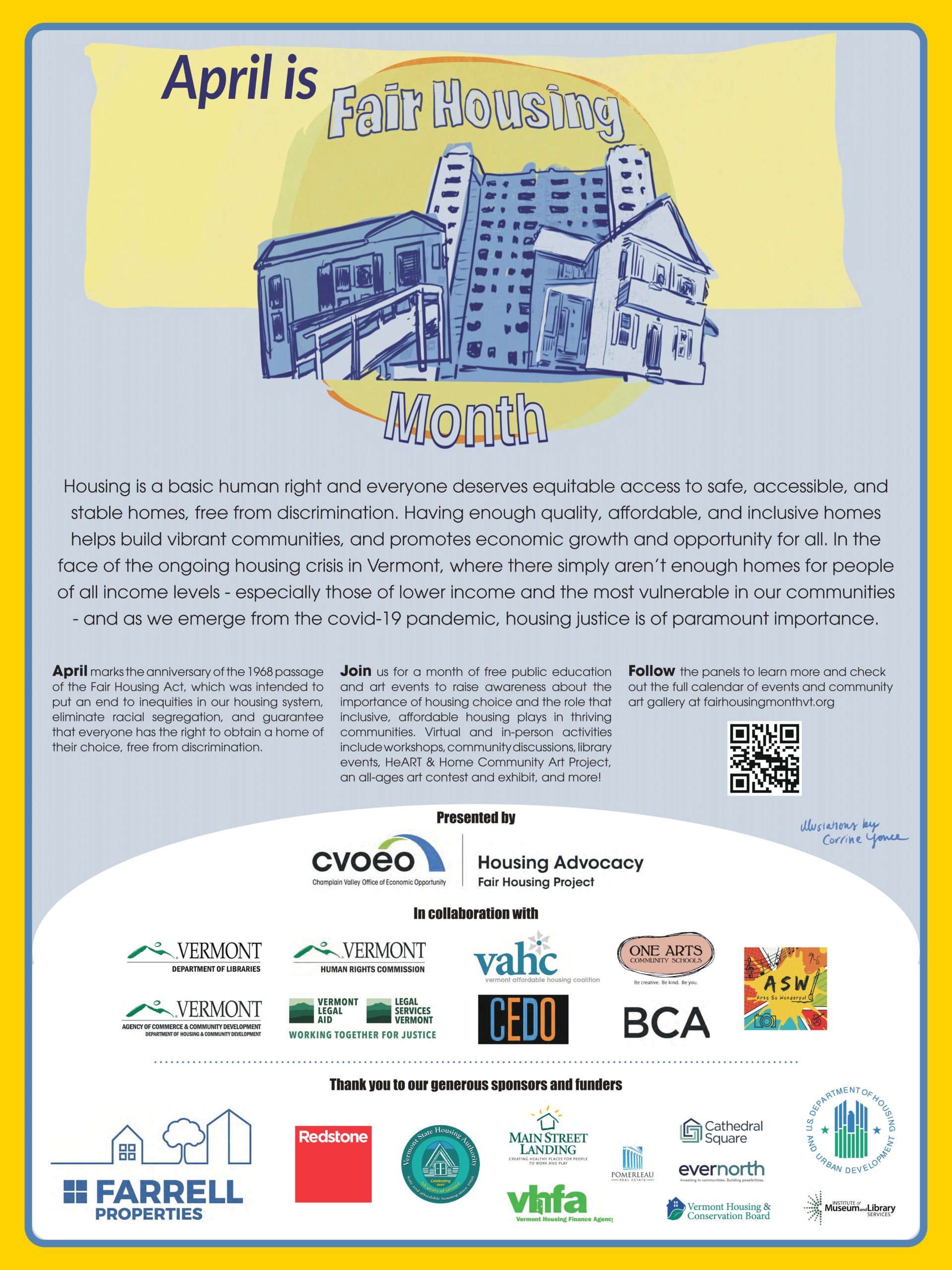
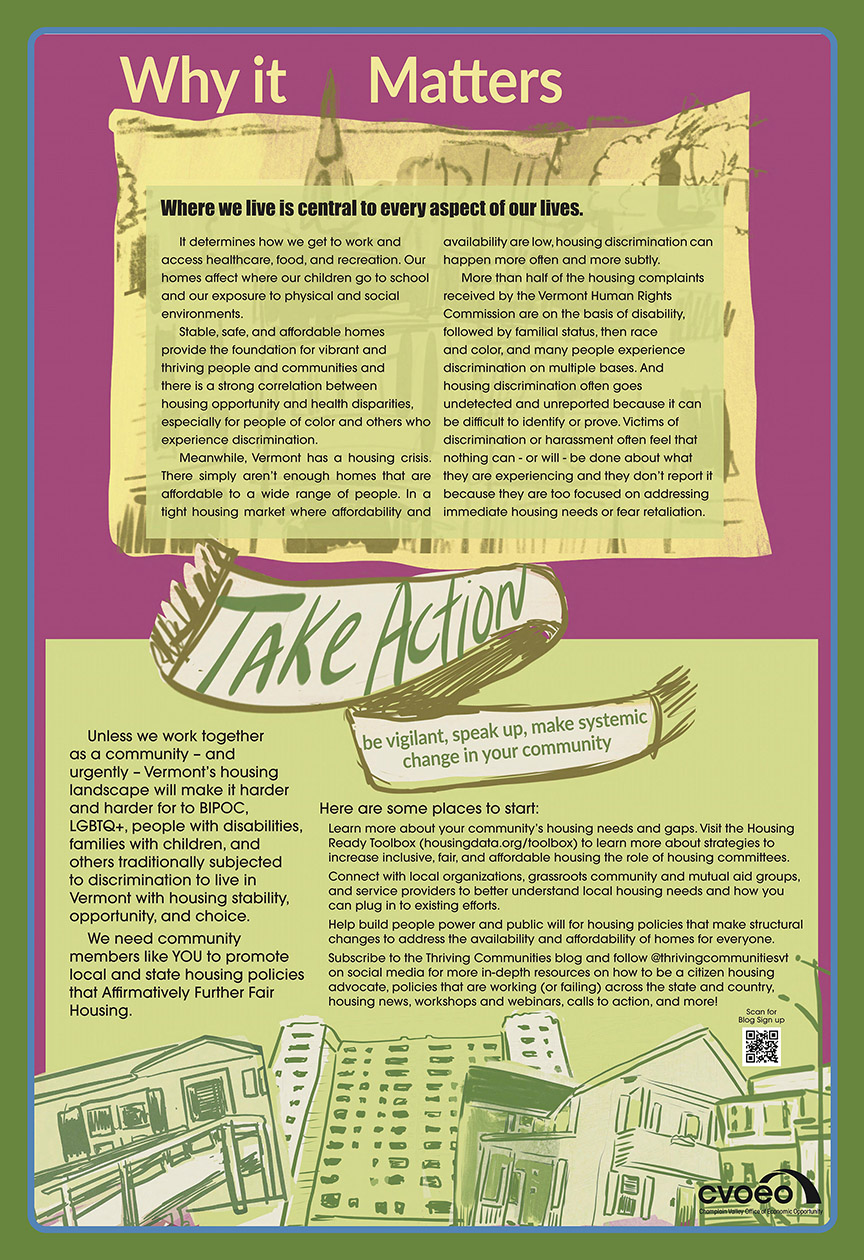
Housing is a basic human right and everyone deserves equitable access to safe, accessible, and stable homes, free from discrimination. Having enough quality, affordable, and inclusive homes helps build vibrant communities, and promotes economic growth and opportunity for all. In the face of the ongoing housing crisis in Vermont, where there simply aren’t enough homes for people of all income levels – especially those of lower income and the most vulnerable in our communities – and as we emerge from the covid-19 pandemic, housing justice is of paramount importance.

This week’s Fair Housing Month event- overview:

  • Thursday April 14th 12pm-1pmLandlord Management Series: Fair Housing :Join Angela Zaikowski of Vermont Landlords Association, Cole Elwood of Strong Will Real Estate /Keller Williams Vermont, and Jess Hyman of the CVOEO Fair Housing Project as they cover fair housing in Vermont
  • Thursday April 14th 6-8pmSEABA Virtual ‘Affordable Housing Roundtable’ : A roundtable for Burlington’s South End artists and businesses to better understand recent housing policy reforms and engage on innovative solutions to help tackle the affordable housing challenge in Burlington’s South End.
  • Friday April 15th 12:30pm Fair Housing Friday Why Aren’t We Building the Housing We Need?  Featuring Katherine “Deac” Decarreau, ED Winooski Housing Authority, Nate Besio, Peer Advocate Counselor Coordinator VCIL, Carol Jaramillo. Community Builder Northgate Resident Owned Corp, in this webinar we will hear about the barriers to housing development, what kind of housing we are building, and why (or why not) the housing we are developing meets the needs of our most vulnerable community members.

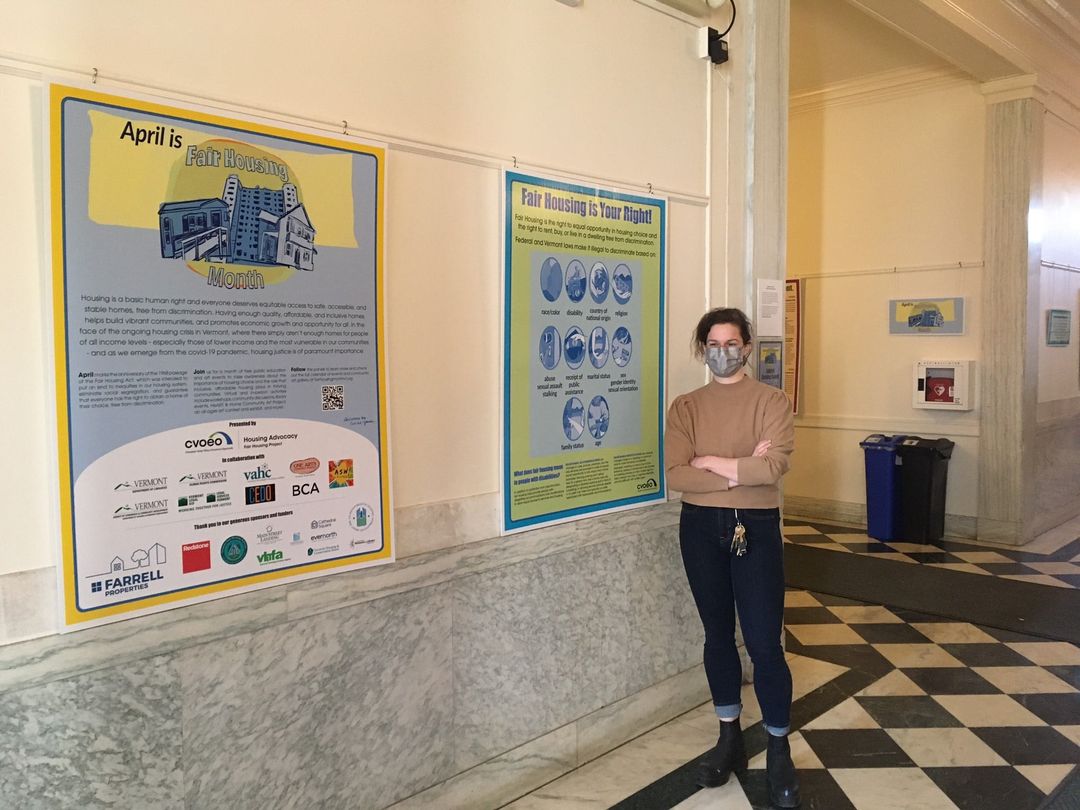
Visit the City Hall Gallery at 149 Church Street in Burlington to  check out CVOEO’s Fair Housing Project Fair Housing Month exhibit!  

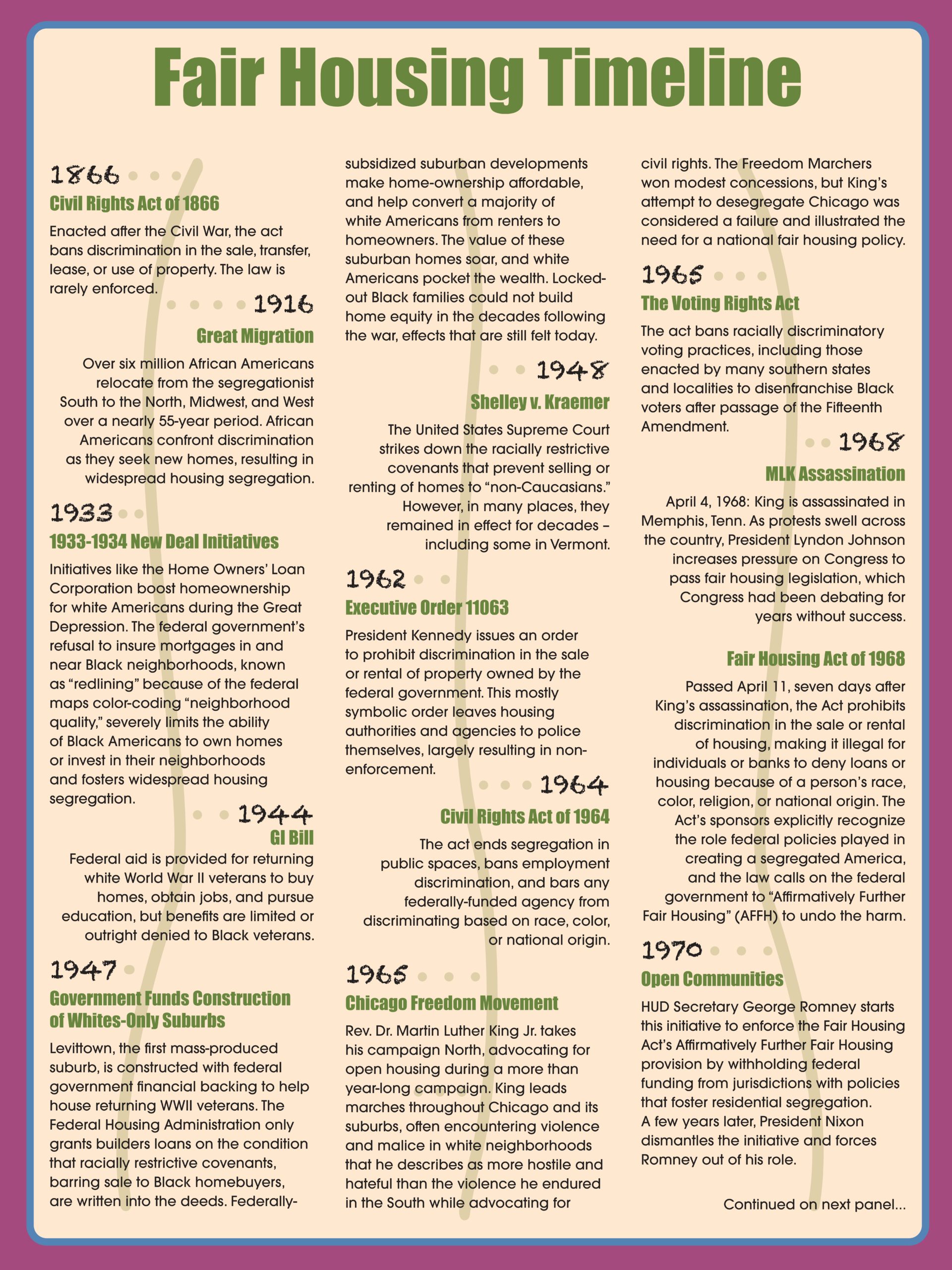
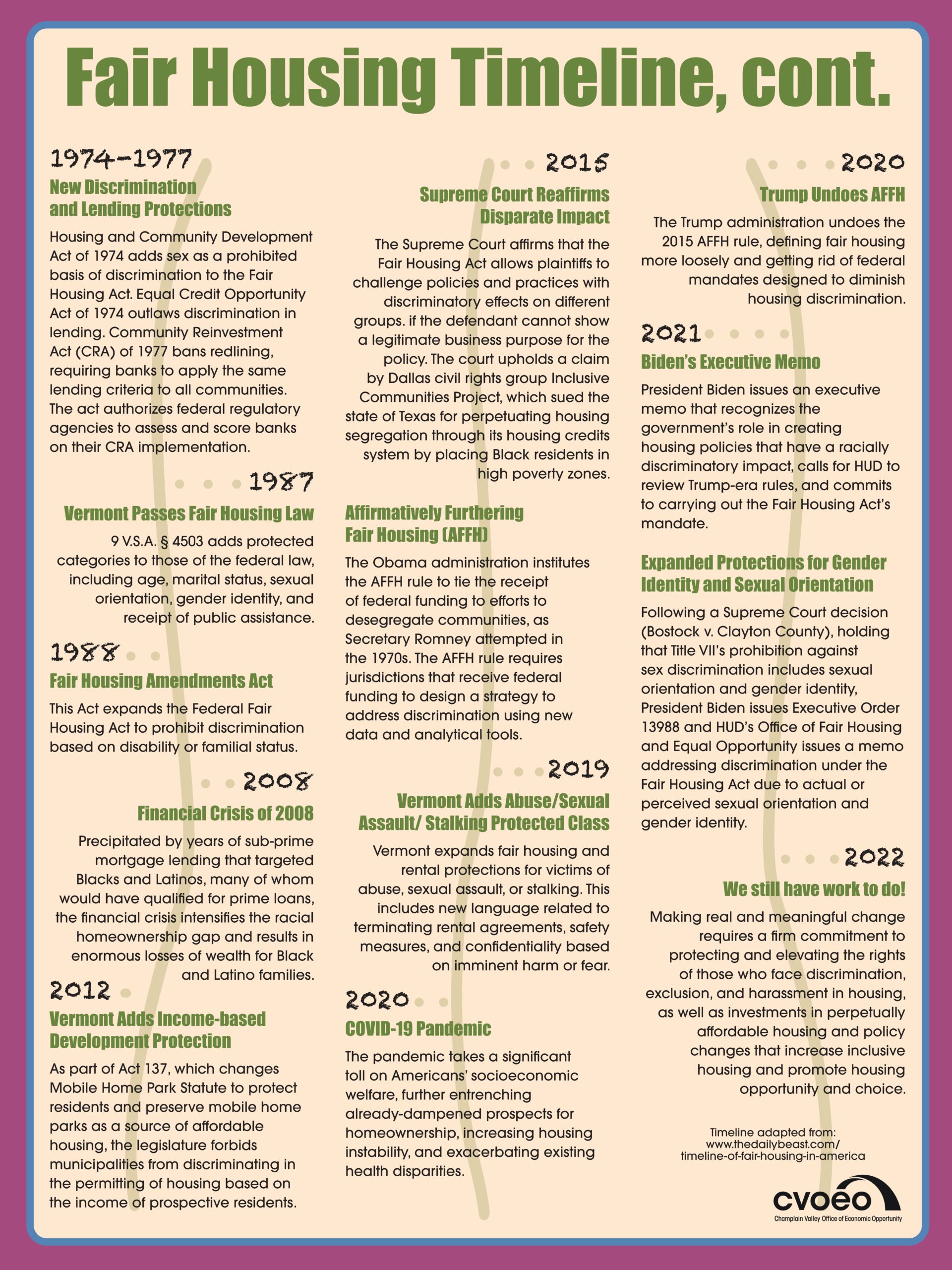
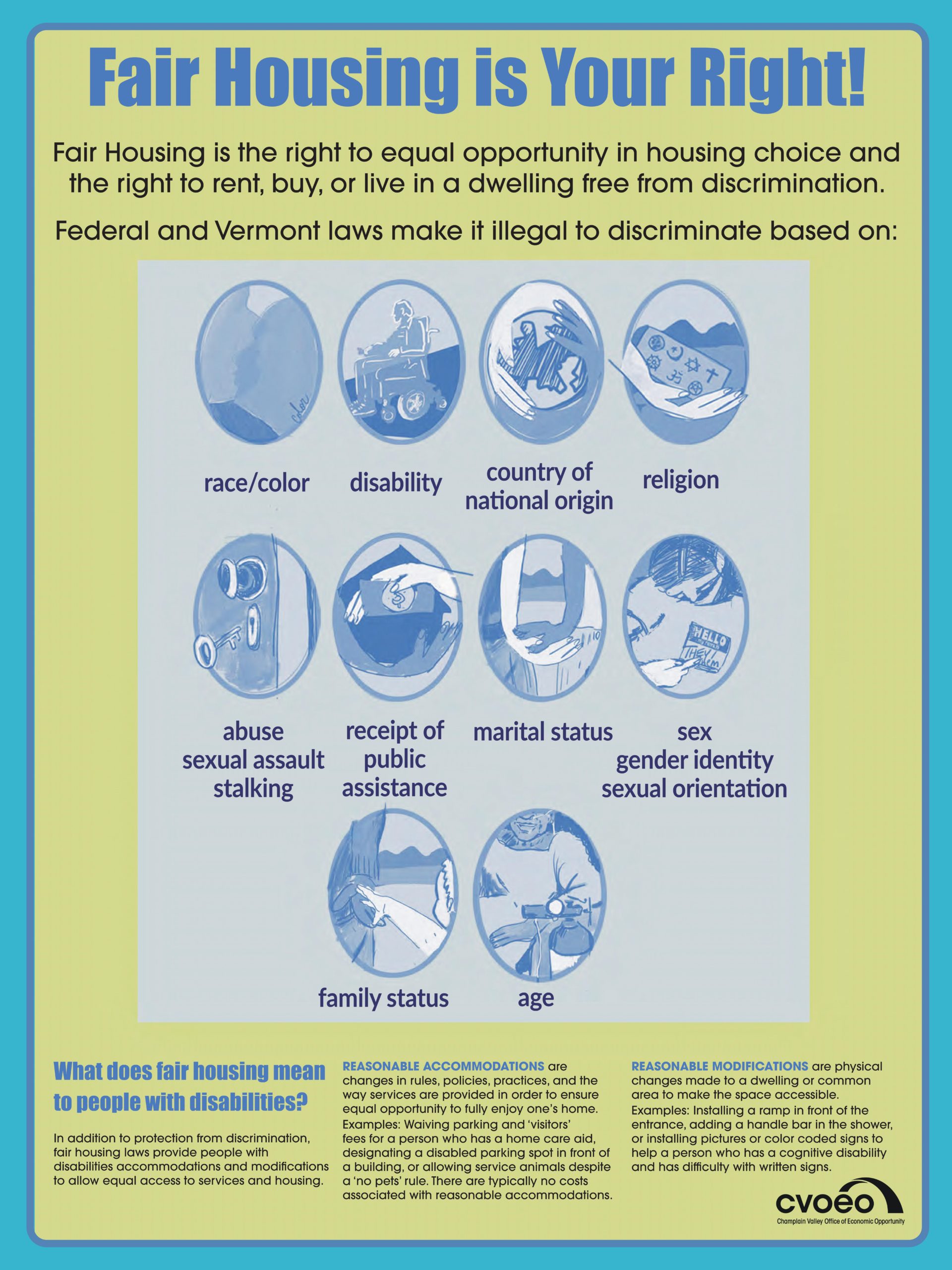
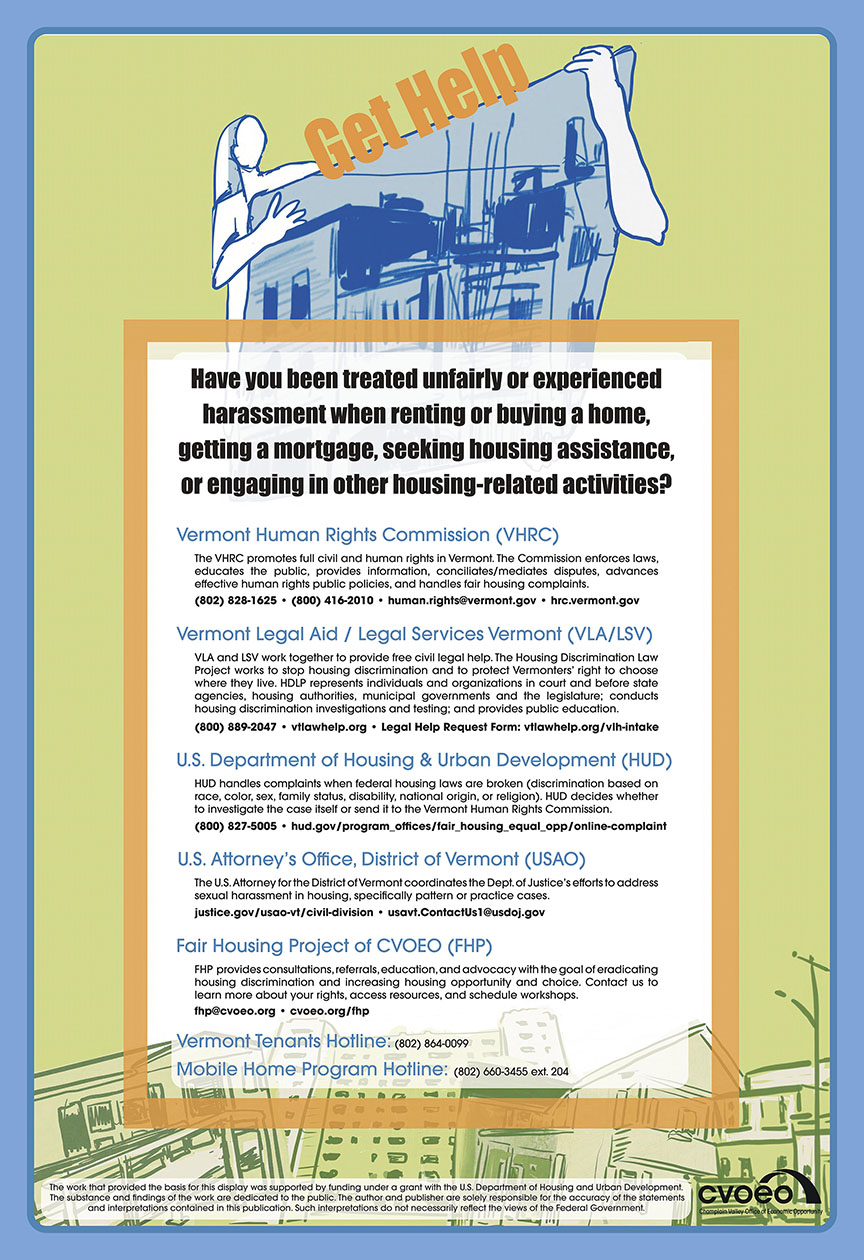
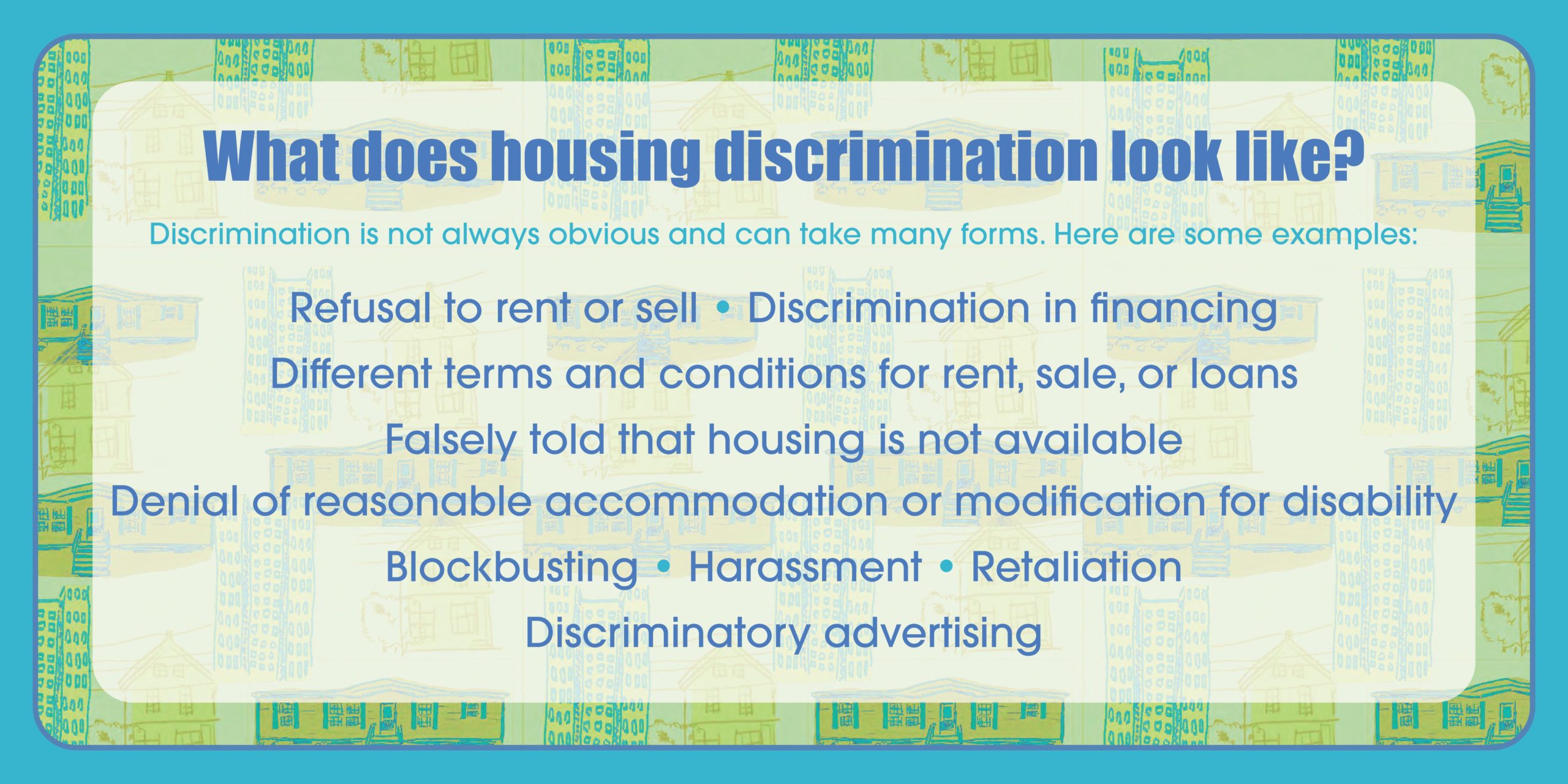
April marks the anniversary of the 1968 passage of the Fair Housing Act, which was intended to put an end to inequities in our housing system, eliminate racial segregation, and guarantee that everyone has the right to obtain a home of their choice, free from discrimination. Visit the City Hall Gallery at 149 Church Street in Burlington to learn more about the history of the Fair Housing Act, your rights and responsibilities under Federal and Vermont law, and how Fair Housing is connected to the challenges and opportunities of Vermont’s current housing landscape. These newly designed panels  feature our updated protected classes iconography, ways to become an advocate, and a brief history of Fair Housing

For those of you who cannot make it, you can view our PDFs below!

This exhibit was created by the Fair Housing Project of CVOEO with illustrations by Corrine Yonce.

Special thanks to Burlington City Arts & Vantage Press.

The Center & the Margins:

High School Students of Burlington City & Lake Semester Consider the Issue of Homelessness & Inclusive Housing

Continue reading The Center & the Margins:

New video highlights issues Vermonters face accessing safe, quality, accessible & affordable housing

It’s not a secret — Vermont is experiencing a housing crisis. There’s so much going on (high rents, escalating home prices, motel vouchers, eviction moratoriums, mobile home park affordability, housing discrimination) it can be hard to know what’s happening and what we can do about it. 

Four housing advocates join the Vermont Affordable Housing Coalition (VAHC) in this video series to highlight some of issues Vermont residents face accessing safe, quality, accessible and affordable housing—and how we must keep these multiple issues in mind as we increase investment in housing.

The video covers mobile home infrastructure with CVOEO’s former Mobile Home Program Resident Organizer Laura Mistretta; evictions in the aftermath of COVID19 with CVOEO’s Vermont Tenants Advocate Madeline Roberts; fair housing and discrimination with CVOEO Fair Housing Project Education and Outreach Coordinator Corrine Yonce, and broadband access with Evernorth Director of Asset Management Rewa Worthington.

In the words of CVOEO’s Corrine Yonce, “The creation of housing that starts happening this fall and will continue for a couple years because of this [federal] funding influx is going to impact the housing landscape and the overall community landscape of Vermont for decades to come. … We need to make sure that our new housing being created actually enables housing choice.”

NLIHC’s Out of Reach Report tells us what we already know: Vermont has a growing affordability problem – Here’s what we can do about it.

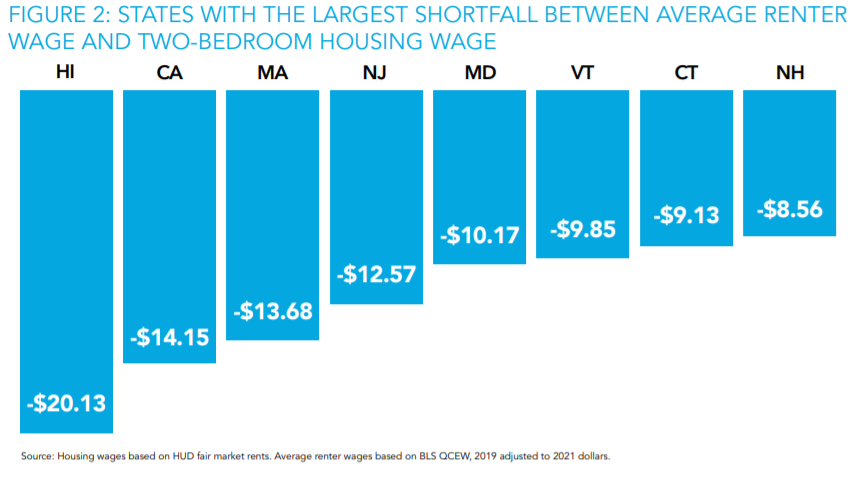
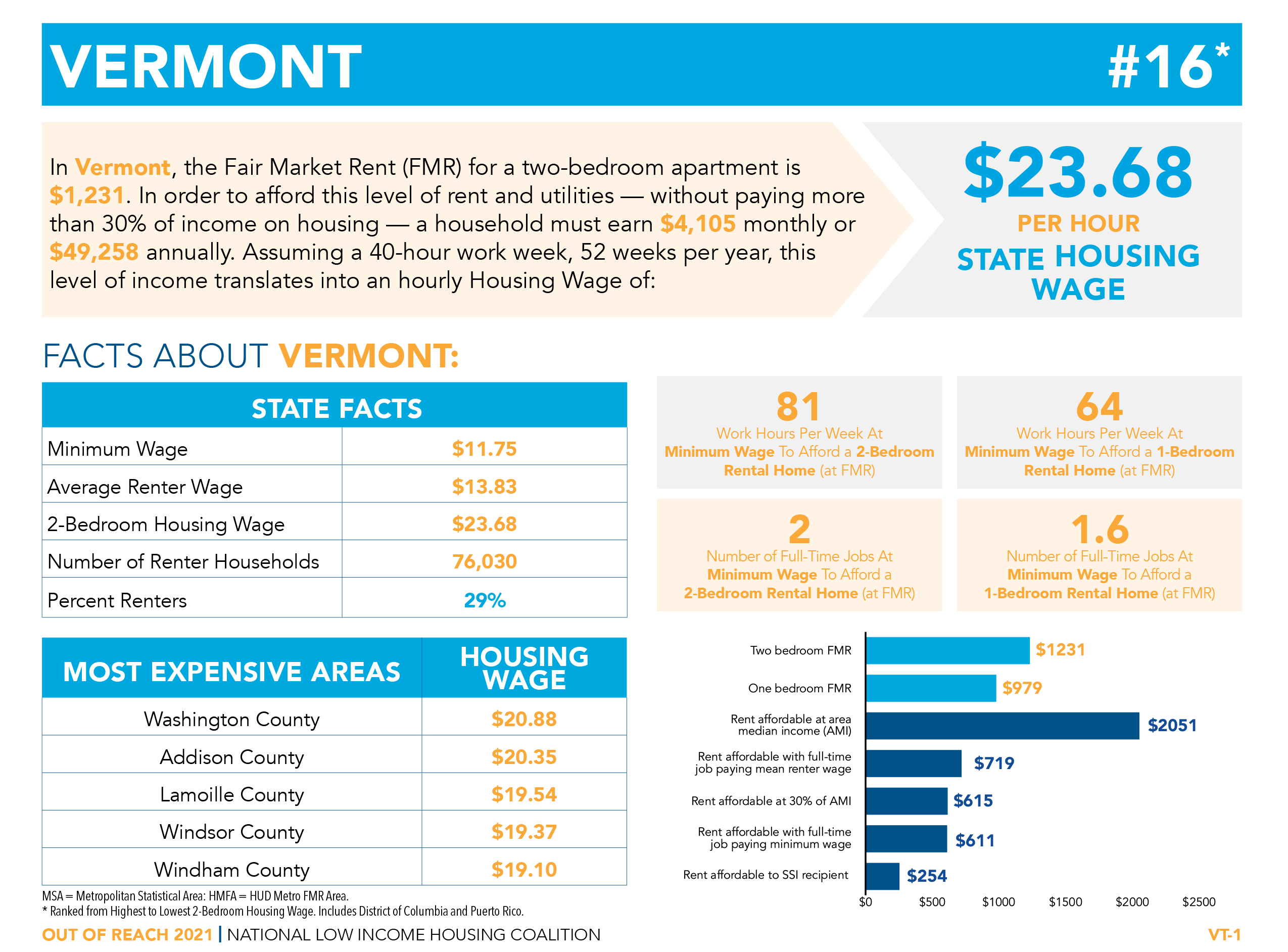
The recent release of the National Low Income Housing Coalition’s Out of Reach report shows that Vermont has the sixth largest shortfall between the average renter wage and the two-bedroom housing wage. In the Burlington/ South Burlington region, where the 2-bedroom housing wage jumps from the state’s average of $23.68 to $31.31, the housing wage gap is particularly acute. This means that full-time employees living in Burlington and South Burlington have to make $31.31per hour in order not to spend more than 30% of their income on rent. Meanwhile, the average hourly wage for Vermont renters is $13.83.

Source: Housing wages based on HUD fair market rents. NLIHC The Gap 2021 pg 5

“We’ve been in the midst of a chronic affordable housing crisis for many, many years,” Kerrie Lohr of Lamoille Housing Partnership, asserted to VTDigger earlier this week, “This report pretty much shows what we already know to be true, is that housing is out of reach for many of Vermont’s renters.” What housing advocates have been seeking to address over the course of Vermont’s long housing affordability history crisis has become especially acute during this past year. While Vermont’s housing sales spiked 38% this past year, many of these new residents purchased with cash-on-hand, often significantly over the asking price, with sales of million dollar homes almost tripling.

These numbers are particularly concerning when we turn an eye to Vermont’s pattern of racial inequity. This year saw rates of COVID doubling in communities of color, highlighting the disparities in health and economic opportunities for People of Color in Vermont. Nationally, the home ownership rate of White households is 70% to the 41% of Back homeowners, a gap caused and reinforced by a pervasive history of racist housing policies, inequal lending, and lack of meaningful policy change to address this systemic problem. Vermont’s homeownership gap is much larger with only 21% of Black households owning their home compared to 72% of white households. Local student activist (and current Fair Housing Project intern) Minelle Sarfo-Adu spoke to VPR about experiencing this stark disparity in her South Burlington community, “I think I only have two African American friends in the whole — like in all Vermont, that actually own homes,” she said. “Other than that, every other one of my friends actually rents, unless they’re white. All my white friends actually own their homes.”

The severe affordability crisis in Vermont creates an environment where landlords can be more discriminative in who they rent to. For renters who belong to the Fair Housing protected classes and face the greatest barriers to housing access in our state, this means longer and more desperate housing searches. While housing advocates are certain that most discrimination goes unreported, testing performed by the Housing Discrimination Law Project of Vermont Legal Aid indicates that housing providers generally disfavor African American renters, renters of foreign origin, renters with children and renters with disabilities. Reports from the CVOEO Vermont Tenants hotline and housing community forums are riddled with stories of people being turned away from housing because of a housing voucher or for having children (both violations of the Fair Housing Act in Vermont), and of desperate housing decisions such as signing leases before viewing the property or even offering to pay more than the listed monthly rent.

So what do we do about it? 

“Treat the housing emergency like an emergency,” retorts the collective voice of Anne N. Sosin, Mairead O’Reilly, and Maryellen Griffin in their recent VTDigger commentary, “Housing is a Public Health Crisis in Vermont.” Sosin is a policy fellow at the Nelson A. Rockefeller Center at Dartmouth College; O’Reilly is a medical legal partnership attorney at Vermont Legal Aid; and Griffin is a housing attorney at Vermont Legal Aid. Housing activists, policy makers, and the broader population of Vermont need to act now to address this growing problem, they wrote as they shared the major lessons housing advocates have gleaned from this past year of COVID response. Their voice has urgency, as some key opportunities to enhance renter protections have already passed. These key missed advocacy moments include the veto of the Rental Housing Safety Bill and a failure to delay the ending of the State of Emergency – which had expanded shelter space for houseless folks through federal CARES funding – until more rental housing was made available. Some economists and sustainable communities experts caution this trend is only at its early fruition as climate change pushes folks from more geographically vulnerable locations.

Much of what Sosin, O’Reilly, and Griffin called for is still possible. Mobilize a statewide response,” they stated, noting that these solutions will be unique to the region and therefore require regional solutions. Our Fair Housing Friday panelists this spring noted that creative solutions require broad civic engagement, especially from those most impacted by the growing inequity of available resources. Housing Committees are a critical tool to mobilizing regional solutions to a statewide problem and can jumpstart conversations at the community level. The common thread  running through all these solutions is that they must center the needs of the communities consistently facing the highest barriers to housing.