More housing-crisis dispatches

Another of our occasional samplers on the unaffordability epidemic:

  • As Seattle wrestles with housing unaffordability, an op-ed in the local paper recommends looking to Berlin!

berlin2

Germany’s largest city, newly flooded by young people and immigrants, has a population of 85 percent renters and has introduced a new form of rent control — the “rental price brake,” which seeks to rein in rent increases. (Median rents have gone up 50 percent in six years, by one account.) And government has imposed other constraints – on renovations (can’t be too fancy without approval) and on conversion to vacation homes. Well, that may sound promising, but to what effect? Protesters are in the streets, we learn in the Wall Street Journal, as “Berlin’s Housing Problems Boil Over.”

Unicode

  • In Edina, Minn., a suburb of Minneapolis, 96 percent of the housing stock is unaffordable to a family of four earning $43,000 annually. So, the City Council is considering a form of inclusionary zoning with a buy-out provision. New developments would have to include 10 percent affordable units, or that requirement could be waived if the developer pays $220,000 per unit into a city fund to support affordable housing. Now, that’s not a new idea, but the buy-out figure looks rather high (Burlington’s is $100,000 per unit), and of course, there’s the concern that any new housing developed by the city not lump all the lower-income people together in their own blighted enclave.
  • In Columbus, Ohio’s Franklin County, more than 24,000 people applied for Section 8 vouchers from an agency that is prepared to give out … 200, followed by 70 a month. That’s in a county where 13,000 vouchers are in use.
  • In Miami, old people camped out overnight just so they could file applications to live in an affordable senior housing complex.
  • In Portland, Ore., the newly declared “housing emergency” is expected to last at least a year.
  • And in Palo Alto – we know, we know, this is Silicon Valley and expected to be unaffordable beyond  imagining – a local man and college graduate who earns a “decent salary” is living with his parents because he can’t afford an apartment. He graduated from Palo Alto High 20 years ago, so he’s too old to be a Millennial! Here’s what he told the City Council about himself and his cohorts:

“All of us went to great colleges, great grad schools, and not one of us can live in the city.”


So much for artists’ affordable housing

When Burlington’s mayor announced that he would not support housing in the South End’s Enterprise Zone, he won cheers from artists who feared gentrification. While the mayor’s isn’t necessarily the last word in “Plan BTV South End,” the product of extensive public input (or so the city proudly insists), it does stack the odds against any kind of housing in the zone.

Too bad. One of the more intriguing prospects raised in the draft plan was to create work/live spaces – aka, affordable housing – for artists. Could that be done deftly in some of those South End warehouses without gussying up the surrounding neighborhood and driving up rents for everyone else? Maybe, maybe not, but it seems a shame not to consider this. A blanket ban on housing seems to foreclose the possibility.

southend

Well, it’s a possibility that’s being embraced elsewhere, all around the country – in little towns and big cities, both. “Colorado’s affordable artist housing efforts catching on quickly,” read a headline in Saturday’s Denver Post. Artspace, out of Minneapolis, has been developing work/live artists’ lofts for more than 20 years – but apparently none yet in New England.

If Burlington’s artists aren’t interested, perhaps their counterparts in other warehouse-rich Vermont towns might be. Bellows Falls, Springfield, Rutland, Brattleboro, among many others? Here’s the view in Colorado, according to the Post article:

“The hope is that some rural projects will have the added advantage of preserving historic structures in need of attention. That makes Trinidad, with its excess of significant, and underused, buildings, a good candidate for the pilot program…”

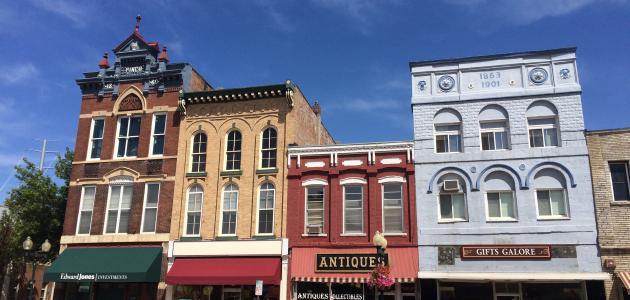
Check out what’s been done in Fergus Falls, Minn. (pop. 13,300)…

fergus

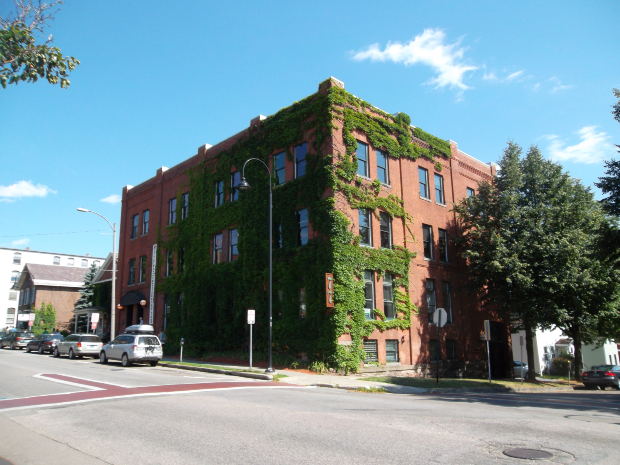
or  Hastings, Minn. (22,400).

hastings

If you’re looking for an example of a dreary warehouse transformed, look at Council Bluffs, Iowa …

council bluffs

or even Memphis – which is fashioning an arts district around its project.

memphsis

Now, it may be that some of projects, the affordable housing notwithstanding, have contributed to surrounding gentrification. But if so, did it have to be that way? Municipal planners take note.


Carrots and sticks

Affirmatively furthering fair housing (AFFH) is a recurrent theme on this website, so if you’re still not conversant with the phrase, today’s post is another opportunity. Essentially, the AFFH rule issued by HUD over the summer represents a reinvigorated push to promote inclusive communities and to break up concentrated areas of segregation and poverty that the 1968 Fair Housing Act was intended to dispel.

AFFH

If for no other reason, you should become familiar with AFFH because it’s a key addition to contemporary American civil rights vocabulary. You can bone up on previous posts here,  or here, or delve in to some of this website’s Resources.

And if you’re a citizen committed to supporting affordable housing development in mixed-income, higher opportunity areas, your role may be important than you thought. Consider this excerpt from an essay by Michael Allen, a partner in the civil rights law firm of Relman, Dane & Colfax and one of the leading legal lights nationally in fair housing litigation:

“What HUD produced is a Final Rule long on ‘carrots,’ but painfully short on ‘sticks.’ To compound that problem, HUD does not currently have—and is very unlikely to acquire—sufficient resources to police the compliance of 1200 block grant recipients and 3400 public housing agencies. As a consequence, the promise of the Affirmatively Furthering Fair Housing (AFFH) mandate is likely to be realized only in communities where grassroots and legal advocates mobilize and create their own enforcement strategies. The success of the Final Rule will depend on this grassroots mobilization, on a community-by-community basis, all over the country. That means advocates, collectively, need to step up to the plate and provide the tools and resources for a sustained ‘ground game.’”

As for “carrots” that municipalities can offer for affordable housing development, the Fair Housing Project’s own Ted Wimpey offered a nice summation in his August testimony to the Vermont Advisory Committee to the U.S. Commission on Civil Rights: inclusionary zoning, density bonuses and impact-fee reductions, among others.


Burlington’s unaffordability update

Yesterday was the due date for Burlington’s CAPER – that is, the Consolidated Annual Performance & Evaluation Report that the city has to file with HUD every year as a condition of receiving Community Development Block Grant (CDBG) and HOME funds. (HOME is a federal program that supports the rehabilitation, acquisition and construction of rental housing.)

burlingtonapt

If you want to know more about the allocation of these funds, which amount to several million dollars, and about the beneficiaries, you can go to the report, which covers July 1, 2014 to June 30 , 2015. Here, we’re just going to refer to  three graphics that apply to housing.

The first two may look familiar to you. They’re in Appendix A, Pages 53 and 54. Rental vacancy rates in Chittenden County have been exceedingly low for at least two decades, as shown on the first graph, and still are. That’s one reason rents are as high as they are.

The vacancy rate here here is typically below 2 percent. That’s below  the “Balanced rate” of 4 percent supposedly the threshold for a healthy rental market, and its well below the rates for the Northeast and the U.S.

As for the housing wage – that is, the amount a person has to earn to be able to afford to rent an dwelling of average cost — well, no big surprises here, either. The graph on Page 25 shows four pillars, left to right, represent the costs of renting apartments: efficiency, one-bedroom, two-bedroom and three-bedroom. As you can see, a minimum-wage worker is out of luck, as is a median-wage worker who wants anything bigger than an efficiency.

By definition, you can “afford” an apartment if you spend no more than 30 percent of your income on housing. For context: According to the 2015 edition of “Out of Reach,” put out by the National Low Income Housing Coalition, Vermont’s two-bedroom-apartment housing wage is $20.68 an hour, and the average wage for renters is $11.78.

OK, so how did Burlington fare for the year in its affordable housing program? It came up short, as you can see in the following table:

CR-20 – Affordable Housing 91.520(b)

Evaluation of the jurisdiction’s progress in providing affordable housing, including the number and types of families served, the number of extremely low-income, low-income, moderate-income, and middle-income persons served.


  One-Year Goal Actual
Number of Homeless households to be provided affordable housing units  

15


0

Number of Non-Homeless households to be provided affordable housing units  

76


46

Number of Special-Needs households to be provided affordable housing units  

0


0

Total 91 46


  One-Year Goal Actual
Number of households supported through Rental Assistance  

0


0

Number of households supported through The Production of New Units  

25


28

Number of households supported through Rehab of Existing Units  

6


6

Number of households supported through Acquisition of Existing Units  

60


12

Total 91 46

Granted, a single year is a rather arbitrary term to judge and overall program, given that affordable units might well be coming on line before or after. Such is the case here, the report notes, with the prospect of the Bright Street Co-op. You can read the city’s account of its affordable housing program on Pages 24-26, where the reader is assured that:

“Ensuring the availability of a continuum of housing, for all residents of Burlington, continues to be a top priority for the City.”


Plotting neighborhoods, top and bottom

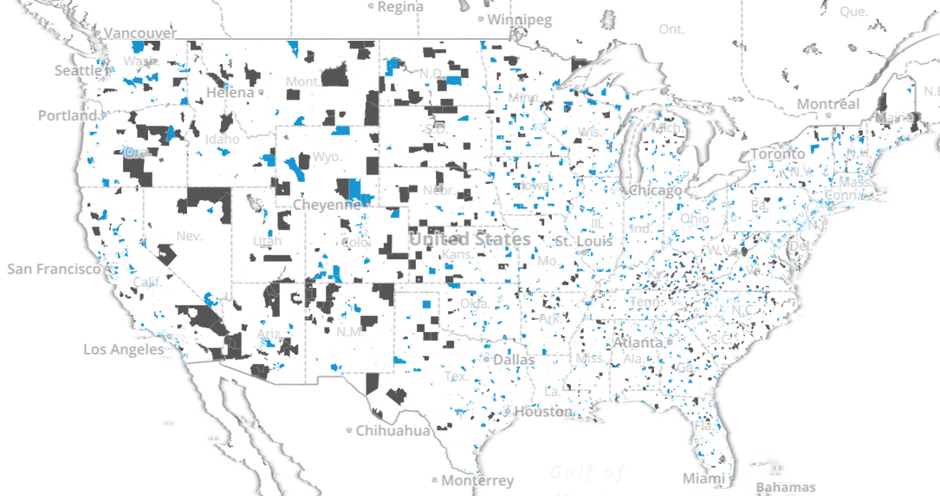
To your library of testimonials on the growing income inequality, you can add this one from the Urban Institute, a study titled “Worlds Apart: Inequality between America’s Most and Least Affluent Neighborhoods,” that shows disparities increasing from 1990 to 2010. This paper uses a composite index (income, educational attainment, home ownership rates, median house value) to identify neighborhoods in the top 10 percent and bottom 10 percent.

You can see them plotted on an interactive national map. Here’s 2010  (blue is “top,” grey “bottom”):

citylab

If you scroll to the Northeast you can check out Vermont’s evolution – interesting, but not particularly dramatic.

As is the case with most such national surveys that focus on metropolitan areas, this one analyzes “commuting zones.” In Vermont’s case, that’s a designation of questionable applicability, because it means a zone centered on Burlington with a population of 321,946, more than half the state’s total.

In an appendix, the study lists dozens of commuting zones, each with its “inequality index,” and Burlington comes out OK – somewhere in the middle. Ditto Burlington’s growth of income disparity over 20 years.

Although there has been some shifting of the top and bottom zones across the country, the wealthy zones have remained fairly impregnable. One reason for that, as this analysis of the Urban Institute data emphasizes, is that discriminatory housing policies, such as exclusionary zoning (e.g., large lot sizes) that preserve richer residential enclaves. Multi-family rental housing, affordable or not, is typically missing from these neighborhoods altogether.

Of course, discriminatory land use policies aren’t the sole culprit. High land prices are an obvious deterrent for affordable housing development. Then again, discriminatory policies in many cases may have contributed to the higher prices … a vicious circle.


A non-presidential candidate gets to the point


Elizabeth Warren, the Massachusetts senator, gave a speech Sunday in Boston that the website “Salon” called “the realest talk on race by any American politician.” She delivered her remarks at the Edward M. Kennedy Institute for the United States Senate as part of a “Getting to the Point” lecture series.

Congressional Oversight Panel for TARP Chairman Elizabeth Warren briefs reporters on the latest news of her agency, which oversees the government's disbursement of billions of dollars to U.S. banks and the auto industry by the Troubled Assets Relief Program, at the Reuters Financial Regulation Summit in Washington, April 27, 2009. REUTERS/Mike Theiler (UNITED STATES POLITICS BUSINESS)

She had something to say about violence, about voting, and about economic justice – and economic justice as it relates to housing. Some excerpts:

“For most middle class families in America, buying a home is the number one way to build wealth. It’s a retirement plan-pay off the house and live on Social Security. An investment option-mortgage the house to start a business. It’s a way to help the kids get through college, a safety net if someone gets really sick, and, if all goes well and Grandma and Grandpa can hang on to the house until they die, it’s a way to give the next generation a boost-extra money to move the family up the ladder.

“For much of the 20th Century, that’s how it worked for generation after generation of white Americans – but not black Americans. Entire legal structures were created to prevent African Americans from building economic security through home ownership. Legally-enforced segregation. Restrictive deeds. Redlining. Land contracts. Coming out of the Great Depression, America built a middle class, but systematic discrimination kept most African-American families from being part of it.

“State-sanctioned discrimination wasn’t limited to homeownership. The government enforced discrimination in public accommodations, discrimination in schools, discrimination in credit-it was a long and spiteful list.”

Here we interject that she’s just scratching the surface of the federal government’s tawdry history of promoting residential segregation by race. For an eye-opening summation, check out what Richard Rothstein, of the Economic Policy Institute, had to say at the recent HUD conference in Washington. See the video we posted previously.

We note also the racial disparity in home ownership. In 2010,  in Vermont, according to the 2012 “Analysis of Impediments to Fair Housing Choice,” the home-ownership for whites (71.4 percent) was nearly twice that for blacks (32.5 percent).

Warren went on to talk inequality over the last few decades, including the disparate effects of predatory lending that preceded the housing crash:

“Research shows that the legal changes in the civil rights era created new employment and housing opportunities. In the 1960s and the 1970s, African-American men and women began to close the wage gap with white workers, giving millions of black families hope that they might build real wealth.

“But then, Republicans’ trickle-down economic theory arrived. Just as this country was taking the first steps toward economic justice, the Republicans pushed a theory that meant helping the richest people and the most powerful corporations get richer and more powerful. I’ll just do one statistic on this: From 1980 to 2012, GDP continued to rise, but how much of the income growth went to the 90% of America – everyone outside the top 10% – black, white, Latino? None. Zero. Nothing. 100% of all the new income produced in this country over the past 30 years has gone to the top ten percent.

“Today, 90% of Americans see no real wage growth. For African-Americans, who were so far behind earlier in the 20th Century, this means that since the 1980s they have been hit particularly hard. In January of this year, African-American unemployment was 10.3% – more than twice the rate of white unemployment. And, after beginning to make progress during the civil rights era to close the wealth gap between black and white families, in the 1980s the wealth gap exploded, so that from 1984 to 2009, the wealth gap between black and white families tripled.

“The 2008 housing collapse destroyed trillions in family wealth across the country, but the crash hit African-Americans like a punch in the gut. Because middle class black families’ wealth was disproportionately tied up in homeownership and not other forms of savings, these families were hit harder by the housing collapse. But they also got hit harder because of discriminatory lending practices-yes, discriminatory lending practices in the 21st Century. Recently several big banks and other mortgage lenders paid hundreds of millions in fines, admitting that they illegally steered black and Latino borrowers into more expensive mortgages than white borrowers who had similar credit. Tom Perez, who at the time was the Assistant Attorney General for Civil Rights, called it a “racial surtax.” And it’s still happening – earlier this month, the National Fair Housing alliance filed a discrimination complaint against real estate agents in Mississippi after an investigation showed those agents consistently steering white buyers away from interracial neighborhoods and black buyers away from affluent ones. Another investigation showed similar results across our nation’s cities. Housing discrimination alive and well in 2015.”


Fascinating notes from all over

A Monday potpourri that panders to our friends with short attention spans:

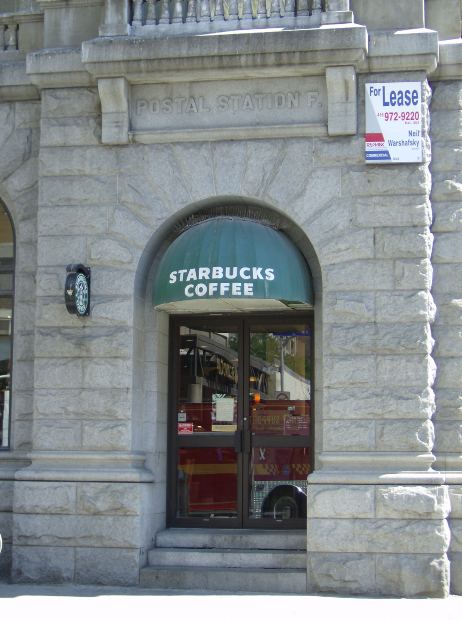
starbucks

  • Starbucks, which offers tuition-assistance to its U.S. employees, offers rental assistance to its workers in the U.K. After a year’s employment, they can get a no-interest loan for a rental deposit.

downsize

  • The U.K., never short of fresh approaches to chronic social problems, offers this one for the housing affordability shortage: oldsters downsizing to free up their unused extra space for youngsters. Worthy of debate, no?
  • Vermont’s recurrent lament that it’s getting too old and can’t hang on to its youth prompts the question: Where are the youth going? Well, here’s one answer, in the form of a list of cities where Millennials are buying homes in large numbers. They’re mostly out west (Des Moines! Grand Rapids!), the same territory where young Vermonters fled during the 1830s. Back then, the people they left behind wrung their hands about that exodus, too.

dubai

  • Maybe some of the fleeing youth are heading to Dubai, but if they are, they’re encountering – ta-dah! –– an affordable housing shortage, complete with 30-mile commutes from the suburbs.


Something to cheer in Woodstock

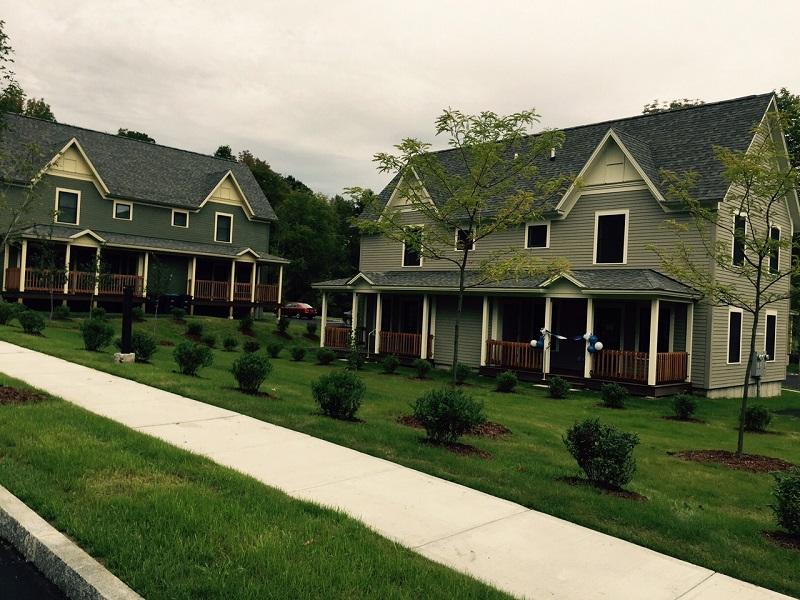
The opening of Safford Commons in Woodstock earlier this week has been widely and deservedly celebrated. This 28-unit development was about a decade in the making – a decade marked by legal battles and neighborhood opposition. You can get some of that history from a Valley News story on the ground breaking a year ago, and a you can get an thumbnail idea of where things stand now from accounts on Vermont Digger and on VPR, source of this photo:

saffordvpr

Let’s throw a little context around this. Woodstock is an employment center, with more than 2,100 jobs in more than 270 establishments last year, according to the Vermont Department of Labor. By that measure alone, Woodstock would seem to be a prime candidate for workforce housing – that is, housing that working people can afford to live in.

Woodstock is also a relatively wealthy town, with an estimated median income of about $99,600, compared to Vermont’s average of $68,100, according to Vermont Housing Data. A smaller share of its total housing units are rented (23.5 percent) than Vermont’s average (25.9 percent), and those residents who do rent in Woodstock tend to be slightly better off than their average Vermont counterparts. Just 29 percent of Woodstock’s renters are housing-cost “burdened” (that is, they pay 30 percent of their income on housing), compared to Vermont’s average of 52 percent; and just 14 percent are “severely burdened” (they pay 50 percent or more), compared to Vermont’s average of 26 percent.

All of which suggests that many of the lower-wage employees who work in Woodstock don’t live there and have to commute from some place else.

Until Safford Commons opened, however, Woodstock had only two subsidized housing complexes (Melishwood I & II), with a total of 26 units (11 of them for elderly residents). The addition of a third affordable rental complex in Woodstock is not only welcome, it’s overdue. Here’s hoping it won’t be the last.


New population bulge: renters

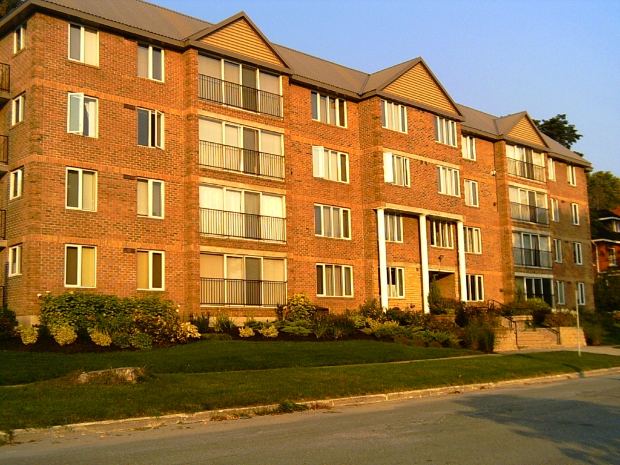
Renters — and the cost burdens associated with renting — are on the rise across the country. Two recent studies say so, so we might as well cite them here. One, by Enterprise Community Partners and Harvard’s Joint Center for Housing Studies, projects that renter households will increase by 4.2 million over the next 10 years. Another, by the Urban Institute, puts that number at 6 million. And the share of rental households that’s “severely cost-burdened” – that is, paying 50 percent of income or more for housing – will go up 11 to 25 percent under various economic scenarios, says the former study.

apartment2

Meanwhile, says the Urban Institute, the home ownership rate will go down for all but the oldest population segment. The explanations of these and other stark housing projects are familiar – among them, that college-debt-burdened Millennials aren’t moving into the house-buying market the way their age group did a generation or two ago.

Here we inject the good news/bad news for Vermont.

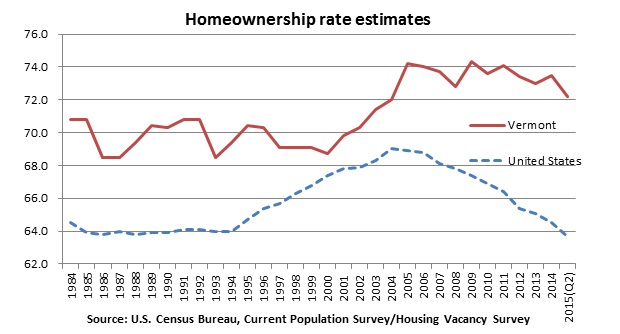
The home ownership rate here is above the national average and has not mirrored the national drop over the last few years.

vthomeownership

Rental cost-burden rates here are, however, about at the national average: 26 percent of Vermont’s renters are “severely cost burdened,” according to Vermont Housing Data.

If the renter population swells in Vermont, how likely is it that the number of affordable housing units keeps pace? Not very, without some form of government intervention. Here’s what the Enterprise/Harvard study says about that:

“The need for affordable housing is already overwhelming the capacity of federal, state and local governments to supply assistance. At last measure, 11.2 million extremely low-income households competed for 7.3 million units affordable to them – a 3.9 million unit shortfall. And with 7.7 million unassisted very low-income renters with worst case housing needs in 2013 as defined by U.S. Department of Housing and Urban Development (HUD), only just over a quarter (26 percent) of eligible very low-income households received rental assistance.”

Now, some might argue that if private developers are simply turned loose to produce a flood of new housing, affordability will take care of itself.

That’s not likely, either. Check out the state of affairs in Portland, Ore.,  a place that has experienced both a building boom and an unaffordability boom, and where the mayor just declared a “state of emergency for housing and homelessness.”


Teachable moments in New Hampshire

If you think New Hampshire is a socio-political backwater, from its license plate slogan to its lack of an income tax, think again. The state has been grappling with its affordable housing shortage for years — certainly since 2008, when a “landmark law” (as state housing officials termed it) sought to goad towns into taking action.

New Hampshire’s Workforce Housing Law mandates that every municipality provide “reasonable and realistic opportunities” for the development of workforce housing. What is “workforce housing”? As defined by the law, it means housing for that’s affordable (a cost burden of no more than 30 percent of income) for families making up to 100 percent of median income, and for renter families who make up to 60 percent of median income. (Click here for the income numbers.)

Now, “reasonable” and “realistic” may be subject to varying interpretations, as a recent discussion at a City Council meeting in Londonderry suggests. Londonderry officials are trying to open up more opportunities after an examination of the towns ordinances last year revealed impediments. The current push, as this news article indicates, is both for multi-family developments and increasing density in single-family zones.

londonderry-nh

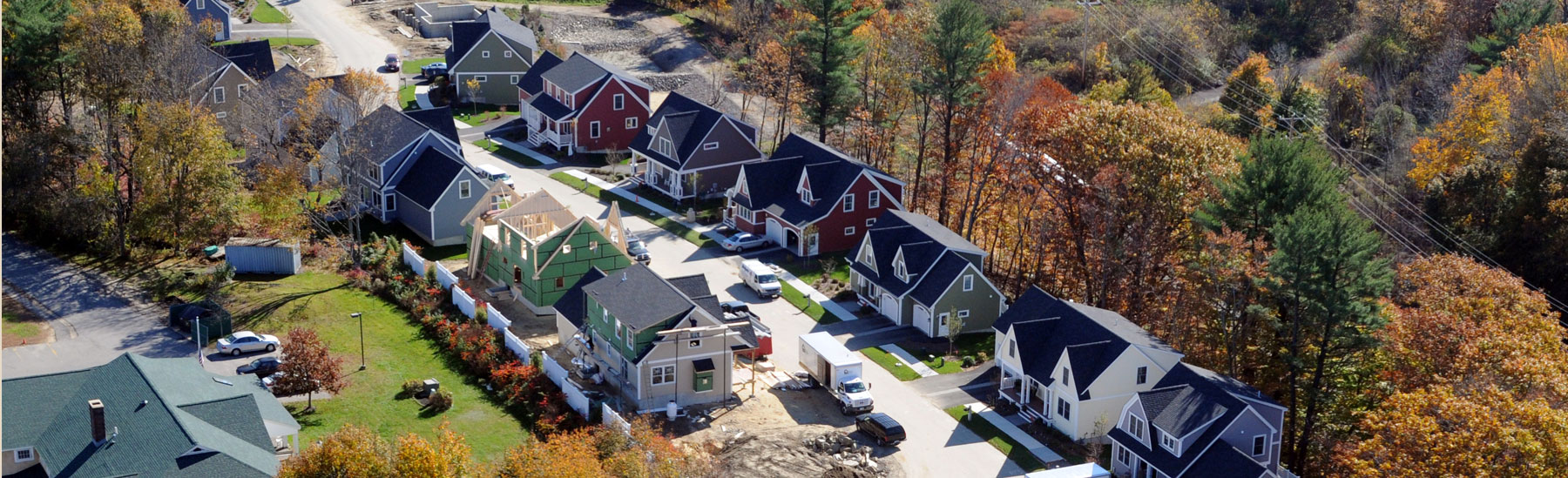
The latter got pushback at the meeting. (We’d recommend that people in Londonderry and elsewhere watch our “Thriving Communities” webinar when it becomes available on our site, because it shows, among other things, how neighborhoods of the same density can be designed well (aesthetically pleasing) or badly (cookie-cutter ugly).

In any case, we’d argue that this kind of discussion – from the opening up of restrictive land-use practices to the acceptance of residential density in workable and appealing forms — could be going on in Vermont towns, as well. Never mind that Londonderry, N.H., with population of about 24,000, is bigger than every Vermont community except Burlington. The same challenges apply here, on a Vermont scale.