Here a crisis, there a crisis

Never mind California or the Northeast. The housing-unaffordability problem can be found lots of other places, some of them rather unlikely. If you breeze through news coverage from around the country, you can find stories from all over that use the phrase “crisis” or “crunch” or “shortage” to describe the local or regional housing-unaffordability profile:

Just in the past few days, stories have bubbled up from Taos,  Taos Jackson Hole, Aspen, Madison, Asheville, Hawaii, and Austin — all in crisis mode.

Austin is an interesting case: There’s not only an affordability shortage, most of the supposedly affordable units aren’t really affordable after all, according to a rather scathing audit that just came in. From the report summary: “The City does not have an effective strategy to meet its affordable housing needs. Neighborhood Housing and Community Development has not adopted clear goals, established timelines, or developed affordable housing numerical targets to evaluate its efforts in fulfilling the City’s adopted core values. Key information needed to evaluate program effectiveness is incomplete, inaccurate or unavailable.” Austin3  This, in the latter-day birthplace of public housing that  the mayor pronounced the most economically segregated city in the country.

Among the places you might not expect to find a housing crisis: Minot, N.D., rural Iowa, IowaNorth Platte, Neb. (Say it ain’t so, North Platte!) And to think that this is not something the presidential candidates can even be bothered to talk about!

In fact, every county in the country can be said to be in crisis when it comes to housing extremely low-income households (that is, households with less than 30 percent of median income, 11.3 million nationwide). No county has enough units for such people, according to an analysis the Urban Institute did this summer. For an interactive map that will show you how many affordable units in each county for 100 poor households, click here. In Vermont, Orange, Windsor and Windham counties come out the best, with 49 affordable units for 100 households; Caledonia, Lamoille and Orleans have the fewest, at 29. The national average: 28.

Of course, the national challenge is not just to create plenty more affordable housing but to locate it judiciously. New housing options have to be provided for low-income people in low-poverty neighborhoods, otherwise known as “high-opportunity” areas. That’s what affirmatively furthering fair housing is about — breaking up historic settlement patterns of concentrated poverty and segregation and promoting integration.

Naturally, AFFH generates pushback. So, sprinkled among the wash of “housing crisis” stories are accounts of resistance to affordable housing projects in well-healed suburbs – such as Simsbury, Conn. (median household income$104,000) , and Wilmette, Ill. ($127,000).

Tampering with the sacrosanct

The presidential candidates have a lot to say about tax reform, but with one exception, they’re not about to get rid the big sacred cow — the mortgage-interest deduction, found on Schedule A of Form 1040:scheduleA (2)

Economists have been complaining about the mortgage-interest deduction for years. It’s a regressive benefit, increasing with income. It enhances inequality, effectively inflates property values and misallocates resources, or so the argument goes. In 2012, the mortgage interest deduction cost the federal government $70 billion, according to the Urban Institute, compared $36 billion for low-income housing subsidies.

But nobody expects that deduction to go away any time soon. It’s a firmly entrenched loophole (aka “third rail”) not only for the wealthy elite, but for the simple majority. The home ownership rate in this country exceeds 60 percent (in Vermont, it’s over 70 percent), and of course the lion’s share of those people are mortgage-holder beneficiaries. IRS2

The ranks of renters are increasing, though, and the more they do, the more seriously they might be taken as a political constituency. Politicians take renters seriously in Germany, where renters are in the majority and the regulatory climate is much more in their favor. Germany doesn’t offer a mortgage-interest deduction, either.

Might the growing numbers of American renters be mobilized to support the elimination of the mortgage-interest deduction — which ostensibly doesn’t benefit them anyway — in favor of increased housing subsidies for low- and moderate-income tenants? That seems like a stretch, unless another Occupy-style movement sweeps the country.

Well, if eliminating the mortgage-interest deduction discourages home ownership, so be it. There’s even evidence that home ownership isn’t necessarily such a wonderful thing, because it damages labor markets:

“We find that rises in the home- ownership rate in a U.S. state are a precursor to eventual sharp rises in unemployment in that state,” write economists David Blanchflower and Andrew Oswald, in a 2013 paper. Why? Partly because higher rates of homeownership curtail labor mobility and lead to longer commutes.

So, who’s the exception among the presidential candidates? Ben Carson. bencarson He’s the only one who has said he’d do away with the mortgage-interest deduction. (Even Bernie Sanders doesn’t go that far – he’d cap it at $300,000.) For a full-throated defense of this Carson stance from someone who doesn’t agree with much of anything else he says, click here. 

Another population bubble

Millennials become the most numerous living generation this year, outnumbering the Baby Boomers, and there’s no shortage of treatises analyzing their tastes, their world views, and their impact on the housing market. How seriously to take these generalizations, or any other thumbnail pronouncements about generations, is an open question. (For a Pew Foundation exegesis of “generations research” that finds Millennials less religious, more diverse and less conservative than their predecessors — that is, compared to Generation X, Baby Boomers and the Silents(!), click here.)

Clearly, though, people born after 1980 tend to have higher levels of student loan debt than their forebears, and fewer are buying houses as a result.Millennials1 Young renters’ student debt burdens grew after the Great Recession, even as their median incomes dropped, which left them less able to qualify for a mortgage or to save for a downpayment. A new research brief from the Harvard Joint Center for Housing Studies, “Student Loan Debt and the Housing Decisions of Young Households,” lays out the details.

Nevertheless, there are commentators who see Millennials as poised to fuel a housing boom. “Millennials are making their move in the housing market,” proclaims the Dallas Morning News, quoting real-estate industry source attributing 30 percent of home sales to Millennials.

The common notion that Millennials want to live in cities is subject to dispute. More Millennials are moving from cities to suburbs than the other way around, Census data supposedly show. A survey came out earlier this year that got plenty of attention: It had 66 percent of Millennials preferring a life in suburbs, 24 percent rural areas, and just 10 percent cities.

The survey was sponsored by the National Association of Home Builders, though — an entity that would seem to have a vested interest in promoting the single-family-home-big-yard lifestyle.

But wait. A survey closer to home suggests that many Millennials really do hanker for a single-family home with a big yard. The 2014 “Young Professional Housing Survey Report,” sponsored by the Lake Champlain Regional Chamber of Commerce, asked 400 respondents (63 percent of whom were renters) what type of residence they would most like to live in, and 82 percent said single-family detached house with a yard. And most of those wanted a big yard!millennials2

Now, to the extent that these Burlington-area Millennials prefer suburban living, they do want to live in a place that’s a short commute to work, and a place where they can walk to community services.

Still, the young cohort seems to cling to the old American dream of a low-density-neighborhood lifestyle. Hasn’t anyone told them that big yards are obsolete in the Age of Climate Change?

Good news, bad news

First, the bad news:

  • The city council in Parsippany, N.J., faced a stark choice –- affordable housing or Whole Foods — and picked the latter. Just how it happened that the fate of a 26-acre site called Waterview came to this is no doubt a story in itself, but this much seems clear: the powers that be leaned against a 600-plus unit affordable housing development, contending it would be a drain on local taxes. whole-foods1This might not be in the spirit of affirmatively furthering fair housing. That site, next to a neighborhood of single family homes, might well be a “high-opportunity” location for affordable housing in a city with a median family income of $81,000. Whole Foods, we suspect, does not as a general rule move in to low-opportunity areas.
  • The Illinois Housing Appeals Board was established six years ago to hear pleadings by developers contending they’ve been unfairly prevented from building affordable housing projects. The appeal process was created in connection with a law requiring municipalities to submit affordable housing plans to the state if less than 10 percent of their housing units were affordable. Well, it seems that municipalities ignore the law with impunity, the board has no authority, and it has yet to hear a single case. Back to the legislative drawing board? In the Chicago metro area, low income tax credits are issued preponderantly in lower-income areas, an analysis found. Among the wealthy suburbs where opponents are showing up in force is Wilmette (pop. 27,000, median household income $130,000), where a hearing on a 20-unit development drew a crowd the other night.

The good news comes in two forms, tangible and intangible.

  • On the tangible side, 19 units of affordable housing are back on the rolls in Montpelier, thanks to a rehab projectbarre-st-construction by Downstreet Housing and Community Development, with an array of collaborators. These are studios and one-bedrooms on Barre Street, all a short walk to downtown. This is the sort of transit-friendly positioning that we’d like to see more of.
  • One of the collaborators was the Vermont Housing & Conservation Board, an affordable-housing mainstay that has been underfunded for years. A report to the governor from the Council on Pathways to Poverty calls on the state not only to fund VHCB at its full statutory rate ($19.5 million), but also to restore the money meant for VHCB that has been diverted to fill budget gaps since 2001 ($41 million). With full funding, VHCB might be able not only to support more low-income housing, but workforce housing for people who make “middling” wages of $13 to $25 an hour. The report also calls for a $2 lodging fee, half of which would be reserved for affordable housing and homelessness-aversion. This is intangible good news, in the sense that somebody is saying and pushing for the right things that have yet to happen.
  • Speaking of workforce housing, people in Bend, Oregon, are realizing that middle-class people ineligible for subsidized housing are shut out, as housing prices soar. So the City Council is starting to give some serious thought to what can be done for them in addition to low-income people. Again, nothing has happened yet, but we take the fact that this discussion is underway as more (intangible) good news.
  • This item might seem like a stretch for the good news category, but at least it’s of the intangible all-talk variety: A prominent Republican has emerged to say that the housing crisis deserves more attention in the presidential campaign. That’s Scott Brown, the former senator, scottbrow who also happens to be a member of the board of J. Ronald Terwilliger Foundation for Housing America’s Families. In an opinion piece, Brown lamented that housing has been missing from the debates, and said that if he were moderator, he’d ask the candidates what they’d do about the shortage of affordable rentals. Meanwhile, another opinion piece, by foundation president Pamela Patenaude in a housing industry publication, calls for an increase in federal support for the low-income housing tax credit. Hear, hear.

Learning from Massachusetts

The Greater Boston Housing Report Card 2015 is out, and it’s an eye-opener. Prepared for the Boston Foundation  by the Dukakis Center for Urban and Regional Policy at Northeastern University, it’s a detailed analysis of Massachusetts’ housing-unaffordability crisis –a crisis that results, in part, from not enough housing being produced. What accounts for the insufficiency?Mass2

“We have failed to meet housing production targets because there is no way to do so given the high cost of producing housing for working and middle-income households.”

That’s from the executive summary, which goes on to make the same point in another way:

“(T)he cost of developing new housing for working and middle-income households has become prohibitive in Massachusetts. Radical remedies will be needed to overcome the barriers to housing production …”

And what are the barriers? High development costs, of course ($274 per square foot for urban projects, of which $159 is construction and $41 is land acquisition). And zoning regulations that limit density and where multi-family projects can be built.

Now, you might be thinking, what does any of this have to do with us, up here in our little, rural, unprepossessing state? Metro Boston is another world — far pricier and denser than any place around here.

Well, we’d argue that the problems that Massachusetts is facing are problems we share — albeit on a smaller scale. And remember, Massachusetts has an affordable housing zoning law (Chapter 40B) that’s arguably stronger than what’s on Vermont’s books.

Yes, it would be nice if we could get a comparable report card for housing in Vermont, but failing that, perhaps we can learn something from what the one for Massachusetts.

The report notes that “Although there is a lot of vacant land, most vacant sites are not zoned for multi-family residential development.”

As for zoning:

“Highly restrictive zoning, present in virtually every one of the state’s 351 municipalities, creates an artificially high barrier to development. It pushes developers to propose smaller projects (i.e., fewer units) and smaller units (i.e., fewer bedrooms per unit) in order to reduce the perceived impact on the neighborhoods and — in the case of larger units attractive to families with school-age children — the perceived impact on the town or city’s education budget. The complexity of getting zoning changes approved dramatically extends the development period and increases carrying and soft costs. The cumulative effect drives up both the cost of development (seen in the high level of site costs, financing, and soft costs) and rents.Mass1

“Thus, significant resistance to any change in the local community ambience has also meant that local support has heavily favored low-density, smaller projects, both of which are far more expensive to produce. Higher density housing maximizes the efficiency of land use, and larger projects create economies of scale in development and construction. Massachusetts residents opposed to zoning for multi-family housing at 20 units per acre are astounded to learn that the city of Paris — a pretty nice place to live with undeniable “character” — has a density of approximately 120 units per acre!

“When developers are given permission only to build projects of very low density, they will do so. As a result, the housing that is built will be expensive and affordable only for the very well-to-do or, if public subsidies are involved, to people with very low incomes. Working and moderate-income families will not be able to afford these units. This state of affairs, of course, causes the average cost of producing multifamily housing in the Commonwealth to increase.”

Here we note that merely increasing the housing supply (as some are advocating) isn’t going to solve the affordability problem if the added supply happens to be … luxury-scale and thus … unaffordable to all but the wealthy.

More brainstorming: self-building

The housing-unaffordability problem is too big, pervasive and complex to yield to single, simple remedies. Yes, government at all levels has to play a substantially bigger role than it does now. But without substantial new federal funding and subsidies — which can’t be found on mainstream politicians’ lists of spending priorities — we might as well brainstorm about piecemeal, alternative solutions.

Having touched on co-living and cohousing in the last post, we bring you a continental variant of this idea: collective building.baugruppe1

This intriguing headline in the Guardian, “The do-it-yourself answer to Britain’s housing crisis,” offers an entrée: community members, with help from a land trust, building their own affordable homes. Britain even has an organization, the National Custom and Self-Build Association, to promote such efforts.

Self-building seems to be an even bigger trend on the continent. In Germany, baugruppen, or building groups, are active all over, and reportedly account for 10 percent of new homes built in Berlin. baugruppe3These are groups of people who come together, often with something in common (they might be musicians, say, or share a political philosophy), and take responsibility for acquiring land, hiring architects and contractors, and creating their own housing. For a summary of how it works, click here, or another brief description, here.

The baugruppe is a well-established form of organization in Germany and apparently gets a good deal of institutional support, including financing from a state bank. Whether something like this could work in this country is an open question.

Mike Eliason, a designer who was author of a seven-part series on baugruppen, seems to think it could, at least in a place like Seattle. For the first article, on the website of a Seattle advocacy organization called The Urbanist, click here. As Eliason describes it, baugruppen projects cost less than traditional models because they do without developers and marketing, as well as real estate agents.baugruppe2

It all sounds reminiscent of cohousing, except that it’s commonly done in an urban setting — as the photos in this post reflect. It also sounds like a fairly middle-class phenomenon, considering how much of a personal investment it requires of its participants. Who has the time and energy necessary to do all the meeting and planning and hiring and so on? Probably not someone who holds down two minimum-wage jobs. Not that we don’t need affordable housing, sometimes called workforce housing, for middle-class professional types, too.

Scaling back, sort of

A new verb, or gerund, is twittering its way into the contemporary housing lexicon: “co-living.”

It’s often paired with “co-working,” another neologism, and “micro-housing.” These words are being used most commonly to describe the emerging lifestyles of highly driven, hard-striving young entrepreneurs, typically in technical fields — Millennial start-up wannabes, they’re sometimes called in the literature.tiny1 Harnessed to their ambitions, they’re willing to live in tiny spaces with some common amenities (co-live), work in open-space offices where they can freely network and brainstorm with peers (co-work), and abandon the idea of maintaining a conventional “work-life balance.”

These patterns reportedly originated in the Bay Area, as you might expect, but are showing up in New York. This summer, the Times ran a story about Pure House, one of several businesses renting apartments with amenities to such people who are willing to pay $1,600 to $4,000 a month to share rooms with others of their ilk. “The Millennial Commune,” read the headline. (For BuzzFeed’s elaboration on this phenomenon, click here.)tiny2

We’ve never met anybody like that, but we take it on faith that such people really do exist. What we’d like to suggest, though, is that some variant of co-living might have appeal for ordinary people, too – Millennials and oldsters, alike. We’ll explain in a moment, but first, let’s be clear that co-living is not the same as cohousing.

Cohousing, as the Cohousing Association of the United States describes it, is “an intentional community of private homes clustered around shared space.” There are many variations of this basic idea of combining private and communal space, and a couple of dozen of these communities have sprung up around Vermont. These are clustered developments, but they’re not necessarily adduced as an answer to the housing-unaffordability problem because of the added costs associated with the shared facilities.

Co-living, by contrast, puts people in tiny apartments (say, 200-300 square feet) with access to some shared space (such as a communal kitchen and lounge). Typically, these are furnished rentals.

An example is Commonspace, 21 micro units being developed on two floors of a five story building in Syracuse, N.Y., above a co-working office space. Each unit will have a bathroom and a kitchenette and will rent from $700 to $900 a month — supposedly slightly less than a one-bedroom apartment goes for in Syracuse, according to a fine profile in The Atlantic. tiny3

Quite apart from the “co-working” annex, micro-units have proliferated in Seattle over the last few years and appear to appeal especially to people who want to live close by where they work.

Now obviously, this sort of place is not for everyone. It means, among other things, giving up the idea that you’ll be paying for living quarters big enough to hold all your seldom-used stuff.

But it might make sense for lots of people — recent college grads working their first jobs, dislocated workers or homeless people getting back on their feet, retirees living on fixed incomes. Not that all these people would necessarily have live together, but assorted communities might suggest themselves.

And beyond rentals, perhaps different ownership models could be devised by land trusts, using judicious public subsidies, all with an eye to affordability.

From prisons to penthouses

Given that Britain, like the United States, is beset by an affordable housing shortage, this headline in the Financial Times is an attention-grabber: “UK to build 9 prisons and sell outdated ones for housing.”

Actually, this is not a new idea. The U.K. apparently already has some experience in converting old prisons to hotels and student housing. So does Germany. Here’s what became of a “correctional facility” in Berlin: Apartment house. prison-berlin


And in North America, former prisons or jails have been transformed into all manner of things options: homeless shelters, office/retail complexes. Here’s an example of conversion to affordable housing in Vancouver…

prison-vancouver


Lower-income people are not necessarily the likely suspects for occupying these developments. In Massachusetts, somehow, luxury apartments found their way into the old Salem Jail, seen here in its former state: prison-salem


Repurposing prison property isn’t going to solve the affordable housing problem, obviously, but maybe it’s worth thinking about this in another way: Democrats and Republicans, both, are talking about substantially reducing the nation’s inflated prison population, particularly by free inmates convicted of nonviolent crimes. One might expect that would lead to a substantial reduction in corrections budgets, which could in turn free up public money for other purposes … such as affordable housing.

Consider Vermont, where the annual corrections budget of around $140 million vastly exceeds the amounts allotted two of the state’s major affordable housing stewards, the Vermont Housing & Conservation Board (around $15 million) and the Department of Housing and Community Development ($10 million).

What might those numbers look like if the state readjusted its priorities and stepped up its commitment to affordable housing? Including, of course, affordable housing for former inmates.

So what if?

If you’re fed up with the high-priced housing here and want trade the Champlain Valley for the Treasure Valley (Boise, Idaho), be careful. Boise If you’re making less than $35,000 a year, you’ll be hard-pressed to find an affordable apartment, according to this article in the Idaho Statesman. (“Low-income housing crisis,” blares Idaho Public Radio.)  Sure, average rents are lower there than in Burlington, but they’re rising fast. What’s more, developers say they can’t make a profit on affordable housing without more incentives than Idaho makes available.

If you think you’ll be better off in Illinois,Illinois1 be aware that you probably can’t get on a waiting list for a housing choice voucher (72 percent of the Section 8 waiting lists are closed, we learn from a report whose title says it all, “Not Even a Place in Line.” True, average rents in Illinois are a bit lower, as is the “housing wage” — the amount you need to earn an hour to be able to afford a two-bedroom apartment.  (“Afford” means you pay no more than 30 percent of your income for housing.) Vermont’s 2BR housing wage is $20.68 an hour; Illinois’ is $18.78. Don’t spend the difference all in one place.

If you still hanker for California in hopes that you can make do outside the glitzy metro areas, think again. Even Bakersfield, site of a recent “Affordable Housing Summit,” is brooding about a housing “crisis,” with rent inflation far outpacing wage growth. (Bakersfield!)

In Denver, described as “a landlord’s market,” at least you can call a housing hotline for advice, but you might be put on hold. Calls are coming in steadily, with affordability the main concern and callers reporting rent hikes of $200 to $400.

If you think a career in academia will spare you housing-unaffordability travails, you might be right in the long run … but not necessarily in the short run in Ithaca, N.Y.,  where junior faculty at Ithaca College are reportedly struggling.

If you’re a prospective student at Middlebury College with an ambulatory disability, you might wonder if a new townhouse-style dorm under construction – sans elevators — will fully accommodate you. But you can take heart that scores of accessibility/visitability advocates at the college are in your corner.

If you’re an artist hankering for affordable artists’ housing – something that is emerging in warehouses and abandoned factories around the country, as we’ve noted before – you can forget about Burlington’s celebrated artists’ enclave, the Enterprise Zone in the South End. The mayor said no to housing there, as did the City Council, as did the Housing Action Plan. Did anyone take a serious look at whether affordable housing could be introduced there without gentrifying the neighborhood? Not that we’ve heard.

Oh well, Kingston, N.Y., had another idea. An old lace factory Kingston there has been converted to affordable housing  for “writers, dancers, graphic designers, musicians, painters, photographers, and even a puppeteer,” we learn from a local news account.

Strange bedfellows, or not

Not long ago we heard a tidy summary of two converging demographic trends bearing down on the affordable-housing problem:

There is the surging population of older people, Baby Boomers and beyond, who are looking to downsize.aging2

Then there is the younger-adult population — Millennials, Gen-Xers — who are looking to up-size but can’t afford to, as they postpone buying homes.

Might there be a way to meet these divergent generational needs in some way that somehow preserves neighborhoods with a stamp of affordability?

That’s a key challenge that one of the presenters in our “Thriving Communities” seminar, John E. Davis, posed at the end of his discourse. (You can see the seminar in webinar-slide form if you click here, or in video mode if you click here.) He admitted he didn’t have any easy answers.

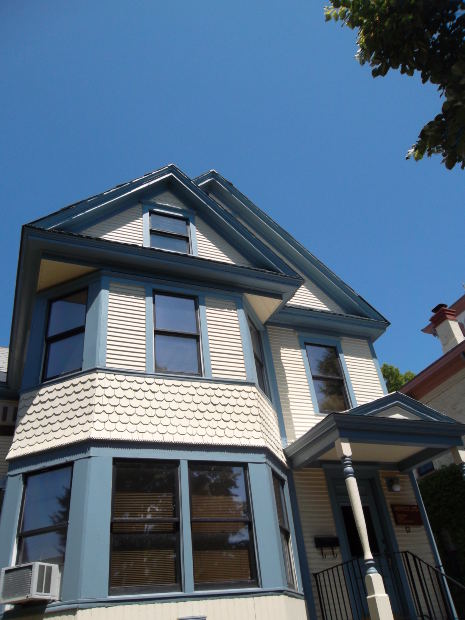
Neither do we, but we have a few notions that might prolong the discussion. These ideas are predicated on the fact that older people, overwhelmingly, want to age in place (that is, in their own homes); that in many cases, those homes are too big for them to manage; that increasingly, older people are open to the idea of home-sharing (as we noted in the post about a recent AARP survey in Burlington). Why not look for ways to convert big, empty houses into spaces that can accommodate both an aging widower and a young family?burlingtonhouse

One way would be to encourage — and drop regulatory barriers from — the addition of accessory dwelling units. (For an article on how zoning can facilitate aging-in-place, click here. For an essay on aging-friendly land-use policies, click here.) The new unit could be an annex that the older person would occupy, freeing up the main house for other residents.

Or the new unit could be a self-contained space within the house itself. We’ve seen articles touting the idea of grown children adding an “in-law suite” to their own homes to house an aging parent. Why not turn that around, so that that aging person’s home is remodeled to include an independent suite that the aging person parent can then occupy, opening up the rest of the house for another owner, perhaps a young family?

family

How might affordability enter this picture? Perhaps as a condition of publicly subsidized financing that could be offered to promote construction of accessory units or the conversion of big old houses into duplexes. Various tax incentives could be offered for older home-owners to take these steps.aging1

And who knows, maybe the hide-bound mortgage world could be expanded to include new forms of co-ownership or shared equity for some no-longer-strange bedfellows: Older empty-nesters aging at home compatibly under the same roof as younger full-nesters.


Note by Ted Wimpey:

Another good option for “aging in place” is “home sharing.” Check out HomeShare Vermont for a good example.
http://www.homesharevermont.org/about-us/

“HomeShare Vermont helps people stay in their homes by connecting them with potential housemates who are looking for a place to live. While our primary goal is to help elders stay at home, we have found that people of all ages and abilities can benefit from homesharing. There are no age, ability or income restrictions to use our services. “