Surprise! Some rents going down

Burlington’s chronic housing-affordability problem is bad enough — more than a third of the city’s 9,500 renting households are paying more than half their income for rent and utilities, which puts them in the “severely burdened” category — but guess what? It’s getting arguably worse. burlingtonapt

HUD just came out with its 2016 fair market rents for the Burlington/South Burlington metro area, and they’re lower than they were for 2015. This despite the fact that actual rents in this area have been going up every year. (The 2016 numbers are up and down across the state, as Vermont Housing Finance Agency’s news blog helpfully details.)

If you really want to know why Burlington’s numbers went down, you can go to the HUD page to see the methodology. The unfortunate upshot, though, is that anyone with a Section 8 housing voucher is going to have less to choose from in 2016 than they do this year. That’s because apartments that cost more than the “fair market rent” are off-limits for subsidy. (If it makes you feel any better, remember that majority of Burlington’s “burdened” households don’t have vouchers anyway. Nationally HUD rental assistance extends to only about one-fourth of the people who are income-eligible.)

OK, let’s consider a two-bedroom apartment. The 2016 “fair market rent” is $1,172 (as compared to 2015’s $1,302). What are the offerings on Craigslist?

Here are the first 10 listed rents for two-bedroom apartments in Burlington and environs (South Burlington, Colchester) that we found at noon Monday. (Craigslist is constantly updated, so if you do the search the results will vary):

$2,500, $1,600, $2,500, $2,100, $1,425, $2,400, $2,025, $2,000, $2,000, $1,650.

How “fair” is that market? Now, perhaps Craiglist rents tend to be above average (are there studies that document this?), but there’s not much consolation in that, especially if you have a housing-choice voucher.

Renters arise!

 Since 2005, the number of renters in this country has gone up 9 million, to 41 million, the biggest surge of any decade on record. That brings the share of renting households to 37 percent, the highest in half a century. Meanwhile, their rents are up and their incomes are down: From 2001 to 2014, rents rose 7 percent (above inflation) and incomes dropped by 9 percent.

The biggest increase in renter households, surprisingly, came from the Baby Boomer cohort – people in their 50s and 60s. In fact households 40 and older make up the majority of renters.apartment
These are among the findings in “America’s Rental Housing,” a 44-page study out this week from Harvard’s Joint Center for Housing Studies.

Not only are there many more renters, but many more of those renters can’t comfortably afford to live where they do. In 2014, 49 percent of renters were “burdened” (meaning they paid more than 30 percent of their incomes for rent and utilities) and 26 percent were “severely burdened” (more than 50 percent). According to Vermont Housing Data, Vermont’s current rates are a tad higher: 52.5 percent and 26.4 percent.

Yes, the housing burden falls most heavily on low-income people, but it’s growing among the middle-income stratum as well:

“(T)he sharpest growth in cost-burdened shares has been among middle-income households. The share of burdened households with incomes in the $30,000–44,999 range increased from 37 percent in 2001 to 48 percent in 2014, while that of households with incomes of $45,000–74,999 nearly doubled from 12 percent to 21 percent. Regardless of income level, though, the shares of cost-burdened households reached new peaks in 2014 among all but the highest-income renters.”

Meanwhile, only about one-fourth of eligible lower-income households receive housing assistance (Section 8 vouchers are not an entitlement!); funding for HUD’s three biggest rental assistance programs is about the same (corrected for inflation) as it was seven years ago, when the economy crashed; and the HOME program, a major source of federal funding for housing programs, has been cut way back. Private developers continue to add to the multi-family housing supply, but most of the recent additions “serve the higher end of the market,” according to the report. As it happens, high-income households (annual $100,000 or more) represent a small but fast-growing share of the rental market.

The report asserts:

“The challenge now facing the country is to ensure that a sufficient and appropriate supply of rental housing is available for a diversity of households and in a diversity of locations. While the private market has proven capable of expanding the higher-end rental stock, developers have only limited opportunities to meet the needs of lowest income households without subsidies that close the large gap between construction costs and what these renters can afford to pay. In many high-cost markets, moderate-income households face affordability challenges as well.”rental1

“Diversity of locations” is an invocation of AFFH (affirmatively furthering fair housing) and the goal of ensuring that a good share of affordable housing is in “high-opportunity” neighborhoods,” as in what follows:

“Policymakers urgently need to consider the extent and form of housing assistance that can stem the rapid growth in cost burdened households. Beyond affordability, they also need to promote development of a wider range of housing options so that more renter households can find homes that suit their needs and in communities offering good schools and access to jobs. It will take concerted efforts by all levels of government to capitalize on the capabilities of the private and not-for-profit sectors to reach this goal.”

Dare we suggest that concerted efforts have yet to be mounted, or even contemplated, by government at many levels?
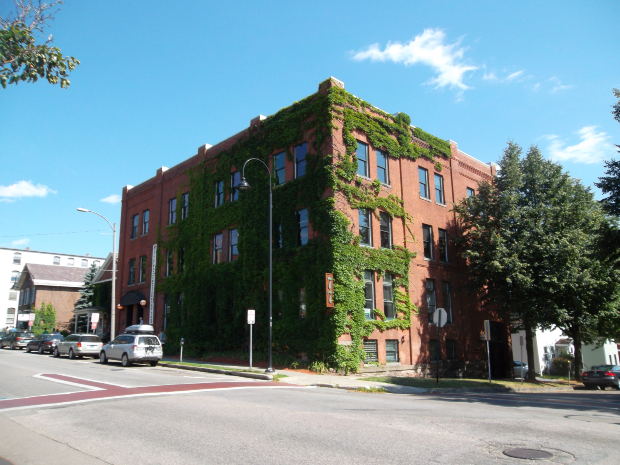
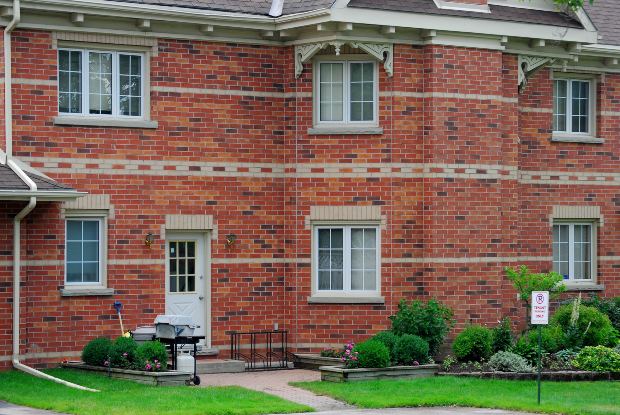
NIMBY notes from all over

Fresh news of NIMBY opposition to affordable housing comes out of … well, our own backyard.

From North Country Public Radio, we learn that residents in Plattsburgh managed to persuade the planning board to reject a proposed four-building residential complex, alleging familiar sorts of adverse effects that low-income people would have on traffic, safety, property values. plattsbugh Affordable housing is a permitted use in that district, but…

 “It is transient housing,” one resident complained. “ They put people in there who are just out of jail, prison whatever until they can get back on their feet … I don’t want it in my area.”

“This concept of us serving transients is so far from reality,” countered the director of the housing organization that would be referring tenants. “The majority of the people that we serve are disabled. They are the veterans in your community. There are elderly people in your community that we serve…”

She might have also cited reports, like this one, that affordable housing can have an uplifting impact on economic development and property values.

Oh well. The developer is appealing the rejection in court. “The thrust of it was, they did not want ‘these people’ moving into their neighborhood,” the developer’s lawyer said.

Plattsburgh is in good company. Upper Saddle River, a toney community in New Jersey, is being sued for rejecting a multi-family housing complex, and thus, by proxy, new residents who happen to be black or Latino. Another interesting case of NIMBY opposition to multi-family housing recently arose in Arizona, where the “backyard” in question belonged to a mortuary! Apparently the mortuary and the developer resolved their differences, though.

NIMBYism gets some of the credit, or blame, for California’s housing-affordability crisis, and it certainly comes in many forms, as this entertaining catalogue attests. Among our favorites are “mega-mansion NIMBYs.” 

New life for old idea?

When the housing-unaffordability problem comes up at a public meeting in Burlington, chances are someone will stand up and call for rent control.  rental1Never mind that the city rejected the idea three decades ago and no one has made a serious effort to revive it locally. It’s an idea that never goes away, though, and is getting some fresh currency these days — where else, in California, the housing-unaffordability epicenter.

Rent control’s heyday was in the ‘70s and ‘80s, apparently. Massachusetts did away with it in 1994 via a statewide vote, but it can still be found in many municipalities in New York, New Jersey and Maryland, as well as California, where tenants’ advocates are pushing to get more communities to sign on and have come up with an organizing toolkit. “Rent control moment gains momentum as housing prices soar,” read a recent news headline, but a closer look suggests that much of the impetus is in California. Most states, after all, have laws that prohibit rent control, although in Washington, there’s an effort to lift the ban for Seattle.

Any groundswell in favor of rent control would have to grow out of large numbers of renters, and renters are certainly on the increase nationally. A new Harvard report announces that “that 43 million families and individuals live in rental housing, an increase of nearly 9 million households since 2005 — the largest gain in any 10-year period on record.”

Renters are a distinct minority in Vermont, where the home-ownership rate is above average. In fact, renters outnumber homeowners in just two cities — Burlington and Winooski — so if rent control were plausible anywhere in Vermont, those would be the likely places. City voters would have to approve a charter change, which would require legislative approval. How unlikely is that?

Burlington voters overwhelmingly rejected rent control in a special election in 1981, during Bernie Sanders’ first mayoral term. (Actually, they rejected the creation of a “fair housing commission,” which everyone agreed was a proxy for rent control.) They were influenced by a publicity campaign against the measure mounted by commercial interests.  burlingtonhouseSanders’ critics on the left complained he didn’t try very hard to see the idea through, and in fact he went on to promote affordable housing via a range of other policies.

Barring a major ground shift, rent control will remain one of those recurrent policy ideas with no traction in these parts. Like single-payer health care.

Unease Down East

Burlington and Portland, Maine, have a few things in common. They’re the biggest cities in their states, they both pride themselves in their trendy livability (as measured by magazine rankings, food-trucks per capita, those sorts of things), they both experienced negligible development of rental housing for many years, they both worry about gentrifying neighborhoods, and they both have a housing affordability problem.

Portland’s problem might seem a bit more acute, thanks in part to a six-part series in the Portland Press Herald that elaborates on what the mayor-elect calls a “housing crisis.” portland1The themes echo other crises around the country – soaring rents (up 40 percent over the last five years), stagnant or declining incomes, middle-income renters priced out and fleeing to the burbs.

The average two-bedroom apartment in Portland, according to the newspaper, is $1,560. That’s too bad, because an apartment like that is out of reach for anyone with a housing voucher. HUD puts the fair-market rent for a two-bedroom in Portland at $1,074 – which happens to be well below Burlington’s $1,309. What’s more, landlords in Portland can capitalize on the hot rental market by charging non-refundable application fees, which their counterparts in Vermont cannot.

How Portland is going to relieve its “crisis” is an open question. The mayor-elect has appointed a committee. The city is examining municipally owned land with an eye toward potential sites for affordable housing. New developments are supposed to make some units affordable for middle-income renters, but that inclusionary policy apparently doesn’t extend to the working poor. Here, as elsewhere, the remedies seem to pale before  the problem.

Modest proposal revisited

At first glance, The Times’ recent  exposition on the surfeit of Chinese residential real-estate investment seemed exotic, distant. The money seems to be flowing into hot, upscale regions to the south, and one of the investors even asserted, “Chinese people like newer areas.” china1

But before you conclude this phenomenon has nothing to do with us, in graying old Vermont, consider this: Chinese students are enrolling in U.S. universities in increasing numbers, the story pointed out, adding: “Their parents often buy homes in college towns.”

“If you look at the stuent populations of any major or nonmajor university,” the Times story quoted a Chinese real estate executive as saying, “you’ll get a really good indication of what property prices are going to do.” What he apparently meant is that Chinese buyers, who more often than not pay cash, bid prices up.

This brings to mind the University of Vermont – never mind whether it qualifies as a major or a nonmajor institution. It’s eagerly stepping up its quotient of international students – part of the strategic plan, don’t you know – and the lion’s share of those students come from China. These are students, generally, whose parents can afford to pay full fare.

Here we pause and pivot to point out two independent trends:

  • Chinese investors are pouring money into American residential real estate, and many of them hanker to live in this country.
  • Vermont is desperately short not just of affordable housing, but of the capital needed to fill that need.

All of which suggests that we revive the EB-5 idea we floated a few months ago. Why not tap the profusive cash of Chinese investors who yearn for green cards to build affordable housing for Vermonters – affordable housing in upscale, high-opportunity areas, no less. With their residency established, the parents could then find accommodations for themselves near their collegiate offspring. China2

We can’t resist noting, again, that the Vermont regional EB-5 office is headquartered in the same state agency (Commerce) that hosts the Department of Housing and Community Development.

The co-op alternative

 Before Burlingtonians succumb to the blandishments of “purpose-built” student-housing developers, they might do well to consider an alternative with a long tradition of affordability: student co-op housing.

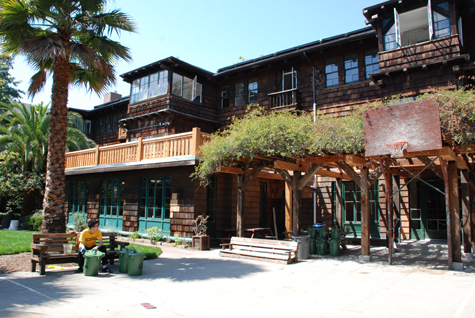
Student housing co-ops are scattered around the country. Perhaps the best known is the Berkeley Student Cooperative, which dates from 1933 and offers housing to about 1,300 students in 20 properties.  Berkeleystudentcoop1According to the co-op’s website, monthly rent is about $745 in a room and board house (compared to $1,354 in a university dorm triple) and $433 to $881 a month for single room in an apartment. (By comparison, the market rate for a one-bedroom apartment is typically over $2,000.) No wonder there are 1,000 students on the waiting list.

And yes, some of those Berkeley co-op houses have game rooms and hot tubs.

A thumbnail case for student co-ops can be found here, on the website of the North American Students of Cooperation (NASCO). Housing co-ops operate on variations of a shared-equity model. Here’s NASCO’s description of a common form:

“In a ‘Market Equity’ coop, a member joins the coop, buys a share, and lives in a unit.  This is similar to something like a condo complex, but instead of owning one condo, you own a share in the whole complex.  When you decide to leave the coop, you can sell your share at whatever the market will pay for it.”

Housing co-ops also come with shared governance, work expectations, and so on. They’re not limited to students, of course. Champlain Housing Trust has five co-ops with 81 apartment units in Burlington, with another one on the way on Bright Street.

You’ll never be faced with this choice, but it never hurts to ask: Which would you rather see on the northeast corner of North Winooski Avenue and Main Street: purpose-built student housing, with a climbing wall, or a student housing co-op without one?


Daunting affordability gaps

Here’s a seat-of-the-pants calculation that shows one dimension of Burlington’s (and Vermont’s) affordability problem for renters:

According to Vermont Housing Data, Burlington has 9,596 rental units. Of the households living in them, 61 percent are paying more than 30 percent of their income for housing — the standard threshold of unaffordability. By that standard, 5,853 rental units in Burlington are unaffordable to the people who live in them.

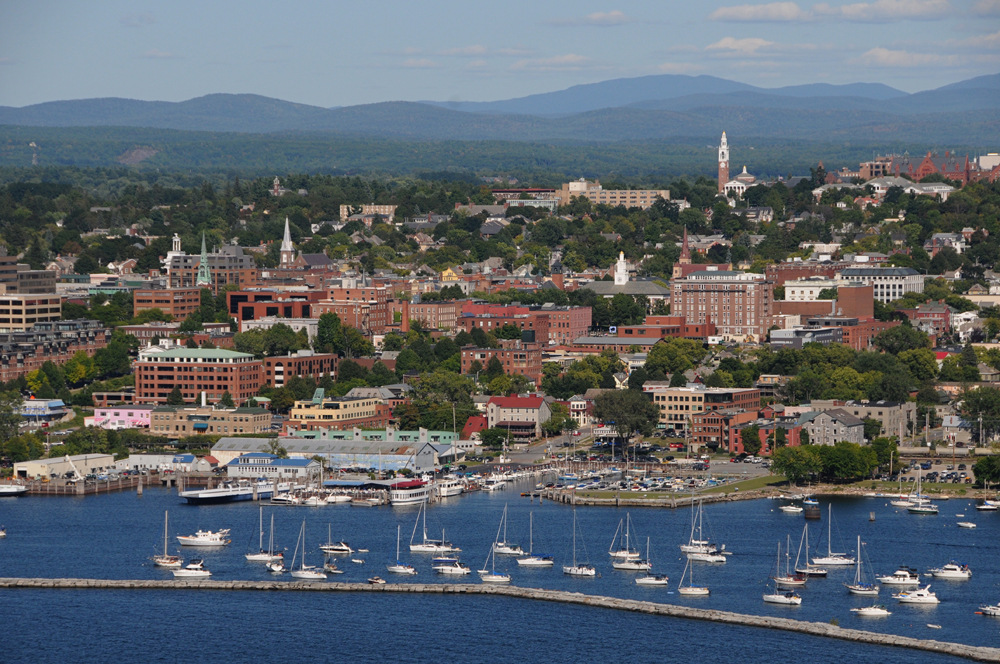
Lake Champlain Burlington, Vermont.

(The same source reports Vermont’s rental units at 69,581. More than half the households in those units – 52.5 percent – are paying more than 30 percent. That puts the state’s unaffordable rental units at 36,530.)

Those are just the figures for the standard housing burden. In Burlington, 35.7 percent of renters are severely burdened, paying more than 50 percent of their income on housing. That works out to 3,426 rental units that, for them, are severely unaffordable (and 18,369 such units statewide).

These are unsettling numbers, and of course there’s no easy remedy or policy panacea (although doubling public funding for affordable housing and raising the minimum wage to $15 would probably help).

Inclusionary zoning – which requires a specified percentage of units in new developments to be affordable – is among the policies that can be brought to bear. For a thorough, thoughtful treatment of the subject by Rick Jacobus, a Burlington alum, click here. He points out, among other things, that “inclusionary housing is one of the few proven strategies for locating affordable housing in asset-rich neighborhoods where residents are likely to benefit from access to quality schools, public services and better jobs.” In other words, it’s fully in keeping with the renewed national emphasis on affirmatively furthering fair housing.

He also writes that “inclusionary housing has yet to reach its full potential.” That’s an understatement in Vermont — one of 13 states that has statutes authorizing inclusionary policies that virtually no municipality except Burlington has taken advantage of – and in Burlington itself, where an inclusionary ordinance has been on the books for 25 years. Over that period, the policy has resulted in only about 260 affordable units (many of them condos).

That relatively low number reflects, in part, a lag in Burlington housing development in comparison to the rest of the county. What accounts for that, and is there any way the city’s inclusionary policy could be tweaked to make it more effective? Answers to these and other questions may be a year away. The Housing Action Plan calls for hiring a consultant to review the city’s inclusionary policy and make recommendations by next fall.

At last! Housing that serves a purpose

Thanks partly to the Burlington Housing Action Plan, which calls for housing up to 900 collegianspotentially on one to two carefully-selected downtown locations,” we’re going to be hearing a lot, over the next few years, about something called “purpose-built student housing.”

That’s because the new wave of student housing around the country is being generated by private developers on behalf of colleges and universities, as would be the case in Burlington. And what these developers say they’re putting up is “purpose-built.”  KnoxSuch as “The Knox,” in Knoxville, Tenn., near the University of Tennessee campus.

Now, you might well wonder: “Purpose-built” housing as opposed to what? Pointless housing? (Perhaps examples of the latter spring immediately to mind.)

So, what does “purpose-built” mean? Here’s the Merriam Webster definition:

Designed and built for a particular use

Like, to be lived in? As in, duh, apartment building? There must be more to it.

Students aren’t the only target of “purpose-built” developments. A cursory Google search turns up “purpose-built” developments for older people, disabled people, mixed-income people. A prime example of the latter is East Lake, a revitalized neighborhood in Atlanta that used to be a rundown public housing project.

Take note: “Purpose-built communities” and “intentional communities” are not the same thing. (“Intentional communities” as opposed to what, you might wonder. Accidental communities?)

The purpose-built phenomenon seems to be hot in Canada. Check out Mirvish Village in Toronto, which prides itself on its diversity. The website does not make it easy to discern, however, how much it costs to live there.

OK, so what’s special about “purpose-built” student housing, as distinct from a plain old privately contracted dorm? (Redstone Lofts on UVM’s campus, privately built and managed, would be an example of the latter, sort of. Nobody was describing that as “purpose-built” when it went up a few years ago.)

The amenities, apparently. knox2Roof decks, hot tubs, climbing walls, flat-screen TVs in every suite, swimming pools, those sorts of things.

Very well, let’s imagine six-story “purpose-built” student housing on the northwest corner of South Winooski Avenue and Main Street, the parking lot next to the fire station. (Presumably the climbing wall and hot tubs would be on the inside, not accessible to passers-by.) Here’s what we’d like to know:

Will the inclusionary zoning ordinance apply, and if not, how can the ordinance be amended to ensure that a decent share of these “purpose-built” units are affordable? 

Extracurricular accommodations

There’s a particular form of workforce housing that’s getting a lot of attention lately: affordable housing for teachers. Much of that attention is being paid in California, of course, where many school districts are having trouble recruiting and retaining teachers who can’t afford the prohibitive housing costs (in Silicon Valley, for example, or San Francisco, where the mayor has announced plans to build 500 affordable units for teachers). Similar plans are afoot in Oakland, San Mateo, L.A.

But housing complexes for teachers have arisen on the East Coast, too, mostly in bigger cities — Newark (pictured),teachersvillage  Baltimore and Philadelphia, with a development in Springfield, Mass., in the pipeline. These are projects aimed at Teach for America recruits for these cities — recent college graduates who spend two or three years in public or charter schools before they move on to other pursuits.

Not all the teacher-housing initiatives are urban, though. Several counties in North Carolina have provided, or pledged to provide, affordable housing for teachers, as has McDowell County, W. Va., in a project carried out with the American Federation of Teachers. In West Virginia, the hope is that the housing will help attract teachers to a place where they otherwise wouldn’t be inclined to settle.

Other states use housing as a teacher-recruitment tool in different ways. Oklahoma offers low-interest loans, for example. Texas offers mortgage assistance for teachers, and Mississippi subsidizes down-payments and closing costs. These happen to be states with pronounced teacher shortages.

Vermont has a teacher shortage, too — perhaps not as dire as those states’, but a shortage nevertheless. According to the Agency of Education’s “Designated Shortage Areas” for 2015-16, teachers of English, Spanish and special education were needed in all counties, and math teachers were needed in half the counties. Could it be that Vermont’s housing costs are a barrier to teacher recruitment? And if so, would it make sense for school districts — which are being encouraged to merge anyway — to collaborate in finding ways to ease the housing burden?

OLYMPUS DIGITAL CAMERA

Another line of argument is that school districts, instead of futzing with housing benefits, should simply pay teachers well enough so that they can afford to live in those districts.

In any case, teacher villages, or housing complexes, come in different forms, and it’s not  always  clear how they gibe with affirmatively furthering fair housing standards. The one in Newark, for example, has been criticized as an oasis for transient young white professionals in a gentrifying neighborhood. (For a nice overview of these programs in The American Prospect, click here.) Still, Vermont communities would do well to think about how they can make affordable housing available to middle-income people – such as teachers – who are hard pressed to pay market rates.

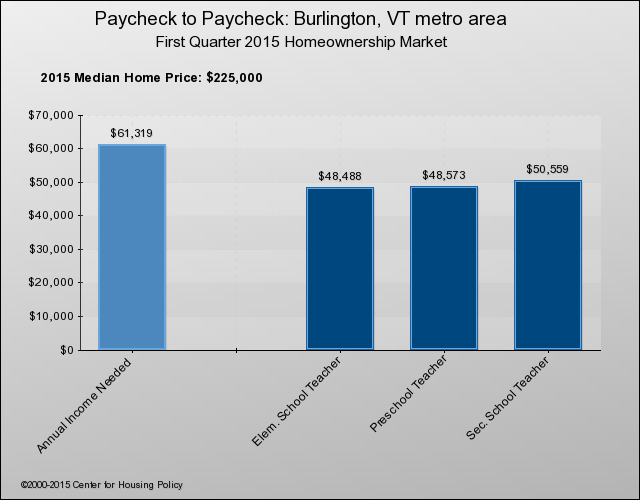
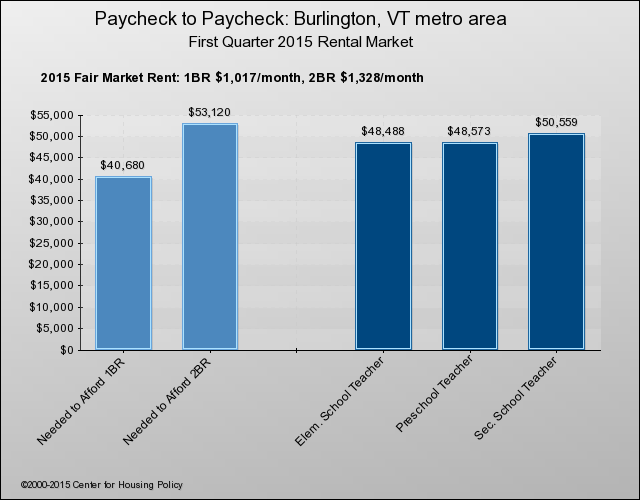
Consider educators in the Burlington metro area. The National Housing Conference’s interactive “Paycheck to Paycheck” matches housing costs (the annual salary needed to afford a house of median price, $225,000) and the salary needed to afford a one-bedroom or two-bedroom apartment.

When you run the model for three educators – preschool, primary and secondary school teachers — you find that:

They can’t comfortably afford the median mortgage…

p2phomeowner


… or the two-bedroom apartment…

p2prenter